Showing posts with label Britain. Show all posts

Friday, February 20, 2026

Europe 1975: A Throwback Memory

I've been travelling independently for well over half a century. From my earliest trips, I have scattered memories of incidents here and there. This week, I got hit out of left field by a memory from my first independent trip to Europe in 1975, thanks to Instagram's random selection of stories that the software thinks might interest me. That picture so intrigued me that I promptly went digging for more. Here's the photo that IG turned up for my consideration -- a rather unusual sight by anyone's standards.


Let's face it, it isn't every day that you see a passenger train charging across the apron at an airport terminal. The location was the airport at Le Touquet - Paris-Plage in northern France, right on the coast of the English Channel south of the ferry ports at Calais and Boulogne. The scene was the transfer point between two legs of an unusual rail-air hybrid service that used to connect Paris and London three times a day -- "The Silver Arrow."


Since this was 1975, there was of course no Channel Tunnel to speed up rail travel between the two capitals. The available options were using rail at each end to connect with the ferries across the Channel from Calais and Boulogne, or to fly from Paris (Orly or Le Bourget) to London (Heathrow or Gatwick). The all-air option was fearfully expensive, while the traditional ferry crossing would take 5 hours or more (including train times) and laid you open to the notoriously rough seas of the English Channel, one of the most seasick-prone sea crossings on the planet.

I'd just spent four weeks touring on the continent, and would soon be heading back to England for my flight home when I saw an ad (while browsing a bookstore) for the Silver Arrow. I had a vague memory of having heard of it earlier, but wasn't aware of the details. However, the price was right and I booked it with no hesitation, having had my own baptism by rough water when crossing the North Sea from England to Norway several weeks earlier (that ranks as one of the most miserable travel experiences of my entire life).

The journey began at the Gare du Nord, the same station in Paris where Eurostar expresses now depart for London via the tunnel. The train, shown in the first photo at the top, ran express to Le Touquet with only a single stop in the northern city of Amiens. As we approached Le Touquet, the diesel train left the main line on a branch. This ran north-westwards into the airport property, crossed two active taxiways, and then curved around to west and ran right across the apron into a station platform attached to the end of the small airport terminal. The track across the airport has been paved over now, but you can still see traces of the route today on aerial photographs marked here with several "silver" arrows!

As we were rolling into the airport, I was seated on the right-hand side of the train, and so completely missed a grandstand close-up view of the aircraft as we rolled in.


Considering that this train would go no further than the airport before returning to Paris, it was far bigger than any possible need. The plane only seated fifty people; the train probably had space for three times that number. And indeed, the train had loaded up with the inbound passengers and departed back to Paris before we'd even boarded the flight.

Check in went very quickly, and so did the security check. And then we walked out to the plane. Ah, the good old days!

The name of the airline was British Island Airways, one of a sizable collection of independent airlines in the British Isles which flew smaller turboprop aircraft like this one in and out of smaller airports at various cities beyond the big metropolitan centres of the United Kingdom. The aircraft was a real rarity, one of a number of aircraft types produced in the 1950s and 1960s by the British civil aviation sector which saw only limited service with non-British airlines. This one is the Handley Page Herald. It was one of several different types built at the same time by various British manufacturers, all seating around 50 passengers, and all powered by the ubiquitous Rolls-Royce Dart turboprop engine. The Herald struggled to make sales, and only 50 of these aircraft were completed.

Oddly enough, one Canadian airline operated the Herald around the same time period. Eastern Provincial Airways, the regional airline of the Maritime provinces, operated this type into a number of smaller airports from their main hub at Halifax.   

The two pictures shown so far were of BIA's final colour scheme, so they must have been taken a few years later on, perhaps on one of the final runs of the Silver Arrow. Here's one more picture which dates from an earlier year and shows the colour scheme as it appeared on my flight. 

Attribution:  

Once we were all aboard and seated (and the plane was not full), the engines were fired up with that memorable plaintive whining tone unique to the Dart engines, and we taxied quickly out to the runway. It was a beautiful sunny day, and the flight to London Gatwick airport took only 35 minutes, a great advance over the 90-minutes-plus that a ferry would take from Calais to Dover. We flew at a fairly low altitude and had a great view.

Why Gatwick? London Gatwick had a feature that was nearly unique in 1975, although it's now seen as more or less essential in Europe and much of the rest of the world. This airport had direct rail access to the city with a station on the main line from Brighton up to London Victoria. Once we deplaned at Gatwick, it was a quick walk through the terminal, across the footbridge over the tracks, and down to the platforms. Our ticket included travel on the premium-priced Gatwick Express service which ran into London nonstop in a matter of 35 minutes.  

I was saddened a few years later to find out that the Silver Arrow was no more. It wasn't the Channel Tunnel that caused the demise of this unique service -- that still lay years in the future. It was something completely different in the world of ferries.

 Photo credit: Andrew Berridge, CC BY-SA 2.5 <https://creativecommons.org/licenses/by-sa/2.5>, via Wikimedia Commons  


Photo Credit: Bachcell, CC BY-SA 3.0 <https://creativecommons.org/licenses/by-sa/3.0>, via Wikimedia Commons
 
These monsters, the SRN-4 hovercraft, could carry 450 passengers and 100 cars at a time, "flying" across the waters of the English Channel a short distance above the waves, and (most significant) were capable of crossing in wave height conditions up to 3.5 metres (11.5 feet). The hovercraft service was already in existence in 1975, and I admit it was a tough choice, but the unusual aircraft won out over the exotic hovercraft. I never did get a chance to cross the Channel in this way. Pity.


Saturday, April 19, 2025

European Circle Tour Part 1: Getting Your Documents Right

I'm currently sitting in a hotel room in the middle of Heathrow Airport in London. I arrived here just over 4 hours ago after an overnight flight from Canada. It's only a one-night stopover. Tomorrow, I'll be continuing on to my real first stop of this trip, in one of my favourite countries in Europe.
 
The key reason I'm posting this is to warn anyone planning to travel to the United Kingdom, even if it's just for a short stopover like this. Actually, there are two warnings. I'm going to take them in reverse order.
 
First and foremost, you have to get an ETA (Electronic Travel Authorization) before you travel. No ifs, ands, or buts. There's an application fee, and you can get it online, applying at least 3 days in advance to be safe. When I applied, I got the authorization back in about 30 minutes.
 
If you don't remember to get it, here's what happens. Arriving at Heathrow, Canadian passport holders can use the electronic E-Gates to pass immigration control. You plant your passport onto the scanner and wait a few seconds. Face the camera on the gate, it takes your picture, and a moment later the gate pops open and you're through. 

At least, you're through if you got the ETA. The wait to use the E-Gates was slower than usual today because so many people were being refused admission, and each one got sent over to the side to speak to an officer. Smart money says that these are the people who hadn't gotten their ETA.
 
Second warning: don't get scammed when you are getting it. I did. Here's how. When you search for the ETA on your search engine of choice, it will return a whole range of results. The first ones, on Google, were advertisements. I knew that I was looking for the official website, "Gov.UK", but I got snagged by a featured website which displayed those words prominently. This deceptive beast charged me a hefty additional fee for the ETA. In actual fact, all that sneaky website did was present me with a link to the official Gov.UK website. Grrr.
 
Be warned.
 
So far, there is no parallel travel permit required for Europe, but their system (ETIAS) is coming. Last word says it will be up and running in 2026. That said, I had to do a whole routine of scanning my passport with my phone to complete my online check-in for my flight tomorrow to the continent.

Friday, May 24, 2024

Spring Nostalgia Trip # 4: The Man I Never Knew

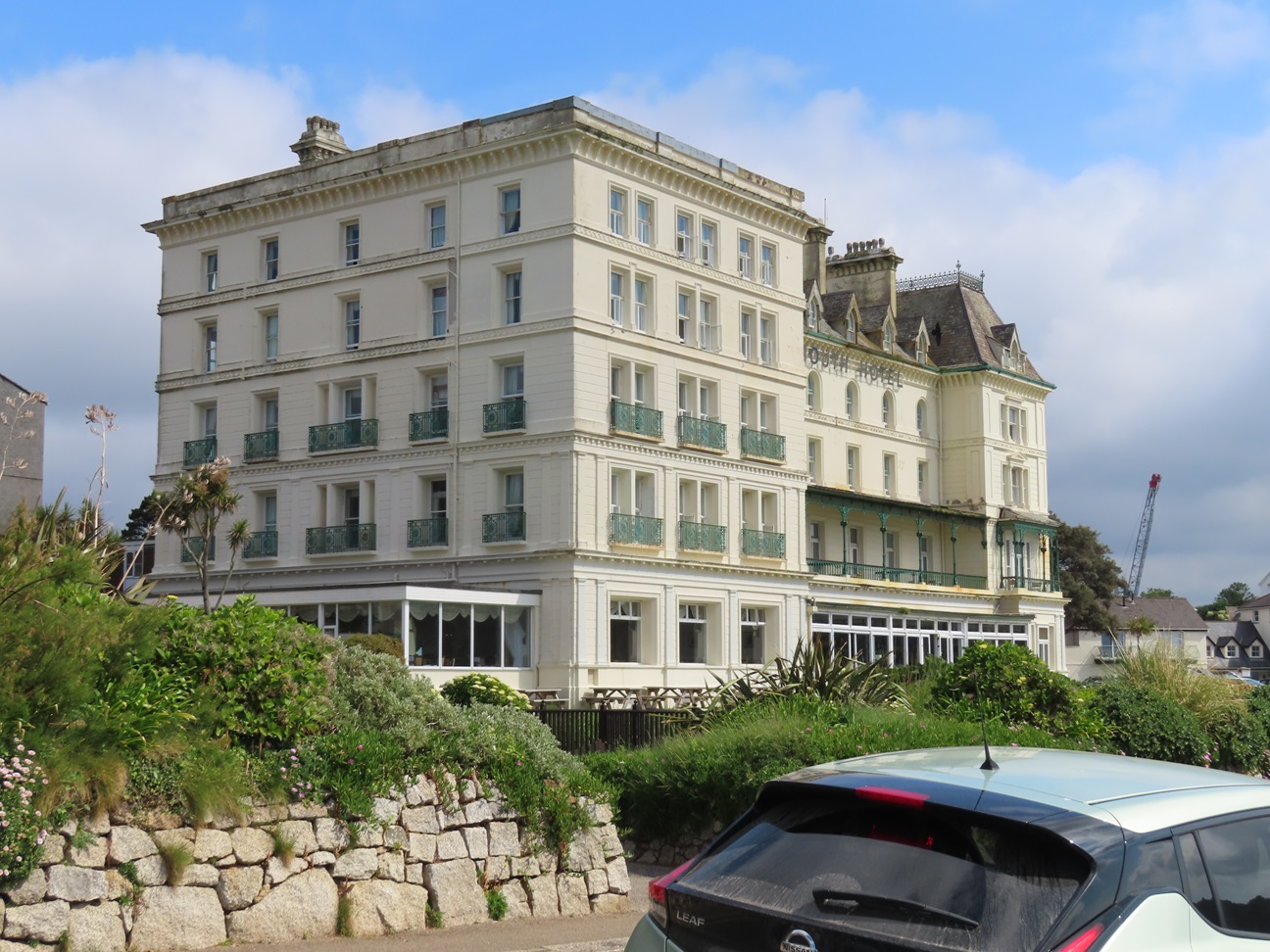
Our next port of call was Falmouth, in the Duchy of Cornwall. Falmouth is one of those classic old English seaside resorts, complete with dignified Victorian hotels, a waterfront promenade, some beautiful beaches, and even a good old-fashioned bandstand for outdoor concerts of Gilbert and Sullivan and other popular favourites of that bygone age (if anyone still organizes such events nowadays!).
 
This town sits on a multi-armed natural harbour, on the shore of the English Channel -- actually the first significant English port on the Channel as you arrive from the open Atlantic. For many migrants to North America, throughout the twentieth century, Falmouth represented their last farewell to their homeland.

For other mariners, it was the first welcome to the British Isles. I well remember reading (years ago) a book entitled simply Tinkerbelle. The author, a Cleveland newspaper reporter, got a significant case of the midlife itch, and sailed single-handed in his small boat, built to a design that made her uniquely suitable for the North Atlantic, from Falmouth, Massachusetts, to Falmouth, England (this in the 1960s). The welcome he received from the Cornish twin of his port of departure was, to put it mildly, overwhelming.

For me, though, Falmouth means just one thing -- which I'll get to in due course. All the other attractions of the place, the cliffs, the beaches, the rocky coastal scenery, the romantic location of Pendennis Castle on a high point overlooking the harbour entrance -- all of these things serve only as a backdrop to the one thing that matters to me the most.
 
But not to sell Falmouth short. It is a lovely and relaxing place in its own right.
 
 
All of which could serve to explain why I never so much as glanced at the tours offered by the cruise line, simply planning a four-mile long walk for my visit. Not that I didn't see anything worth the trouble, by any means. We got blessed again with a beautiful, sunny, not-too-warm day, ideal for walking.

Falmouth has numerous docks, but the harbour is (or so I assume) simply too tight for a ship of our size to manoeuvre around inside the bay. Zuiderdam is, after all, longer, wider, higher, and much heavier than even the legendary Titanic. And remember, this is considered a mid-sized  cruise ship these days. So, no surprise, we anchored outside, with the bow pointing more or less at Pendennis Castle for most of the day. 
 
 
This meant that we had to board tenders to ride for 25 minutes each way to get to the dock and back again. And this was my first bonus of the day. To help with the morning rush hour to get ashore, Holland America chartered one of the two-deck ferries that normally operates across the harbour from Falmouth to St. Mawes. This was bonus because the ship's own tenders are fully enclosed rescue boats, but the ferry had an open-air upper deck, and I took full advantage.


Like many harbour towns, Falmouth has steep hills. I had to climb a few of them. The first one took me up from the harbour and over the ridge to the seafront, where I emerged on the promenade right beside the grand old Falmouth Hotel.


Walking along the clifftop walkway, you soon notice that the tide is out and there are large areas of bare rocks showing. Well, that and the big cruise ship anchored out yonder.


And then you approach the first of the two large public beaches, Gyllyngvase Beach, or simply "Gylly" to the locals. 


Beyond the beach, I kept following the path along the edge of the bluffs above the protruding rock beds between low and high tide marks. Here the path becomes a kind of green tunnel, with wild flowers popping out every so often.


Then the path curls to the right into a bay, drops abruptly down and you are on the second beach, the Swanpool Beach. At the back of the beach, simply turn right along the road on the shore of the Swanpool, an enclosed body of water which reminds me very much of Grenadier Pond in Toronto's High Park.


At the north end of the Swanpool, the road curves right and starts up the hill back towards town -- and it's here that I came to a gate in a stone wall with this sign beside it -- and so arrived at the purpose of my morning walk.


And here it is: the grave of the man I never knew.


Gordon was my father Stuart's only (and younger) brother. He died when his ship, on anti-submarine patrol, was torpedoed no great distance offshore from Falmouth. Our cruise liner could very well have sailed right over the spot where it happened on the way in. Three men died, and my uncle was buried here.
 
Much of this old town cemetery has been allowed to lapse back towards natural vegetation, the graves and paths of the Victorian era and earlier becoming overgrown (there is a modern cemetery a bit farther up the hill which is still in use). However, this one area with the Commonwealth War Graves is still tended, each grave decorated with a different flowering plant -- and over the whole place hovers a wonderful sense of an entire country saying, "We have not forgotten you. You are still remembered and cherished." 

You can probably imagine that this was a very thoughtful day for me, especially as I've now reached an age where I can see clearly, as never before, the consequences of this event reaching forward for years and years into my family's future. We may never have met our uncle, but he certainly had an impact on our lives in many ways. So, for the sake of the record, here are the two of them in 1944, Stuart on the left and Gordon on the right.
 
 
After I'd spent some more time, standing in the sunshine and thinking about it all, I began the walk back. I know it sounds cliche but the sun did seem brighter and the colours of the flowers more vivid on the return trip through town and back down to the docks.


And here is the latest version of our cruise map. 


Tuesday, November 8, 2022

The November Epic # 1: Welcome Aboard the Emerald Princess!

 And the winner of the contest for "Name That Destination," which nobody got right, is....
 

 Base map attribution:  https://freevectormaps.com/canada/CA-EPS-01-0004?ref=atr

Don't feel bad if you didn't guess right. After all, I was a little bit sneaky in leaving the correct direction off the previous map! Not to mention that few if any people would think of flying from Toronto to Kelowna BC to begin a trip to England.
 
By the way, if you have no idea what this introduction is all about, go back and read the previous post, and all will be explained. 
 
The flight from Vancouver to London is a bit of a gruelathon. It only lasts 8½ hours, but in that time you cross no less than eight time zones. This is what comes of flying across the narrowest part of the world -- the polar regions -- enroute from Point A to Point B. I'm probably going to be jetlagged for close to a week.

I always love watching the moving map on a flight. This one from the start of the trip gives a perfect illustration of what would be the straightest line direct route from Vancouver to London.


In this second one, taken when we were almost at our destination, you see clearly that the designated flyways across the Atlantic often do not correspond to the most direct route. Part of this is the need for twin-engine long-range aircraft like the Boeing 787-9 to keep within safe flying distance of suitable airports with long enough runways in case of an engine failure. The rest is the need to keep the flights to designated flight tracks to avoid collisions in the busy North Atlantic air corridor.


The good news was that when I staggered off the plane at noon in London, everything happened very quickly indeed. It's a long hike from the Air Canada gate in Terminal 2 at Heathrow to the immigration and customs area, but passing through the checks is very quick and civilized indeed. Holders of certain passports (including Canadians) are allowed to use the quick kiosks. You scan your passport, the machine takes your picture, and after a moment the gate pops open and you're through. After you pick up your bags (mine was already on the carousel, as usual at Heathrow), you simply walk through the "Green Channel" and out -- unless you have goods to declare which are going to remain in the U.K.

It then takes about 4 more minutes to hike across the outdoor but covered access area, past the lifts, and across six rows of parking spaces in the garage. You then enter the hotel, walk up a short ramp and arrive at the check-in desk. The best? Even though it was still only 1230, my room was ready. The Hilton Garden Inn Heathrow Terminal 2/3 asks you at check-in what time you expect to leave, and the housekeeping crew is on the job as soon as you go, freeing the rooms up for early arrivals. Pretty awesome.

So was the view from my room on the 13th floor. Of course, I've been in love with airports and airplanes ever since I was a kid.


The tall tail with red/green/black flashes on it is an Airbus A380 of Emirates Airlines. Emirates had two of these 600-passenger monsters leaving London within a couple of hours of each other. Crazy -- I've been on cruise ships that held less people! It's a weird sensation watching an A380 taking off. Because of its sheer size and bulk, it doesn't look like it's going anywhere close to flying speed when it lifts off the runway into the air. 
 
This second pic was taken a few hours later and just after sunset (and after I'd caught up on some lost sleep). Here, I caught two planes silhouetted against the colours of the sky.

I had a decent dinner in the Apron Restaurant on the first floor, where I got a good chuckle from this description of one of the wines on offer. Perhaps this less-than-technical description was meant to get you past the fact that it was the most expensive white wine on the list, by a wide margin.
 

I went with the pinot grigio, and after dinner had another one in the Runway Bar on the top floor, which gives awesome night views over the airport. This is where I watched that A380 taking off.
 
 
The next morning, after breakfast, I went back to the airport and found the transfer service. Presently, I boarded a coach and after a 2¼ hour drive found myself arriving at my real destination, in the south coast port city of Southampton. And here we go -- Princess Cruise Lines' Emerald Princess.

Princess Cruises photo
 
Say hello to my home for the next two weeks and a bit. Emerald Princess is one of a class of nine broadly similar (but not identical) ships built for Princess Cruises and sister company P & O Cruises over a period of a decade or so, beginning in 1998. Princess refers to them as the "Grand Class" after the first of the group, Grand Princess. I've been on 3 other ships of this class previously. These vessels carry different numbers in the range of 2600-3100 passengers. At the time of construction in 1998, Grand Princess was the world's largest cruise ship. These days, the Grand Class are looking more and more like mid-sizers!
 
Oh, the cruise? Sixteen days from Southampton to Fort Lauderdale. The real attraction of this trip for me was getting a whole series of destinations that I'd never seen before. That's the best kind of cruising -- you get to sample a wide range of places, and decide which ones merit more detailed visiting at a later date.
 

As we were driving into Southampton, we passed a couple of historic buildings along the waterfront of this historic commercial port. Here's the Southampton Harbour Board headquarters.


This building, whose identity I haven't been able to determine (although it may have been the Southampton offices of White Star Line), is the site on the lawn outside of a memorial plaque to White Star's most famous ship, RMS Titanic, whose home port was in Southampton. 
 

Indeed, the Titanic and many other great liners in the golden age of Atlantic sea travel used the Oceanic Dock, now the Ocean Cruise Terminal, which is where our ship, Emerald Princess, was moored. Here's the first look I got.


Boarding was very quick and efficient indeed -- 17 minutes from coach to cabin. The big luggage was sent down from London by separate truck, and was a bit slower, but still arrived at my cabin before the ship sailed which was all I asked!

Q: How do you know you are on a cruise ship?

A: As the afternoon moves towards evening, the internet service gets slower and slower and slower....
            (mainly because of all the people trying to stream and share video, I'd guess)

From my cabin, on the port side, I had a view of two Isle of Wight ferries docked in an adjacent slip -- I think that was a repair or service facility, as the main ferry terminal was on our ship's other side.

It was already dark when we sailed at 5:00 pm, but here you can see the unmistakable diagonal slant of the Oceanic Dock, which you can compare to any number of online photos of classic ocean liners moored here. I saw one beauty which I wanted to use, but the $69 license fee was too steep for my budget to take. Just Google "White Star Line Southampton" and you'll find them, no trouble. 


In this picture, a brilliantly illuminated cruise ship at the Queen Elizabeth 2 Cruise Terminal poses a huge contrast to the much more decorous Emerald Princess. Looks like a very new and flashy vessel from Aida, a cruise line which, despite its name (suggestive of Italian opera), is actually German. German is the working language of all staff on Aida cruises, which helps to explain why they aren't marketed in North America. Aida, like Princess, belongs to Carnival Corp.
 

It felt absolutely awesome to be setting out to sea again on a Princess ship, for the first time in over three years. Nowhere did I feel it more than the three-storey atrium midships called the Piazza, seen here from above...


...and from below.


Our first port of call was Cherbourg. Like its near neighbour of Le Havre, Cherbourg had a long association with the great Atlantic liners. Many ships, leaving Southampton or European ports, would stop to pick up passengers from France here. Today, it's more of a commercial port, although it also serves several ferry routes to and from Spain, England, and Ireland.

It was on the night crossing from Southampton to Cherbourg that my jetlag and lack of sleep caught up with me, and I slept off and on for eleven hours. That caused me to miss my early morning tour to Bayeux, to visit the famous Bayeux tapestry, so that will have to wait for another time. So will a separate pilgrimage to the Normandy beaches from the D-Day invasion on June 6, 1944, all of which are quite close to here.

Instead, I stayed aboard, going for a big breakfast in the buffet, a good brisk walk around the promenade deck, a light lunch in the Piazza -- a hot sandwich and to-die-for cappuccino from the International Cafe, the ship's 24-hour food and drink outlet.

Since then, I've been working away in my cabin at this blog post, while also grabbing another nap. So, to close out, here are a few pictures I took during my walk.
 
Cherbourg is an artificial harbour, enclosed by breakwaters. The breakwaters are marked by numerous forts and castles, which shows that the builders of this port definitely meant business. 


A view of part of the city is centred on the Holy Trinity Basilica, its square tower looking surprisingly Church-of-England for a French Catholic basilica.


To the west of the port, a marina shows that recreational sailing is big business here.


The cruise terminal building looks plainly as if it dates back to the golden age of the Atlantic liners.
 

Later in the afternoon, the mix of sun and rain clouds gave way to clear skies, and we could see the rain clouds departing to the east.


And finally, to wrap up, a last picture on board the ship. I sat down for a breather mid-point of my walk, right opposite one of the lifebuoys on the promenade. It's a sight that always makes me laugh, but you have to have been there to know why. The "Hamilton" named as the port of registry is the capital of Bermuda. It's laughable because Hamilton Harbour is only accessible through a tight gap called Two Rock Passage, or even smaller passages between other islands in the Great Sound. Emerald Princess is so large that, like all fleetmates in the Grand Class, entry to Hamilton Harbour is an impossibility. This ship can never visit the port where it is registered. Seriously.