Our final port of call for the cruise was at Puerto Vallarta -- a combination of major city and resort area which is home to a substantial population, and a resort destination for many thousands more from North America and numerous other corners of the globe.
The highlights tour which I took was a combination of coach tour and walking, and gave a quick "greatest hits" survey of what this vibrant city of nearly 300,000 people has to offer.
Our tour began at the 3-berth cruise ship terminal towards the northern end of the city, and just south of the international airport. Not surprisingly, this sector of the city, known as the Marina area, houses some upmarket stores and restaurants as well as a number of modern, high-rise hotels representing major international brands. Here's a view of the Marina district waterfront from my balcony as the Island Princess sailed out at the end of our visit. The massive and wildly coloured Westin hotel is a real eye-catcher, both for its main building and for its equally colourful waterfront facilities.


It took us about 25 minutes to drive into the centre of the city, the Old Town district. Here you can find several of Puerto Vallarta's most famous attractions. However, my first sight in the Old Town was of a decidedly quirky character, a rooftop statue of a dancing cow.

From the point where the bus dropped us off, we walked down one short block to the waterfront, and the world-famous oceanside promenade, the Malecon.

Here, there is a fascinating collection of public art works of varying character -- from graceful to grotesque, from comical to serious.


Of course, it's a huge challenge trying to photograph these artworks when so many members of the tour party must have their picture taken in front of every single sculpture! But I did my best. It took me two pictures to grasp the entirety of this piece.

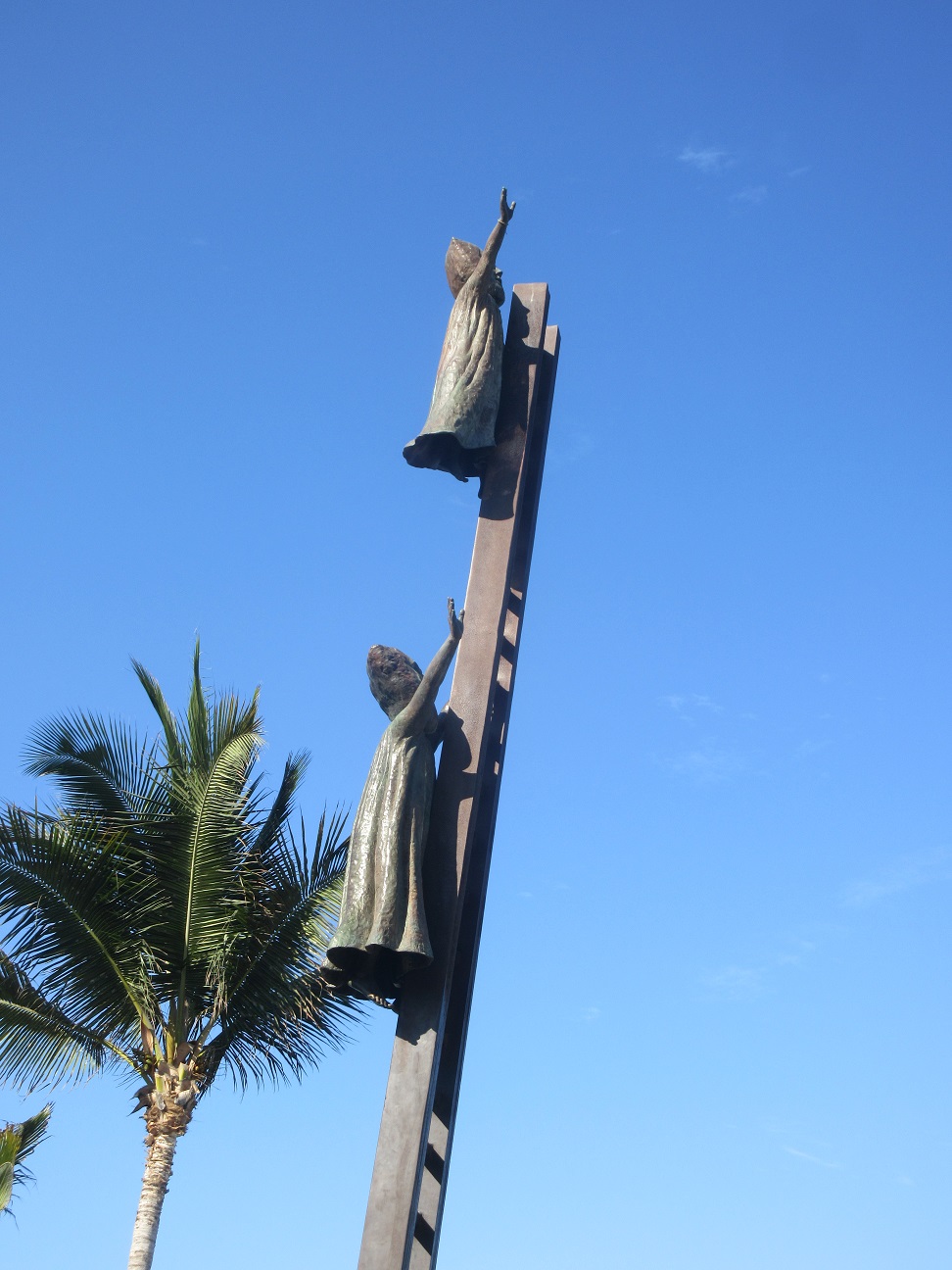
Nor does it help matters at all when the guide, Rosalia, urges you to take a seat on the sculpture's lap and have your picture taken there. Oops! My bad!

This figure, very different in texture and colour, represents an indigenous medicine woman, although to my eye she has also a strong air of the Mother Goddess -- and that may well have been the intention.

One of the best known is the boy on the seahorse. From its reputation, I expected it to dwarf all comers but in fact it is just one among many and by no means the biggest.

This Neptune is my personal favourite.

Almost as exciting for me were the daring aerobatic manoeuvres of the Pelican Air Force.


We then walked up into the town again to visit the central Plaza, where the open-air bandstand hosts popular concerts and shows on weekends.

Beyond the Plaza, we walked to the Church of Our Lady of Guadalupe, a building which is by no means as grandly-sized as its reputation might have you expect. It is in fact rather compact, except for its height.


Life on the Plaza: I was tickled by the exact wording of the tour agency's sign, and laughed heartily at the pair of t-shirts in the store window.


One of the real annoyances of these organized tours is the inevitable stop in a large and boring store. In the case of this tour's big jewellery store, I suspect most of us hit the boredom mark after about 15 minutes of a 35-minute stop -- and that was in spite of the small bar offering free margaritas to all comers, at 9:45 in the morning. This day drinking is crazy!
After that stop, we drove south through the city and out onto the narrow, twisting highway climbing up into the coastal Sierra Madre on the way to the scenic bay of Mismaloya. This coastline is peppered with numerous hotels and condominiums, perched high up on the steep slopes above the Pacific or, in rarer cases, down by the shore..


There aren't actually many places where you can see any kind of view from the road, just a quick snatched glimpse if your timing is good and you aren't driving.

There is one small roadside pullout with a good scenic point which gives a clear view of the famous offshore rocks known as Los Arcos de Mismaloya, presumably because they were once connected by a natural arch.


On the drive back into town, we had to detour up and down a couple of streets of the neighbourhood between the Rio Cuale and the mountains, an area known as the "zona romantica" or "zona rosa." The streets here are filled with shops, restaurants, bars, hotels, and other businesses catering primarily to gay travellers. Puerto Vallarta has for years been one of the principal LGBTQ destinations in the Americas.
The bus then stopped on a bridge over the Isla Cuale in the river, and we walked down a flight of steps to a small souvenir and gift market and a large restaurant. We were offered a free drink again, and a chance to enjoy a light meal in the sizable outdoor covered dining area. I was not yet hungry, and was more attracted by the chance to get some photos of the gardens and flowers on the island.


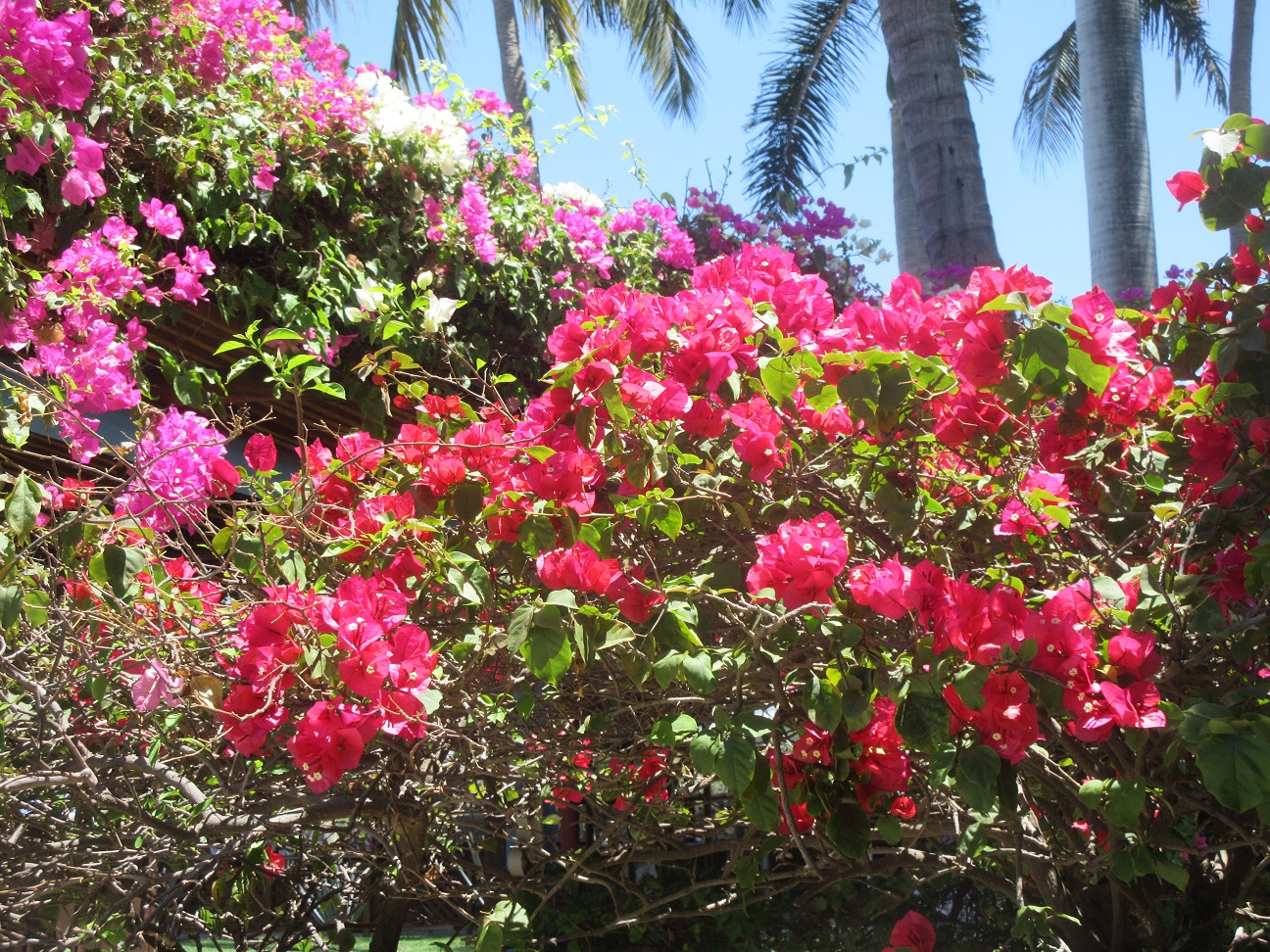
That lunch stop went on quite a bit longer than planned, and was primarily responsible for making the tour arrive back at the pier nearly an hour after the scheduled time.
This was an intriguing "quick look" at Puerto Vallarta. Contrary to what many people might think (especially many of my gay friends). the idea of spending any amount of time here doesn't appeal to me. The streets are narrow and crowded, many of the shops and restaurants likewise (not surprising, given the age of many of the buildings in the older areas of town), while the lavish hotels of the Marina district are cut off from the rest of the city by the waters of the Marina, and cut off from me by their hefty room rates.
However, for those who are intrigued -- and not just LGBTQ travellers, either! -- Puerto Vallarta offers some lovely seaside settings, beautiful beaches on Banderas Bay, intriguing places to discover on foot, and generally more congenial weather than areas farther south (apart from the rainy summer months).
The morning after we sailed from Puerto Vallarta, I was having early breakfast in the buffet. I knew it was early on a sea day because most of the passengers weren't up and doing yet, and I actually nailed a rare table-for-two, facing the windows on the starboard side. One look outside was enough to tell me that we were out of the tropics. The sky looked different. The clouds looked different. Even the wide open ocean water was behaving very differently from the way it had acted for most of the last two weeks.


And then, so suddenly that it startled me a little, there were the rugged mountains of Baja California looming up out of the sea mist.

And with that, I knew that we had passed Cabo San Lucas and were on our way back north, next destination the Port of San Pedro at Los Angeles in two days time. I found out just how true that was when I set out onto the promenade deck for my morning walk, and found the ship sailing directly into the teeth of a stiff, chilly northwesterly breeze which blew at full throttle down both sides of the ship. The captain's noon report quoted an air temperature of 16 degrees Celsius, quite a shock to the system after nearly two weeks of nonstop temperatures in the 30s!
Lest this whole voyage begin to seem unlikely to any skeptical readers, I attach this photo. This certificate was dropped off in my cabin on the night of May 8, 2023, the day we visited Puerto Vallarta.

Way back in 2000, I got a similar certificate for crossing the Arctic Circle and voyaging all the way to Spitsbergen, one of the two or three land masses on the entire planet closest to the North Pole. What I did with that certificate, I don't remember. In fact, I think it may even have been a certificate for surviving a Polar Bear Swim (in the ship's pool, ha ha!) at 6:30 am on a July morning when we were at our closest approach to the North Pole.
*************************
*************************
This entire set of blog posts about the Panama Canal voyage is dedicated with much love and sadness to the memory of my niece, Jennifer. Jenn died suddenly and unexpectedly on the day after we set sail from Florida, and this sudden loss, at the early age of 44, truly coloured and shaped my entire experience during this cruise. Jenn and I never had an opportunity to travel together, but we did swap travellers' tales from time to time, and I would have loved to have her along on this voyage, sharing her own insights and reactions to all the varied experiences that this trip has brought me. I'll never have that opportunity now, but her joyful smiles and hearty laughter are mine forever, in my memories, and never to be forgotten. Rest in Peace, Jenn.


