There could hardly be a better way to spend a brisk, sunny fall day in Prague than to devote some hours to a detailed look at the wonders of Pražský Hrad ("Prague Castle"). This ancient fortification looms on a tall escarpment on the west side of the Vltava River towering above the Malá Strana ("Lesser Town"). I took this photo of the Castle and the Lesser Town last year from the ancient Charles Bridge.


Plainly, the Castle today consists of some massive palaces, although there are a number of smaller buildings for various purposes and four churches within the walls. You really need to see an aerial view to understand the sheer size of the entire complex. So here's an internet photo, with the Castle outlined.

It's easy to get to the Castle by public transit. At the foot of the hill is a major transit hub called Malostranská. There's a Metro station on Line A here, and no less than twelve different tram lines stop at this point also. So you can get a tram to Malostranská from many different parts of the city. At Malostranská you transfer to either a # 22 or # 23 tram. These trams climb the hill and then run along the broad boulevard at the top of the picture above, just north of the Castle. You get off at the second stop from Malostranská, which is called Pražský Hrad ("Prague Castle"). All stops are announced as you arrive at the stop before, and then again as you approach the stop you want. A one minute walk then brings you to the security checkpoint (walk-through metal detectors) before you cross the footbridge to the Castle entrance, taking in the spectacular structures towering above you as you go.

A very important detail to know: you do not have to buy a ticket to enter Prague Castle. You are free to wander wherever you want in the outdoor areas, admiring the buildings, taking advantage of the several cafes, and just soaking up the atmosphere. But -- and it is a big "But" -- you need a ticket to go inside any of the buildings and museums, or to enter the narrow, picturesque commercial alleyway known as the Golden Lane.
The tickets are sold at several "Information" points within the Castle -- the main one is directly across from the entrance to the Cathedral. There are two choices: an A ticket covering everything, or a B ticket which covers four main sights: the St. Vitus Cathedral, the Basilica of St. George, the Story of Prague Castle exhibition, and the Golden Lane. At every entry point, the bar codes on tickets are scanned by automatic turnstiles.
Crossing the footbridge, you enter the Castle through the walkways on either side of the arched gateway under the main palace, a gate which is guarded at all times by soldiers in dress uniforms.


Try to go through the main arch and you will be quickly, politely, but firmly "deterred" by a soldier in the standard uniform, carrying a businesslike firearm. (Voice of experience, I walked through on the way out at the end of my visit -- my bad).
Inside the arch, you're in a courtyard of the palace. Highlights of this courtyard include this fountain...

...and the delicately beautiful Chapel of the Holy Cross.

Turn left and pass through another arch, and you come face to face with the impressive facade and towering spires of the Cathedral.

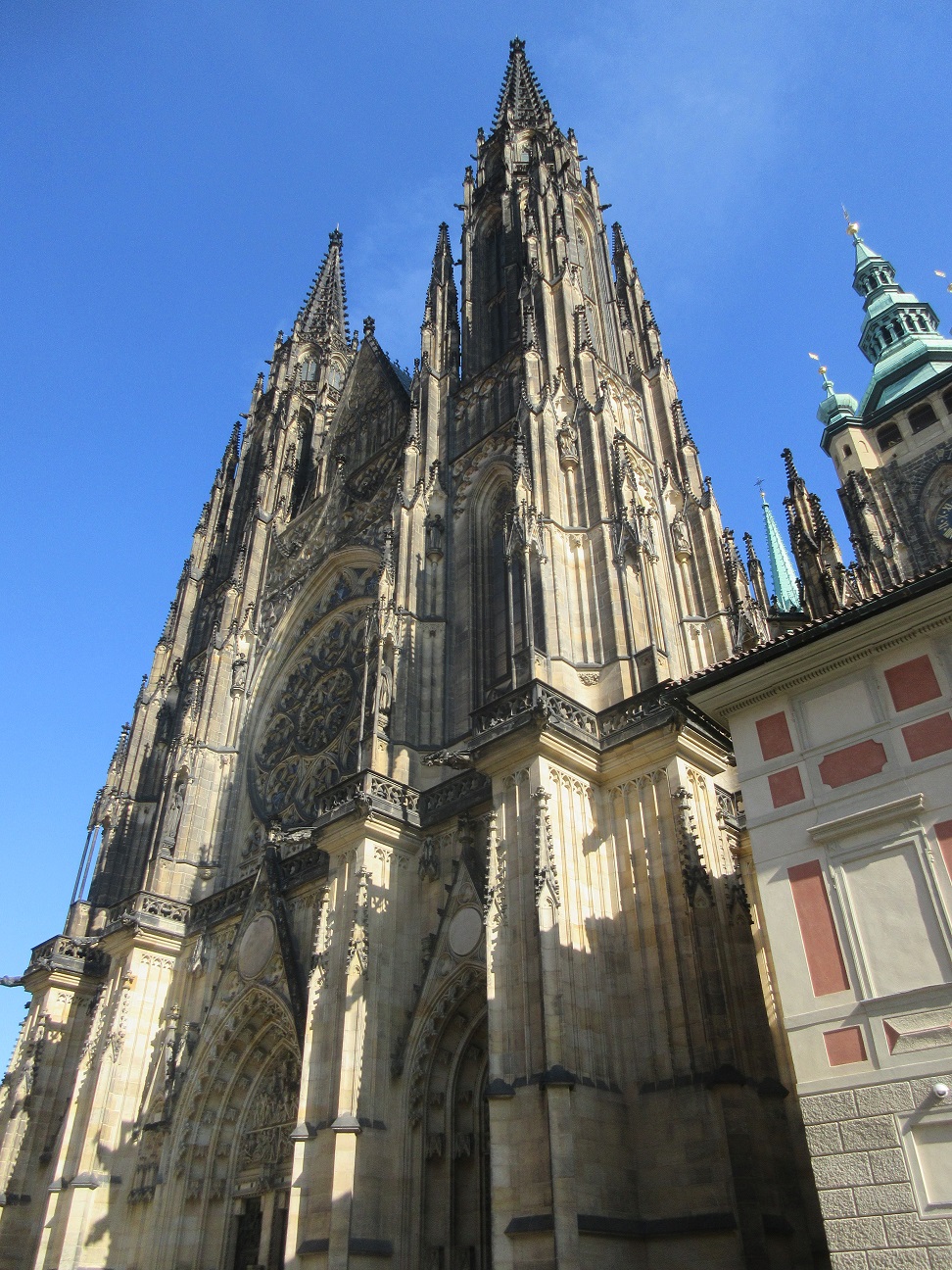
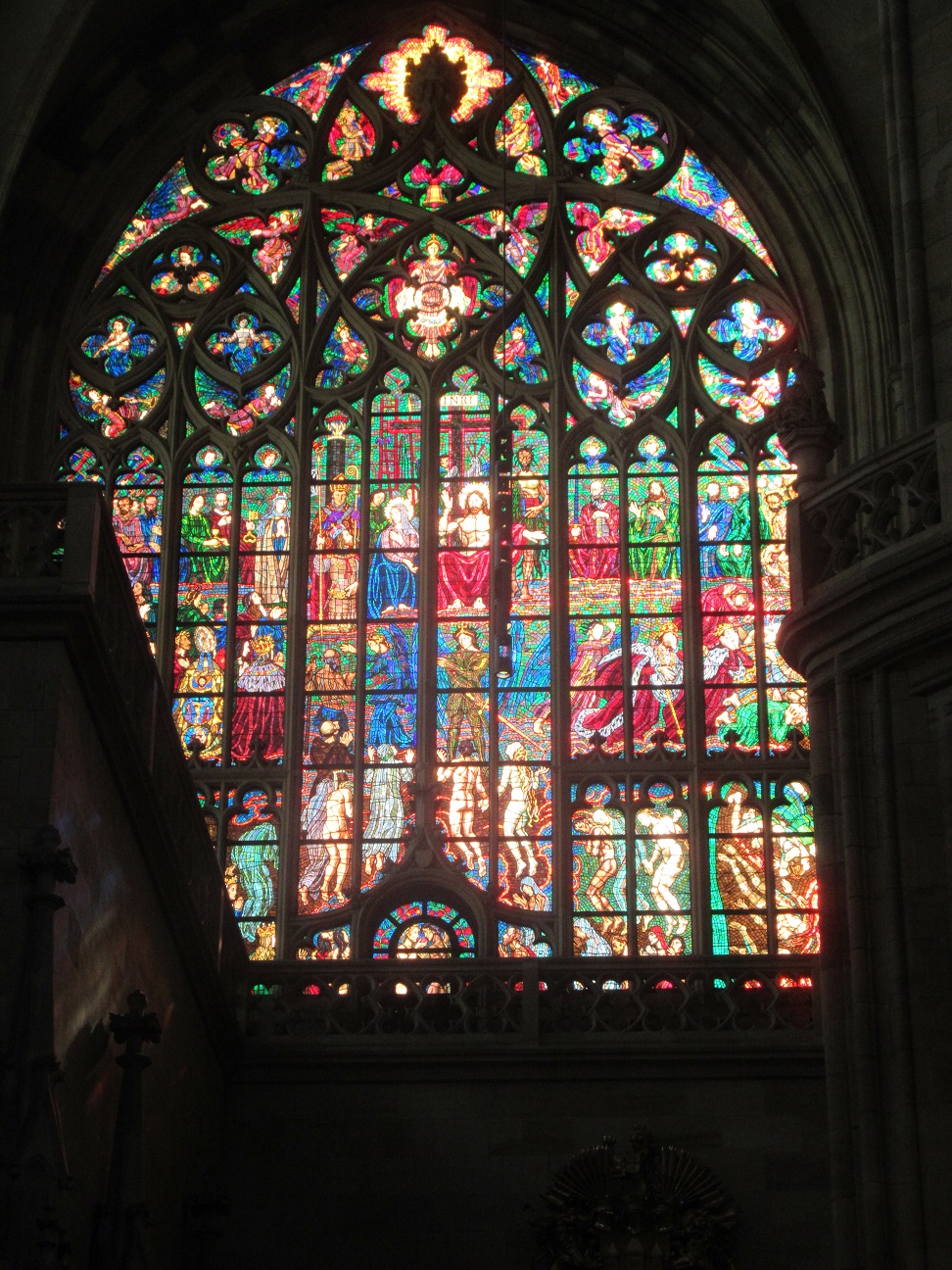
The "Metropolitan Cathedral of Saints Vitus, Wenceslaus, and Adalbert," to give the church its imposing formal title, is the largest church in the Czech Republic, by a fair margin, and has many architecturally unique features, as well as some striking art works and stained glass. It was begun in 1344, with much of the building completed by the end of that century. However, the Cathedral was not brought to its fully completed final form, as we see it today, until 1929! It was the final years of this work that brought much of the most spectacular stained glass, the work of twentieth-century artists.
The exterior certainly reflects that checkered history, with Gothic spires on the front, but Baroque onion domes on the main tower on the south side. The elaborate gilded window tracery on the main tower and the gold-tiled mosaics above the south door both speak to the fact that the base of the tower houses the ornate St. Wenceslaus Chapel, the royal tombs, and the vestry chamber in which the kings would be robed before entering the church proper for the coronation.


With that, here are some pictures of different aspects of the interior.


The Cathedral is located on the highest point of land inside the Castle. As you walk around it, you start going downhill towards the lower eastern end of the hilltop. Behind, and below, the Cathedral is the Basilica of St. George. Outside, it shows a Renaissance facade that would be right at home in Rome or Florence.

But behind that deceptive facade, this church is older -- far older. The roughness of the stonework, the tiny Romanesque arched windows in the thick, massive walls,...

...the faded remnants of frescoes on the ceiling,...

...the Gothic paintings on a wooden tomb shaped like a house, all speak to a history so lengthy that the neighbouring Cathedral seems almost a young pup by comparison. This church was begun in the year 920, and enlarged some 50 years later. Then it was rebuilt following a fire in the 1100s, and that's the building you see today (apart from the six-centuries-younger Italianate false front).

One of the oddities of this very old church is that the walls are not exactly parallel because the floor plan is not a perfect rectangle. The two sides are closer together at the altar end than at the entrance at the rear of the church.
Continuing downhill through the Castle precincts, you pass a number of palaces. Oddly enough, they all look pretty much the same, since all were built or rebuilt at the same time period in the 1700s. The ground floor spaces facing the street house a number of shops and cafes.
As the hill starts sloping down more steeply, you come to a small square on the left which slopes back up. This is the entrance to the Golden Lane. Plainly, these smaller houses jammed up against the Castle's exterior walls were the homes and shops of various artisans and workers -- and particularly of goldsmiths, hence the street's name. Some of the houses have exhibits of everyday life; others contain shops selling unique handcrafted items that are not all labelled "Made in China" (or wherever).

Behind and above the houses runs an enclosed walkway along the rim of the outer wall, with small windows facing outwards that would be used in battle to shoot at approaching enemies. This walkway houses a fascinating collection of suits of armour and related weapons.
At the bottom end, as you leave the Golden Lane, you have access to an outdoor terrace with views over the city.

From this point, you can continue downhill into the Lesser Town, down the Castle Steps -- a route which will take you right back to the Malostranská transit hub. Or, you can turn back into the Castle and climb back up.
That's what I did, and soon found myself (a) hungry and (b) thirsty and (c) sitting at a table in the cafe inside the Lobkowicz Palace. The small outdoor patio has a spectacular view of the city, but I wasn't able to get a table there. But it's all good. The service was fast and friendly and I had a classic Czech lunch of beef goulash with dumplings and rye bread, very tasty, and a glass of wine -- with a decent cappuccino to chase it all. Happy camper.
Thus refueled, I made my way back up the hill past the Cathedral and retraced my steps out to the tram stop to return to base.
I spent about 3.5 hours on my tour of the Prague Castle. I could easily have spent more. What you don't want to do is to take one of those quickie tours that whips you through all the highlights in thirty minutes flat. Doing it on my own and taking my time was much more rewarding.
* * * * * * * * * * * * * * *
The next day was cloudy, with steady light rain promised for the afternoon. I was able to get out and walk around in the Old Town area before the rain hit, and have a few more photos to share.
The entire Old Town area is either a pedestrian zone, or else has such narrow streets jammed with pedestrians that car drivers can only wait, as they would for a flock of sheep in Scotland or New Zealand. Prague is one city where you absolutely don't need a car at all. With transit fares sitting under $2.00 a ride, and so many undriveable streets, a car makes less than no sense.
Having said that, as a pedestrian you do have to be careful for sightseeing vehicles, delivery vans, and private cars alike, as well as hazards like the trams whizzing right through the pedestrian area of Republic Square.

Those trams are especially dangerous because you, if you are even halfway a normal human, are walking much more slowly than on regular pavement -- and that's because of the cobblestones. These range from the huge ones between and around the tram tracks...

... to these mid-size square versions...

... and the very artistic mid-size-arranged-in-fan-shapes style.

The entire Old Town area is either a pedestrian zone, or else has such narrow streets jammed with pedestrians that car drivers can only wait, as they would for a flock of sheep in Scotland or New Zealand. Prague is one city where you absolutely don't need a car at all. With transit fares sitting under $2.00 a ride, and so many undriveable streets, a car makes less than no sense.
Having said that, as a pedestrian you do have to be careful for sightseeing vehicles, delivery vans, and private cars alike, as well as hazards like the trams whizzing right through the pedestrian area of Republic Square.

Those trams are especially dangerous because you, if you are even halfway a normal human, are walking much more slowly than on regular pavement -- and that's because of the cobblestones. These range from the huge ones between and around the tram tracks...

... to these mid-size square versions...

... and the very artistic mid-size-arranged-in-fan-shapes style.

The absolute worst are these rather attractive smaller ones which often form sidewalks. They look pretty, but those polished top surfaces suddenly become like a skating rink in rainy conditions. All the cobblestones are slippery when wet, but these ones are a positive menace.

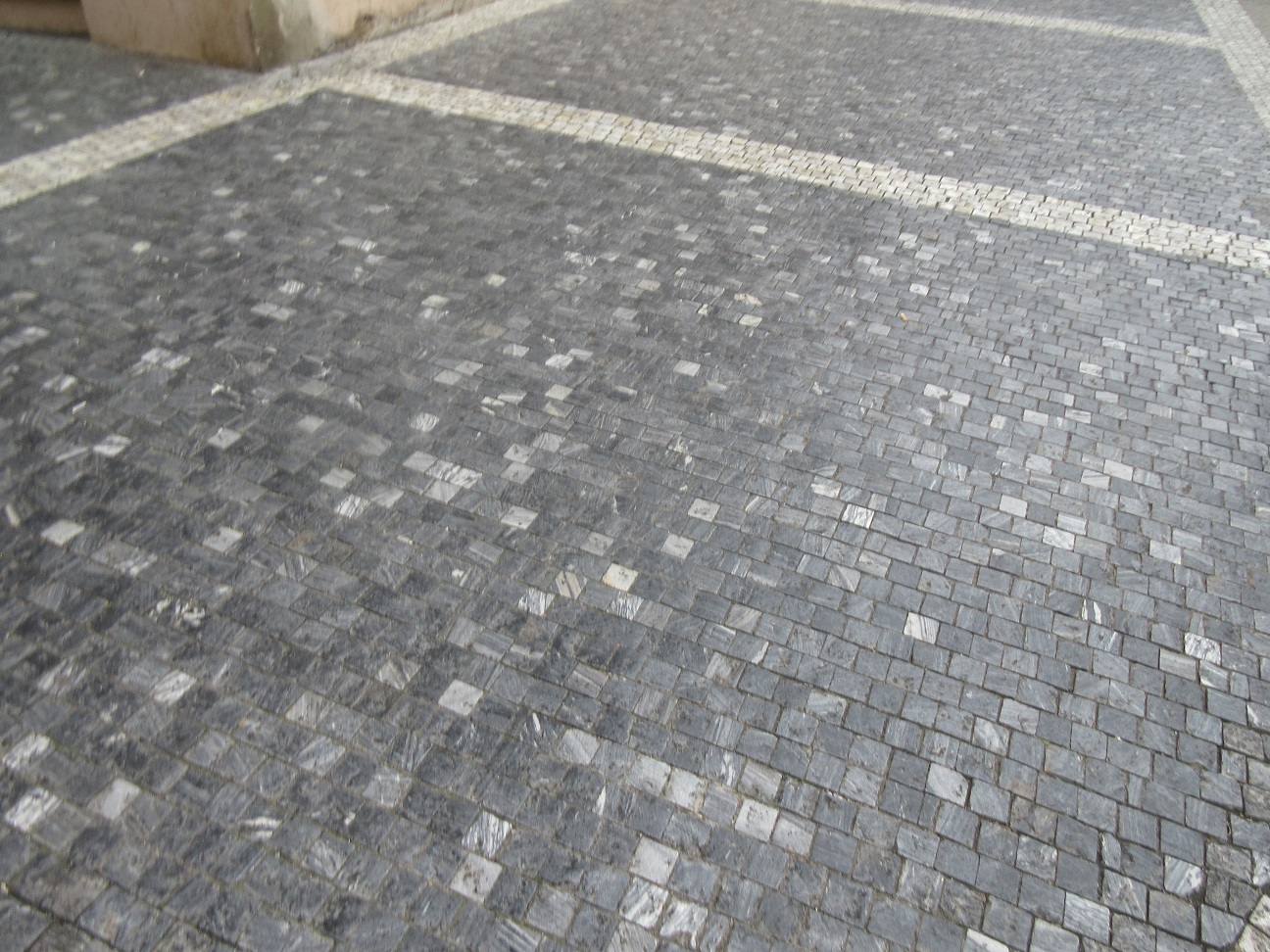
The worst part? They're all at different heights -- the surfaces are incredibly uneven. To survive in cities like this (you find these cobblestones in many parts of Europe), you absolutely must have good, sturdy, supportive, and properly-fitted walking shoes. Every time I come to Europe I see people sitting on the walls or curbs as they nurse some whopping huge blisters, just because they ignored this universal advice in favour of their beloved crocs or flip-flops. There's one born every minute.
So I stop and look around to take pictures, rather than trying to take them on the move and tripping over the damn cobblestones. And here's what I got on my second full day in Prague, between bursts of bad weather. First, an interesting piece of Old Town architecture, perfectly fitted (out of sheer necessity) to the odd, triangular plot of land on which it was built.

An elaborate sculptural frame with a very small window hidden somewhere amid the swirling figures.

One of the numerous quiet little squares hidden all over the Old Town.

Not far beyond that square, I walked down a narrow alleyway and then found myself emerging into Old Town Square, the heart of this district. Along the way, I correctly deduced that I was walking along one side of the Church of Our Lady Before Tyn, which dominates the east side of Old Town Square. I thought, "Good -- now I'll see what the front of this church looks like." No, you won't -- the buildings shown in front of the church are jammed right up against its facade, so it actually doesn't have a facade. Sneaky trick. I know you can walk through a narrow little alleyway and emerge into a tiny square open space just wide enough to let you access the front door, but that hardly counts.

The centre of the Square is dominated by the memorial to Jan Hus, the fire-breathing religious orator and reformer whose revolution stood Bohemia on its ear in the 1400s, and who is now regarded as one of the great patriots of the country's history. As sculpted, the figure evinces the granitic determination and zeal of the man.


The west side of the Square is marked by the whimsically daffy architecture of the Old Town Hall's clock tower.

And where, you ask, is the clock? There is a clock at the top, on the side facing the Square. But the old one, the one everyone is looking for, the world's oldest astronomical clock, is not at the top. That would be too easy. It's around the corner on the south side, and down on the lowest storey above street level. Naturally. But why?


I must have missed this last year, but today I spotted it. And stopped. And maybe scratched my head a few times. But that's tourism for you. If you build it, they will come.

So I stop and look around to take pictures, rather than trying to take them on the move and tripping over the damn cobblestones. And here's what I got on my second full day in Prague, between bursts of bad weather. First, an interesting piece of Old Town architecture, perfectly fitted (out of sheer necessity) to the odd, triangular plot of land on which it was built.

An elaborate sculptural frame with a very small window hidden somewhere amid the swirling figures.

One of the numerous quiet little squares hidden all over the Old Town.

Not far beyond that square, I walked down a narrow alleyway and then found myself emerging into Old Town Square, the heart of this district. Along the way, I correctly deduced that I was walking along one side of the Church of Our Lady Before Tyn, which dominates the east side of Old Town Square. I thought, "Good -- now I'll see what the front of this church looks like." No, you won't -- the buildings shown in front of the church are jammed right up against its facade, so it actually doesn't have a facade. Sneaky trick. I know you can walk through a narrow little alleyway and emerge into a tiny square open space just wide enough to let you access the front door, but that hardly counts.

The centre of the Square is dominated by the memorial to Jan Hus, the fire-breathing religious orator and reformer whose revolution stood Bohemia on its ear in the 1400s, and who is now regarded as one of the great patriots of the country's history. As sculpted, the figure evinces the granitic determination and zeal of the man.


The west side of the Square is marked by the whimsically daffy architecture of the Old Town Hall's clock tower.

And where, you ask, is the clock? There is a clock at the top, on the side facing the Square. But the old one, the one everyone is looking for, the world's oldest astronomical clock, is not at the top. That would be too easy. It's around the corner on the south side, and down on the lowest storey above street level. Naturally. But why?

But there it is, all beautifully neat and clean. Last year when I was in Prague, it was all wrapped up in protective covers and scaffolding while it was being cleaned and repaired.
The south side of the square has a representative row of Renaissance-era palaces now repurposed as hotels or apartments, with a number of equally representative shops or cafes on the ground level. Even this late in the season, with temperatures in the single digits of Celsius, the cafes are getting patrons. A few patio heaters and a nice fluffy blanket on every chair work wonders.

I must have missed this last year, but today I spotted it. And stopped. And maybe scratched my head a few times. But that's tourism for you. If you build it, they will come.


