Showing posts with label walking. Show all posts

Saturday, May 3, 2025

European Circle Tour Part 9: A Great and Mighty Wonder

Our third port call was at Barcelona, a city which I have visited and enjoyed before. This visit showed that Barcelona isn't always the sunny spectacle which online photos would have you believe. I tried going out on deck for a while after breakfast, and I got one brief sunny break between showers -- but it was still windy and chilly. Definitely not "Sunny Catalonia!"
 
During one brief moment in the morning when there was a bit of sun before the rain, I stepped out on deck and took these two pictures. Check out all the lined-up taxis and tour coaches outside our terminal -- and then multiply that by five times for the five cruise ships in harbour in Barcelona that day. 


The unfavourable state of weather continued until about 2:30 in the afternoon. By that time, many passengers had given up and were slogging back onboard, wet, chilled, and unhappy. And this is where I got my lucky break. My tour was leaving at 3:15 pm, and in fact actually left about 5 minutes early because all 17 passengers on a full-size tour coach had already joined the party. Nice -- the least crowded tour I think I've ever been on in my entire cruise career. But we didn't stop in Barcelona. We drove right through the city and out into the Catalan countryside on one of the main highways.
 
This was our destination:
 
Photo by Josep Relalias -- own work.

This extraordinary jagged mountain (mountain range is perhaps more accurate) is called Montserrat -- the Catalan name comes very close to the English translation of "serrated mountain." The highest peak of the range stands 1,236 metres (4,055 feet). Yes, there are taller mountains in many places. But since Montserrat rises with almost no preliminary ascent straight up out of the Catalonian coastal plains, the relative height as you approach it seems much greater.
 
I wasn't at all surprised when we had arrived in one of the deep canyons, and our guide told us that this place, this mountain, had been a site of sacred activity time out of mind. It's a powerful, dramatic landscape. The power seemed to me to manifest in an an irresistible urge to look up, to direct your eyes towards the sky where so many religions have placed the abode of divine power. You don't even have to be especially religious to want to follow the classic phrase from Psalm 121, "I will lift up mine eyes unto the hills." Montserrat will likely find you doing just that. It certainly had that impact on me, the instant I stepped off our coach.
 
 
Our actual destination was a monastery, built onto a sizable ledge of rock between two of the higher peaks. The Benedictine Monastery and Sanctuary of Santa Maria has existed here in one form or another at least since the 1200s (confirmed by an official survey) and is reputed by tradition to have been around since the 800s. Due to the frequent and surging tides of warfare in this region so close to the Pyrenees, the monastic buildings have been destroyed and rebuilt on multiple occasions. What you see today is almost entirely constructed in the 20th century. It's still an active monastery.


 In addition to the monastery proper, there is a music school, an assortment of shops and restaurants, and three mountain railways: one rising to the crest of the peak on the left in the last picture, one dropping down a short way to a chapel in a deep valley, and the third -- the newest -- going all the way to the base of the mountain to make for easier access. That newest railway is the ideal access to Montserrat for anyone nervous about driving or being driven on narrow, twisting mountain roads.
 
Different places along the road and walkway from the parking areas to the monastery proper offer some spectacular views looking down from the mountain as well.


Our visit included a tour of the monastery itself. We were first taken into the courtyard which faces the main facade of the church.
 
 
Before entering the church proper, we went up a narrow winding staircase to view the pilgrimage shrine, housing the Virgin of Montserrat, an old carving in wood of the Virgin and Child. Based on the style and features, the statue is believed to date from the early medieval period, before the year 1000. The faces and hands are believed to have become discoloured and blackened over the centuries by chemical reactions to paint or by smoke, and have been covered over or touched up on several occasions with black paint. Many Catholics, and even Catalans who are not conventionally religious, venerate the Virgin of Montserrat's miraculous interventions. She is the patron saint of the Montserrat monastery, together with Sant Jordi (Saint George), and Catalans refer to her affectionately as La Moreneta ("the Little Dark One").
 

In front of her is a glass window facing out over the nave of the abbey church. 
 
 
In this interior view from the rear of the church, you can see the window with the Virgin of Montserrat in the background, high above and behind the main altar of the church.
 

We also attended a brief audio-visual show about the nature of the monastery, the life of the monks, the choir school, and other aspects of this community.
 
There's a strong legendary link between Montserrat and the tradition of the Holy Grail, a relationship emphasized in Richard Wagner's final and most mystical opera, Parsifal. Wagner even designed the sets for his hall of the Holy Grail Castle based on the design of the Montserrat church.
 
I would have loved to ride the funicular up to the high ridge above the monastery and back, but it's rather slow and runs only three times an hour, and I was afraid I wouldn't have enough time before I would need to be back at the bus. However, here's an internet photo which shows the entire complex viewed from the upper end of the funicular line.
 
By Richard Schneider - aufgenommen, fotografiert von Richard Schneider, CC BY-SA 3.0, httpscommons.wikimedia.orgwindex.phpcurid=587310
 
Our start time for the drive back to the Barcelona cruise port was 7:00 pm, and it could have taken quite a while if the traffic had been bad. It wasn't. We whipped right through the city and down to the cruise port with no delays at all, and arrived beside the ship in 59 minutes. That meant we were actually early enough for me to do a quick change and have a proper dinner in the restaurant, as usual!
 
The monastery of Santa Maria de Montserrat is a truly remarkable institution in a truly remarkable place. I'm very glad I took the opportunity to go there and see both the mountains and the shrine for myself.
 

Friday, May 2, 2025

European Circle Tour Part 8: Safe Harbour

Our second port of the cruise was at the large natural harbour of Toulon, in southern France. To be exact, we were docked across the harbour at the commercial port of La Seyne-sur-Mer, and access to Toulon proper was by a daylong shuttle boat. In a first for my cruise experiences, the use of the boat shuttle was not free. The fare, charged to your shipboard account, was US$35. However, passengers who had purchased tours in Toulon from Princess Cruises were excused from paying that fare. The little things they don't tell you ahead of time can sometimes add up to big added expenses. In this case, if you bought your own tour you could very well end up losing money unless your tour was at least $35 cheaper per person than the tour sold by Princess.
 
So why dock on the other side of the bay? There's no place in Toulon. There's a ferry terminal for the large oceangoing ferries sailing to Corsica or Sardinia, but almost all the rest of Toulon's waterfront is occupied by the Mediterranean headquarters of the French Navy. 

The tour I selected had 2 parts -- first, a scenic boat tour around the bay, and second, a walking tour in the old city centre of Toulon. The boat tour was the real prize here, not least because the weather was absolutely perfect for such a purpose.
 
This first main group of photos include pictures taken on the tour boat. To start with, I have to prove that I was there, of course -- but why was I grinning?
 

Maybe it was because I had spotted the sign in French identifying the bin full of life jackets?
 
 
 As we sailed out into the bay, we got a look at the rest of the commercial traffic docked here. As our guides explained, Marseilles is the main commercial cargo port on this coast. Toulon/La Seyne gets only a few smaller cargo ships.
 
 
We got a series of views of Emerald Princess as we slowly curved around the pier to head towards the naval dockyard across the bay. I'll let you decide what is her best angle.


By this time, we were approaching the row of piers docking the naval ships. First up was the flagship of the French fleet, the aircraft carrier Charles de Gaulle.


Other naval ships of various types followed in succession.


At the end of the naval dockyard, there's a narrow inlet which leads to the city's waterfront, with its waterfront promenade, cafes, shops, and the piers for the shuttle boats -- including ours. Beyond that inlet is the pier for the big seagoing ferries. These ships, almost like cruise liners in themselves, take 8 hours or more to make the crossing from Toulon to ports in Corsica, and in the Italian island of Sardinia. There are ample numbers of private cabins for the overnight voyages.
 

We then moved further south towards the entrance of the bay. Most of the entrance is blocked by a long breakwater, leaving only one deep-water channel. Ships entering this channel sail west past the end of the breakwater, and then have to turn sharply north -- and all under the stern gaze of several stone forts, one of which is shown here.
 

After that we headed back to the Toulon waterfront, and docked at the shuttle pier. Our three guides then divided us into 3 groups for the walking tour of the old town. The first intriguing sight was a building dating from the early twentieth century whose builder incorporated this ornamental doorway from the older building which preceded it.
 

This broad plaza facing the water marked the beginning of the markets. After these merchants of clothes and other assorted goods in the first block, the next three blocks going up the hill were devoted to all sorts of food products.
 

Beyond the markets, we walked through other streets where many of the buildings featured elegant, even artistic railings on their balconies.


Toulon has a number of famous fountains in the old town. These were the two which we saw.


On a large plaza well up the hill from the water, we saw this theatre now devoted to the opera company, and currently undergoing some repairs.


We then walked downhill, back to the main road along the waterfront, and there we saw the historic main gate of the naval dockyard. It is now the entrance to the Maritime Museum. 


Our tour was meant to include a visit to the museum, but this was closed because we were there on May 1, which is Labour Day in France. That also meant we had to take a detour at one point in our walking tour to avoid a parade going on along the boulevard which separates the old town from the more recent parts.
 
At this point, we were free to spend more time in town, but I chose to head back to the ship for lunch. There, I got some views from the upper decks of the harbour area, the city, the docks, and the mountains which loom up as backdrop to the entire scene.


.


European Circle Tour Part 7: The Cruise Begins

You just knew there had to be a cruise coming up, didn't you? 
 
This cruise is one of many billed as starting and/or ending at Rome. But there's a catch to that. It's an hour or more of open highway driving to get from the city of Rome to the cruise port at Civitavecchia. Taxis from Rome charge a flat rate of over 100 euros, which means that anyone travelling alone -- like me -- is definitely ahead of the game by taking the cruise company's transfer service. Plenty of others agreed with me, and the Princess transfer team filled up four coaches! Boarding was quick and efficient and I was onto the ship, bags dropped in my cabin, and eating lunch within about 40 minutes after we got to the pier. And here's the ship, Princess Cruises' Emerald Princess. It's my second time sailing on this vessel.
 
Princess Cruises photo.

The ship has just come off a 2-week drydocking which I assume took place at the Fincantieri shipyard in Trieste, where so many cruise ships, including this one, have been built. Regular visits to drydocks for safety checks and various maintenance issues are a routine part of all cruise ship operations. Sometimes a longer period in drydock will be scheduled to allow for a top-to-bottom refurbish of the public spaces or passenger cabins.
 
A voyage right after the ship comes from drydock might be considered a bit risky in terms of things not working, but so far the only glitch I've noticed with the ship is that there still isn't enough water to open all the pools. They're hoping to have all three pools ready by the end of Day 4. Otherwise, there are minor hassles with service on board since (I suspect) many of the crew may be new to their jobs, or new to this ship, or both. This is a 9-day transit cruise from Rome west, out of the Mediterranean, and north to Southampton in England, where the ship will be based for the summer season. Here you can see my entire route for the whole trip.
 

The first short leg took us from Civitavecchia to Livorno. That's the port for Firenze (Florence) and Pisa. Smart money says that hundreds of my fellow passengers took the 90-minute drive to Florence and spent the day there. Smug me says: I didn't have to. I'd just been! Instead, I went on a half-day excursion to the city of Lucca. If it wasn't as spectacular as the more famous places, it also was not nearly as packed full of visitors -- a definite bonus.
 
The old quarter of Lucca is a walled city. Here's an internet aerial view which depicts the relationship of the walled city to the much larger modern city which encloses it.
 
Photo/Map: Arne Müseler / arne-mueseler.com / CC-BY-SA-3.0 / https://creativecommons.org/licenses/by-sa/3.0/de/deed.de
 
Our coach had to park outside the walls of the old city.


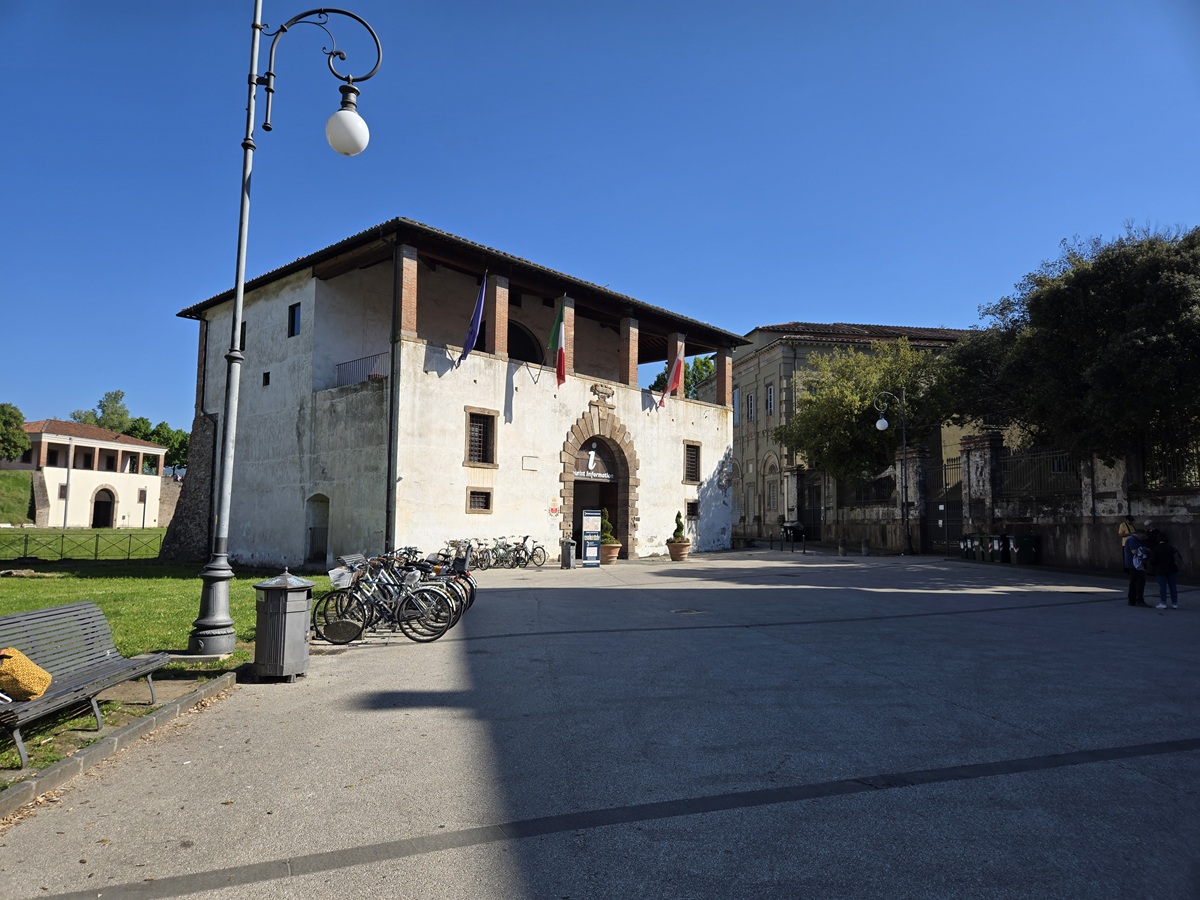
We walked through one of the several gates in the walls, and convened outside the tourist information office. I'm not sure what purpose this building originally served.
 
 
I'm tempted to compare Lucca with the walled city in southern France, Carcassonne, which I have also visited, but there are more differences than similarities. One common feature, though, is the narrow cobblestone and flagstone streets. The cars and delivery vans which try to negotiate these narrow roadways have their work cut out for them at the best of times. When they find a party of tourists in the way, well....
 

We had one stop on the way into the heart of the old town, in a small square where a man sculpted in bronze was seated outside a typical multi-storey apartment house. Our guide informed us that this was the renowned Italian opera composer, Giacomo Puccini, creator of such legendary characters as Madame Butterfly, Tosca, and Turandot. The sculpture stands outside his birthplace, now a museum of his career.


We then moved on a short distance to the Piazza San Michele, site of one of the strangest looking churches I've ever seen. 


The real pride or hubris of that towering multi-arcaded facade becomes obvious when you go around the side of the church and then look back and up.
 

Any takers for climbing that crumbling staircase which seems to cling precariously to the back of the false front? For me it was a little too reminiscent of horror stories about staircases to nowhere. I don't think it is open to the public in any case, and this is likely a very good thing!
 
What is noteworthy about San Michele is that it continues to the full the Tuscan tradition of incredibly elaborate ornamentation and decoration. I suspect a bit of overt nose-thumbing at Pisa and Florence when Lucca was fully the equivalent of those cities in the wealth of its leading inhabitants.


It seems a bit ironic that the interior of this ornate structure is relatively plain to the point of severity. At one time, our guide informed us, the walled city of Lucca contained a total of 93 churches. Many no longer exist, while others (like this one) have been converted to other uses.
 
 
There are a couple of other interesting sights around the Piazza. One is this former palace, now a bank office, but still displaying some sculpture in the covered loggia on the front of the building.
 

Another commercial building now housing a bank plainly shows the brickwork of the centuries-old original -- and bear in mind that this is structural brick masonry, not just a brick facing or veneer as in modern construction.
 

One of the fascinating things about Lucca is that the tourists haven't taken over the town. There are still plenty of shops geared to the needs of the local residents. Clothing, hardware, shoes, food items, all are on display as you walk through the streets. And there's scarcely a souvenir shop to be seen anywhere. Of course, for a group of visitors who had to eat breakfast far too early, and won't get to lunch for quite a while yet, the food shops are especially intriguing! For example, the window display in this bakery...
 
 
...or the various sizes and shapes of pasta on show at this combination store and restaurant. The Tordelli Lucchesi in the upper picture is a particular local delicacy.


Near the bakery was this random piece of ornamental ironwork embedded in the wall, apparently "just because."


Our final stop of the organized tour was outside another church, San Frediano, dedicated to a particular local saint. The mosaic artwork on the exterior was the real eye-catcher here. Parts of this church date back well over 1,000 years.


Outside San Frediano was another lovely display. I took my time to enjoy this before it was time to head for our meeting point back at San Michele.


 An attractive final memory to carry away from an intriguing brief visit to Lucca.