Showing posts with label art. Show all posts

Friday, May 9, 2025

European Circle Tour # 11: Sailing Into Lisbon

Our final port of call before the end of the cruise was in Lisboa (Lisbon), the capital city and biggest port of Portugal. While Lisboa's history is believed to date from centuries before the beginnings of Christianity, back to the arrival of the Phoenicians, there's very little to see today that's any older than 1755, except in the old hilltop Moorish district known as Alfama. That's due to the great Lisbon earthquake which combined a massive tremor with a 20-metre or higher tsunami to destroy almost all of the city.
 
All of Lisbon's long and rich history goes to make this one of the most beautiful cities in the world to arrive in by sea. This first post of two for our one-day port call takes you through the approach by the Emerald Princess up the broad estuary of the Tagus River (spelled as "Tejo" and pronounced "Teh-zhu" in Portuguese). This approach is a truly remarkable experience which land-based tourists can never share. Our sail-in was blessed by uncommonly beautiful weather in the late morning.
 
Coming in from the ocean, you pass by extensive areas of modern apartments and industries. The first notable landmark comes right at the point where the estuary narrows down dramatically. This is the famous Torre de Belém, seen from angles that visitors on land can never get.


As the wide river mouth narrows down, it's a natural spot for the small boat to come out to meet the ship, bringing the harbour pilot to guide us in. Here's the pilot boat heading back to shore. The modern, angled building the boat is heading towards is the headquarters of the port authority. It's slanted at even more of an angle than this view makes it appear. Take that, Leaning Tower of Pisa!
 

Right at this point, we pass the famous Monument of the Discoveries. The people  standing around and looking up at it give you a good idea of the size of this sculpture.
 

Just past the Monument, you get periodic views of the Mosteiro dos Jerónimos, a landmark religious site and museum.
 
 
All this time, the view ahead of the ship has been dominated by the 25th of April Bridge. The bridge was originally named after the man who commissioned it, the dictator António Salazar. The name change came after the remnants of Salazar's Estado Novo regime were overthrown in a bloodless coup six years after his death, an event now celebrated each year on the 25th of April as Liberation Day, but also popularly referred to as the Carnation Revolution. The bridge was the first fixed crossing of the Tagus, and carries both road traffic on the upper deck and trains on the lower deck.
 
As we approached the bridge, the air was filled with a strange, unearthly humming sound which got louder and louder as we drew nearer, sounding reminiscent of the weird chanting music from the light show in 2001: A Space Odyssey.


It's caused by the sound of car tires on the two centre lanes of the bridge, which consist of open steel grid decking rather than solid pavement. It's a feature that makes a long suspended span like this much less resistant to wind and therefore less likely to sway dangerously in stormy weather.
 
After passing the bridge, we drew nearer to the centre of the city and the dramatic Praça do Comércio, as much the monumental centrepiece of Lisbon as the Arc de Triomphe is of Paris. 


Beyond the plaza, we come to the hilly Alfama district. The summit of the hill is marked by the fortress of São Jorge (Saint George). Among the crowded streets, you can pick out what looks almost like another fortress, the twin towers of Lisbon's cathedral. The far end of the hilltop is crowned by the monastery church of São Vicente da Fora. Nearby stands the proud, tall dome of the Panteão Nacional, burial place of famous and notable people.


And it's right at this point, just below the Alfama, that the ship arrives at the sizable cruise terminal and ties up to the pier below the Panteão Nacional. Welcome to Lisbon!
 
I didn't actually spend any time in Lisbon on this visit, opting instead for an out of town tour to the west, visiting the unique historic town of Sintra and beach resort of Cascais. That visit will be covered in the next post. For those interested in a detailed look at the city itself, here's a link to the blog post from my first visit to Lisbon, back in 2022. Enjoy!


Friday, May 2, 2025

European Circle Tour Part 7: The Cruise Begins

You just knew there had to be a cruise coming up, didn't you? 
 
This cruise is one of many billed as starting and/or ending at Rome. But there's a catch to that. It's an hour or more of open highway driving to get from the city of Rome to the cruise port at Civitavecchia. Taxis from Rome charge a flat rate of over 100 euros, which means that anyone travelling alone -- like me -- is definitely ahead of the game by taking the cruise company's transfer service. Plenty of others agreed with me, and the Princess transfer team filled up four coaches! Boarding was quick and efficient and I was onto the ship, bags dropped in my cabin, and eating lunch within about 40 minutes after we got to the pier. And here's the ship, Princess Cruises' Emerald Princess. It's my second time sailing on this vessel.
 
Princess Cruises photo.

The ship has just come off a 2-week drydocking which I assume took place at the Fincantieri shipyard in Trieste, where so many cruise ships, including this one, have been built. Regular visits to drydocks for safety checks and various maintenance issues are a routine part of all cruise ship operations. Sometimes a longer period in drydock will be scheduled to allow for a top-to-bottom refurbish of the public spaces or passenger cabins.
 
A voyage right after the ship comes from drydock might be considered a bit risky in terms of things not working, but so far the only glitch I've noticed with the ship is that there still isn't enough water to open all the pools. They're hoping to have all three pools ready by the end of Day 4. Otherwise, there are minor hassles with service on board since (I suspect) many of the crew may be new to their jobs, or new to this ship, or both. This is a 9-day transit cruise from Rome west, out of the Mediterranean, and north to Southampton in England, where the ship will be based for the summer season. Here you can see my entire route for the whole trip.
 

The first short leg took us from Civitavecchia to Livorno. That's the port for Firenze (Florence) and Pisa. Smart money says that hundreds of my fellow passengers took the 90-minute drive to Florence and spent the day there. Smug me says: I didn't have to. I'd just been! Instead, I went on a half-day excursion to the city of Lucca. If it wasn't as spectacular as the more famous places, it also was not nearly as packed full of visitors -- a definite bonus.
 
The old quarter of Lucca is a walled city. Here's an internet aerial view which depicts the relationship of the walled city to the much larger modern city which encloses it.
 
Photo/Map: Arne Müseler / arne-mueseler.com / CC-BY-SA-3.0 / https://creativecommons.org/licenses/by-sa/3.0/de/deed.de
 
Our coach had to park outside the walls of the old city.


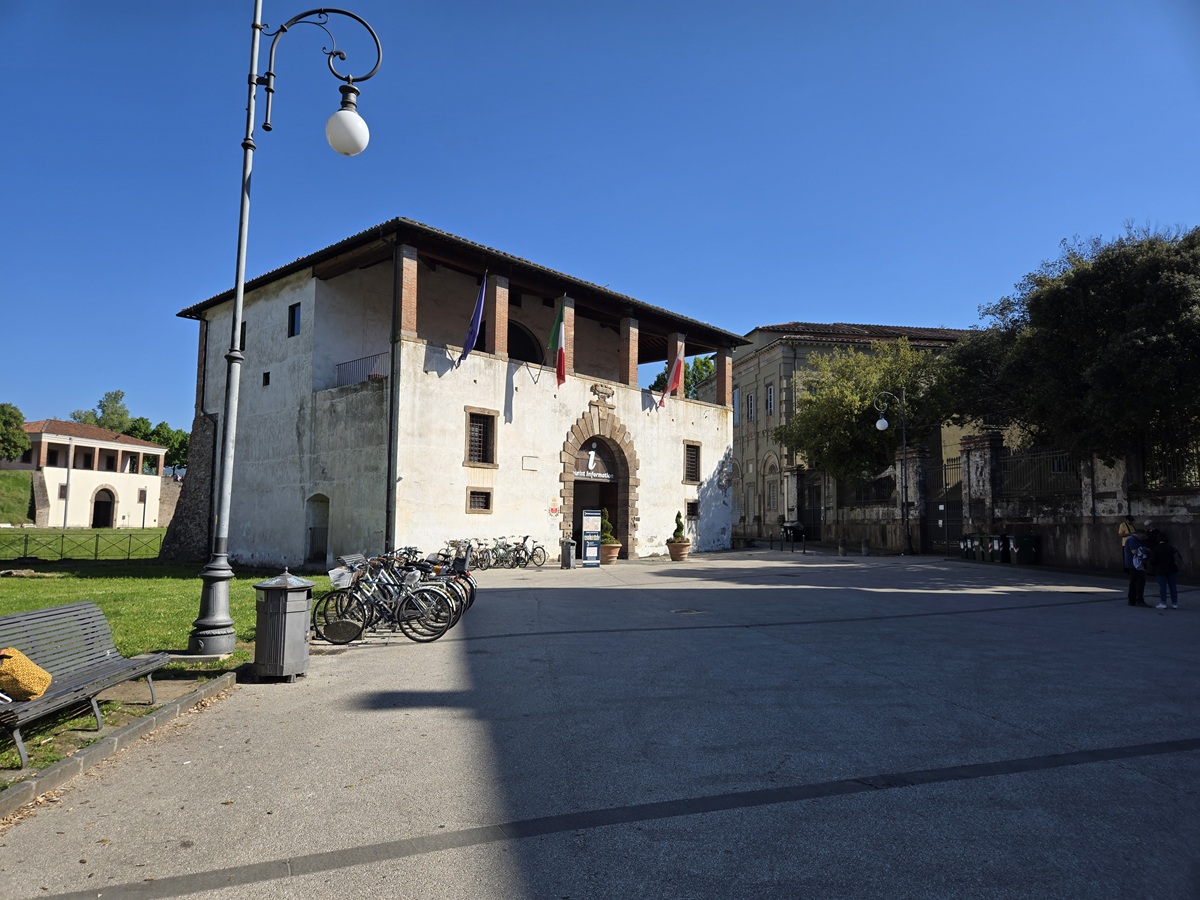
We walked through one of the several gates in the walls, and convened outside the tourist information office. I'm not sure what purpose this building originally served.
 
 
I'm tempted to compare Lucca with the walled city in southern France, Carcassonne, which I have also visited, but there are more differences than similarities. One common feature, though, is the narrow cobblestone and flagstone streets. The cars and delivery vans which try to negotiate these narrow roadways have their work cut out for them at the best of times. When they find a party of tourists in the way, well....
 

We had one stop on the way into the heart of the old town, in a small square where a man sculpted in bronze was seated outside a typical multi-storey apartment house. Our guide informed us that this was the renowned Italian opera composer, Giacomo Puccini, creator of such legendary characters as Madame Butterfly, Tosca, and Turandot. The sculpture stands outside his birthplace, now a museum of his career.


We then moved on a short distance to the Piazza San Michele, site of one of the strangest looking churches I've ever seen. 


The real pride or hubris of that towering multi-arcaded facade becomes obvious when you go around the side of the church and then look back and up.
 

Any takers for climbing that crumbling staircase which seems to cling precariously to the back of the false front? For me it was a little too reminiscent of horror stories about staircases to nowhere. I don't think it is open to the public in any case, and this is likely a very good thing!
 
What is noteworthy about San Michele is that it continues to the full the Tuscan tradition of incredibly elaborate ornamentation and decoration. I suspect a bit of overt nose-thumbing at Pisa and Florence when Lucca was fully the equivalent of those cities in the wealth of its leading inhabitants.


It seems a bit ironic that the interior of this ornate structure is relatively plain to the point of severity. At one time, our guide informed us, the walled city of Lucca contained a total of 93 churches. Many no longer exist, while others (like this one) have been converted to other uses.
 
 
There are a couple of other interesting sights around the Piazza. One is this former palace, now a bank office, but still displaying some sculpture in the covered loggia on the front of the building.
 

Another commercial building now housing a bank plainly shows the brickwork of the centuries-old original -- and bear in mind that this is structural brick masonry, not just a brick facing or veneer as in modern construction.
 

One of the fascinating things about Lucca is that the tourists haven't taken over the town. There are still plenty of shops geared to the needs of the local residents. Clothing, hardware, shoes, food items, all are on display as you walk through the streets. And there's scarcely a souvenir shop to be seen anywhere. Of course, for a group of visitors who had to eat breakfast far too early, and won't get to lunch for quite a while yet, the food shops are especially intriguing! For example, the window display in this bakery...
 
 
...or the various sizes and shapes of pasta on show at this combination store and restaurant. The Tordelli Lucchesi in the upper picture is a particular local delicacy.


Near the bakery was this random piece of ornamental ironwork embedded in the wall, apparently "just because."


Our final stop of the organized tour was outside another church, San Frediano, dedicated to a particular local saint. The mosaic artwork on the exterior was the real eye-catcher here. Parts of this church date back well over 1,000 years.


Outside San Frediano was another lovely display. I took my time to enjoy this before it was time to head for our meeting point back at San Michele.


 An attractive final memory to carry away from an intriguing brief visit to Lucca.


Monday, April 28, 2025

European Circle Tour Part 5: The Endless Beauties of Florence

It's a strange feeling to be back in Florence again, when my last visit here was 54 years ago on a school sponsored trip (I was in Grade 11). You'd think I would want to dive right in as much as possible.
 
But my time this year is limited and I wanted to make maximum use of it. After the day-long side trip to Pisa, I had only one day to give to Florence. Even more so than usual, my walking tour through the historic heart of Florence (actually Firenze) skated over the surface -- not least because I never stepped inside a single building. Just like my visit to Pisa.
 
The game is more than a bit like trying to organize advance reservations for all the most popular rides and attractions at a major theme park. Everybody, it seems, wants to get inside the Cathedral, the Campanile, the Baptistery, the Uffizi Gallery, the Accademia Gallery, the Pitti Palace, the Palazzo Vecchio, Santa Maria Novella... well, you get the idea. Outside every one of these buildings there was a lineup of people who didn't have the reservations, and were going to have to wait for however long it took.  Standing around waiting is definitely not something I can do very well, so I just prefer to get started and keep on going as long as I can.
 
Again like Pisa, there is an extraordinary amount of science, engineering, and artistic detail to consider in these buildings, so there is no shortage of worthwhile targets for your attention on the outside -- targets which many people may miss in their rush to the interiors. 

With that, then, let's start with the church of Santa Maria Novella. I started there, and with the spacious plaza in front of it, because the principal railway station, "Firenze SMN", is located just a block behind the church, and my hotel was just up the road from the station.
 
Here's the façade.  In common with many churches in Tuscany, not just in this city, this bi-coloured or even tri-coloured marble mosaic gives a striking appearance to the front entrance. The remainder of the church, including its bell tower, sticks to the native orange/brown sandstone.


Now, take a closer look at the rich detail in the pediment and in the scroll-like decorative support at the side of the facade's upper storey.


Nearly every church in Florence, and many other buildings as well, can show this kind of artistic detail and craft work to the eye of the observant visitor. 
 
The large piazza in front of Santa Maria Novella is quite the people place, lined with shops, sales booths, and cafés, and often featuring live music and other kinds of shows. That's particularly true of holidays, and my day for touring Florence was April 25, Liberation Day, a major and significant national holiday.


It's a few blocks straight down a major street to the Piazza del Duomo, and the enormous Cathedral of Santa  Maria del Fiore (St. Mary of the Flower) which is the city's crowning glory and dominant landmark. The enormous dome, designed and engineered by Filippo Brunelleschi, remains the largest dome in existence built of brick masonry. The more you study this massive and complex structure, the more you realize that only a city which could command enormous reserves of wealth could ever build such a sacred edifice.


Setting aside the sheer size, notice that every inch of the Cathedral, the nearby Campanile, and the facing Baptistery (not just the fronts!) -- all are covered with the mosaic of three colours of marble, and the mosaic continues into the interiors as well.
 

Again, there are little and not so little sculptures popping up in various places all around the three buildings. In this first example, by all means admire the grace of the Madonna and of the angels kneeling to her -- but don't miss the multiple intricate layers of borders, each one of a different design, which frame the scene.


One of the greatest treasures of all is the set of gilded bronze panels on the east doors of the Baptistery, the doors facing the Cathedral. These doors are frequently called the Gates of Paradise and it's not hard to see why. The sculpted panels depict ten scenes from the Old Testament of the Bible. The amount of detail is eye-popping.


How on earth did the sculptor, Lorenzo Ghiberti, fit so much perspective depth and so many people into an all-but-flat work to be cast in bronze? This scene of Solomon welcoming the Queen of Sheba to his court exemplifies, for me, the status of these doors as one of the great miracles of European art.
 

Note that the doors you see on the Baptistery today are skilful reproductions. When I came to Florence in 1971, the bottom left panel (the life of David) had been torn out a year or two earlier by one of the  catastrophic floods of the river Arno. It was found, after the floodwaters receded, wrapped around the posts of the iron fence protecting the building. After that terrible disaster, many artworks, including these gilded bronze panels, were removed to museums for safekeeping.
 
I could easily have spent another hour just roaming around the Piazza del Duomo, but it was time to move on -- just a short walk down the road to the Piazza della Signoria. Here you find one of the older buildings in the centre of the city, the Palazzo Vecchio ("Old Palace"), construction of which began in 1299. It now serves as the Town Hall of Florence.
 

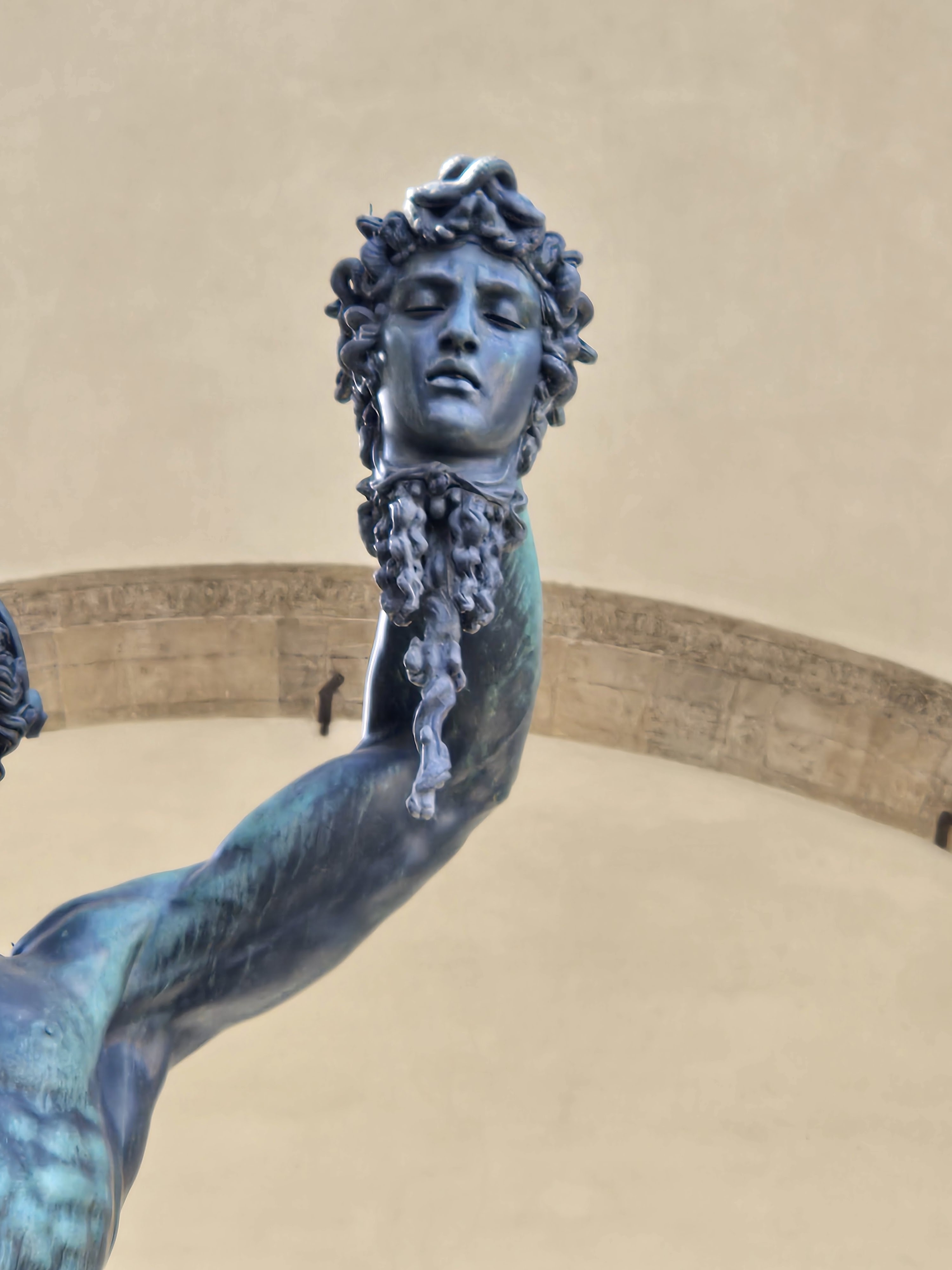
The red chairs and the podium up on the steps are placed there because of an impending ceremony in celebration of the national holiday of Liberation Day, April 25 -- and now you know what day I was visiting Florence. The Piazza della Signoria features a significant collection of sculptures -- some original, some copies of originals displayed elsewhere.


Many of the sculptures are displayed in the Loggia dei Lanzi, an arcade on the south side of the piazza.


Walk past the Loggia, and you find yourself in the long narrow courtyard between two wings of the Uffizi Palace, one of the several homes of the famous (infamous?) Medici family. It's now the home of one of the world's truly great art galleries. 


On the left side, you can see the line of people waiting to be admitted. The line ran the full length of the courtyard in the open, then doubled back behind the pillars on the left and ran most of the way back to the entrance. A perfect example of why advance tickets, preferably with timed admission if possible, are an essential accessory in modern travel.
 
At the end of the courtyard, there's a momentary chance for a unique view of the hills across the river, a view which strongly suggests a Renaissance landscape -- until it's spoiled by the construction crane.
 

Step through the arch and turn right. You are on the north bank of the Arno, walking towards the Ponte Vecchio ("Old Bridge"). This famous bridge is perhaps the only surviving example in Europe of a kind of bridge which could also be found in medieval times in London and Paris, and no doubt many others -- a bridge lined with shops and apartments.


A moment like this definitely calls for a selfie. 
 

The overhangs of the buildings could serve not only for hoisting up goods from boats in the river but also for disposing of certain bodily by-products. It's no wonder that most urban rivers in the Middle Ages were no better than open sewers.

 
Up on the bridge's pedestrian-only roadway, it's easy to believe that you're on  "just another street" until you get to those archways at the middle which give views both upstream and downstream. 


The view downstream is a particularly enticing one, featuring the graceful parabolic arches of the Ponte Santa Trinita. Although the crossing point was far older, this particular bridge was built after a catastrophic flood in 1557. The sponsor? The Medici -- surprise, surprise. In an age when virtually all bridges were built with arches that were circular or segments of circles, these parabolic curves were both startling and elegant. The bridge was destroyed by retreating German troops in 1945, and rebuilt after World War II as an exact duplicate in the exact position as before.


The top level of the Ponte Vecchio houses the famous Vasari Corridor, which joins the Palazzo Vecchio, the Uffizi Palace, and the Pitti Palace on the opposite side of the Arno. It was built to enable the Medici to pass easily and out of public observation between these various buildings, all of which they owned by the mid-1500s. The corridor recently re-opened to the public after a long period of closure.
 
Upon leaving the Ponte Vecchio, you have to walk uphill for a couple of blocks to reach the broad piazza in front of the Palazzo Pitti. At first glance it is far more impressive than the Uffizi as a building. It was left incomplete when the original owner, Luca Pitti, lost his wealth before it was finished. Years later, it was purchased by the Medici and that was when it reached its full stature, becoming their principal residence and housing their vast personal art collection. It is now the biggest single art museum in the city.


The Florence of centuries ago, a city of immense wealth, of Grand Dukes, of Popes and Kings and Queens, and of remarkable artists, can still be seen by visitors. What's the Florence of today like? Well, it certainly has its playful side -- as illustrated by this sign outside a cafe on the Piazza Santa Maria Novella. 


My first thought was "don't bring these things in here" but then, on second thought, what if the real meaning is "leave your drama outside because you're going to encounter things like this if you come in?" Hmm -- I'll just leave this look at a visit to Florence with that question.