Showing posts with label rail tours. Show all posts

Thursday, September 27, 2018

Rail Travel in Europe

Another "helpful hints" post about the mechanics of travel by rail in Europe.
If you are already familiar with the subject, feel free to skip this one.

As I come to the end of my epic-length European trip, I find that I have learned a lot of important lessons about travelling by train in Europe.  Some of these things I mastered when much younger, and had forgotten, some of them are new lessons to be considered.  My comments are based on the idea of an extended trip involving a number of train travel segments.

My key advice can be boiled down into five main points:

[1]  Get a Rail Pass

The time you will save, as opposed to trying to buy individual tickets for each trip, will please you almost as much as the money you will save.  There is such a diverse range of travel pass products available now that it's almost foolish not to buy one.  Of course, there is the classic Eurailpass, but under that umbrella name there are numerous variants based on limited groups of countries, set or flexible time periods, and so on.  Many individual countries also offer their own national passes.  As my experiences in Switzerland clearly show, the national pass there covers even more travel options than the Eurailpass.  It's a point to check for whichever country you are heading to visit.

I bought an 8-days-in-a-month Swiss Travel Pass, and it had more than paid for itself before my sixth day of travel was over.  

Research is key.  Be sure to read all the fine print relating to whichever pass you are thinking of buying.  I didn't follow my own advice, and ended up paying almost $100 more than I needed to pay for one train route, simply because I didn't read that I could have gotten a discount on it with my Swiss pass.  Ouch.

Passes are almost entirely limited to travellers from outside of Europe, who must purchase the pass before they leave home.

Key point: the Eurostar trains through the Channel Tunnel between the U.K. and Europe are not covered by Eurailpass or any national pass.  That trip you have to book and pay directly through Eurostar.

[2]  Go First Class

A lot of people will just say, "I can't afford that."  Actually, in Europe, you probably can -- the fare difference is nothing like as great as one might expect in air travel.  The difference?  Trains generally have 4 seats on a row, 2 each side of the aisle, in second class, and three seats, 2 and 1, in first class.  Bigger seats, more leg room -- these you would expect.  The really big difference comes when you realize that second class often fills right up all the way, and then some.  Do you really want to spend three or four hours of your holiday standing in the aisle of a train because there are no seats available? 

First class rarely, if ever, fills up.  Euro trains love seats which face each other across a table.  On 27 train rides, I had a vacant seat opposite me on all but 5 trains.  On 2 of those 5, I had an airplane-style seat with a seat back in front of me.  Some trains also offer at-seat service of snacks, drinks, or even meals (depending on the travel time) if you are in first class.  Second class, you are most likely leaving your seat and walking how many cars to the buffet -- or lugging all food and drinks for the trip on board with you.

Another key point: many European trains have nowhere near enough space for baggage, as most passengers are making short local trips for only a day or two.  First class has fewer people competing for the limited available space.  Moral: arrive at the station early, and be ready to board as soon as the train arrives -- your chances of snagging baggage space are better.  And in first class, your chances are much, much better.

[3]  Reservations

Many trains require reservations.  Required!  No res, no travel.  This applies to popular tour trains like the Glacier Express, to most international trains, and also to virtually all high-speed train routes like the French TGV, the Eurostars through the Channel Tunnel, the Thalys, the German ICE, and others.  Some of these trains now have three classes of service, an added complication to life with a pass.  Again, read the fine print.  Reservations sometimes (not always) come at the cost of a reservation fee, which is additional to either your basic ticket price or your pass price.  The reservation fee does not upgrade your second-class pass to a first class seat (I saw one guy get evicted from a train for trying to argue that point and refusing to give up).

I booked tickets for this trip through a U.S.-based company called RailEurope, but I don't think I will go that route again. It seemed easy enough to get all my reservations and my pass through one source. But there were problems. The RailEurope system didn't include many stations, and also had less than complete information about trains and routes that were available. In reserving seats, I got much less favourable seat assignments than other passengers who booked directly with the train operators in Europe, even though they reserved long after I did.

I would have done better to make my reservations using the websites of the various railway companies, all of which have full English-language versions of their websites.

[4]  Schedules

Train schedules in Europe are clockwork-precise in many countries, and beautifully interwoven so that a change of trains rarely requires you to stop for any longer than 30 minutes -- and often much less.  So precise is the planning that the German railway, Deutsche Bahn (DB), actually hands out leaflets on their major inter-city trains which give the timetable of the train, and also list all connecting trains at every stop, complete with the numbers of the platforms where those trains will board.  In every station, you will find video display boards like those in an airport, listing departure times and the main destinations of each train.

[5]  Take the Train, Not a Car

I would never rent a car in Europe unless I had to travel in an area which doesn't have trains.  It doesn't matter that the German Autobahn has no speed limit (except when it does), when the German Inter-City Express train can cruise all the way at 300 kilometres per hour or more (180 miles per hour).  Even the more normal trains on conventional lines often cruise in excess of 150 kilometres per hour.  Despite those speeds, the real reasons to skip using a car are the crowded streets and growing numbers and sizes of pedestrian-only zones in cities, towns, and villages all over the continent.  Parking can be hard to find in many locations, and expensive.

And then there's the price of gas -- so high it can make you wonder why you ever thought gas was expensive in Canada.  It's a loser's game -- and those are only some of the very good reasons why so many Europeans don't travel by car. The people I really feel sorry for are the ones who rent a car at the airport to drive up to Zermatt -- only to find that they still have to park the car at Täsch and take the train the rest of the way!

Even for day trips, the trains are amazing.  I wanted to go from Zurich to visit the dramatic Rhine Falls at Schaffhausen.  Of course, there's a train station right there, made to order for the purpose.  No, wait -- there are actually two train stations, one on each side of the river.  Visit the northwest bank views of the falls, take a boat tour, then ride the train into Schaffhausen and come back out on the other line to visit the southeast side views.  Easy to do with a pass.

A Couple of Notes:

A special commendation to SBB, the Swiss Federal Railways.  Just as my first Swiss train was leaving Basel, some idiot tried to light up a smoke in the washroom -- with predictable results.  All of us were asked to decamp into the next car, and were glad to do it because of the raucous smoke alarm.  At the next station, police met the train and hauled the idiot away.  Right after that, the conductor came through and gave us all discount vouchers for the inconvenience -- CHF6 or near Cdn$10.  The voucher could be used for travel, or to buy products in station kiosks, or to buy food/drinks on trains, including the Glacier Express -- which is where I used mine.

And finally: European trains are much more modern, quieter, smoother-riding, comfortable, punctual, and easy on the nerves than any passenger trains in North America.  Only one problem: most of the trains have air-conditioning systems, but those systems were having trouble coping with the epic high temperatures which Europe experienced this summer.  Dress lightly -- this isn't going to be an Arctic expedition like so many long-distance air flights.

Thursday, September 20, 2018

European Epic # 15: The Jewels of the Lake

In a real change of pace, I've returned from ski-resort villages to city life in one of the most beautiful cities I've ever seen in all my travels: the city of Luzern (Lucerne) in Switzerland.  I'm going to keep using the German spelling because that is what you see on all signs and print materials in Switzerland -- highway signs, railway stations, tickets, etc.  Like Vancouver, Luzern has it all -- mountains, a river, a beach, and gorgeous views in every direction -- but all in a smaller, more livable scale with almost no sign of the bigger city's traffic congestion.  

The prize jewel of Luzern is, of course, the lake itself, with its spectacular Alpine backdrop.  


It's often called Lake Lucerne but this is not its proper name.  Its full name is Vierwaldstättersee -- "Lake of the Four Forest Cantons."  The name Luzernersee ("Lake of Lucerne") is properly used to describe only the arm of the lake which ends at the city of Luzern as the lake drains into the river Reuss, enroute to the Rhine.  The river's name is pronounced pretty much the same as a certain famous luxury car brand: Rolls-Reuss.

A good deal of significant Swiss history was written around the shores of this lake, not least the original oath of the cantons agreed upon at the meadow of Rütli (likely in 1307, but conventionally assigned to the year 1291).

The original settlement grew up around the point where the Reuss drains the lake, and it is here that the most historic parts of Luzern today are located.  The centrepiece is the long, oddly-angled covered wooden footbridge called the Kapellbrücke ("Chapel Bridge"), with its fortified tower and its ceiling decorated in the 1700s with paintings of scenes from the area's history.  The name refers to the Roman Catholic chapel located by the bridge's north end.  The original bridge dating from the 1300s was severely damaged by a fire in 1993, and rebuilt the following year.  Only some of the paintings were able to be restored.  The fortified stone tower standing in the river closer to the south shore and attached to the bridge was one of many towers which protected the medieval town on the north shore from invaders -- in this case, invaders coming from the south and trying to cross the bridge.


Both sides of the river are lined in this area with historic buildings, many now serving as hotels and with restaurants on the ground floors -- plenty of riverfront terraces for eats and drinks in warmer weather, and we've certainly been enjoying that!


Dominating the south bank of the river is the twin-towered Jesuit Church.


The north side is centred by the Alte Rathaus ("Old Town Hall"), now housing a large and popular brewery and pub.


Downtown Luzern is compact and easy to get around on foot.  The river is spanned by just 2 road bridges at either end of the downtown area, but no less than 4 pedestrian-only bridges.  Do you think they're trying to tell us something?

In the morning, the walkways on both sides of the river were converted into the city's marketplace with stalls selling fruits, flowers, meats, fish, fresh bread, cheeses of all kinds, and so on.

There are two very prominent mountains which dominate many views of Luzern, even though they are both quite some distance away across the lake:  Rigi to the east and Pilatus to the south.  In the two photos of the Kapellbrücke above, Rigi is in the background of the first picture and Pilatus in the background of the second.

Both mountains are served by distinctive rack railways.  Rigi has the oldest rack railway in Europe (1871), and that railway now actually has 2 separate lines going down opposite sides of the mountain.  Pilatus has the distinction of the steepest rack railway in the world (opened in 1889), averaging 35% gradient and maximum of up to 48% (which is just shy of climbing at a 45 degree angle).

I'd ridden up Pilatus back in 1979 when I first came here, but for this visit I decided to get onto both mountain railways in one day.  It can be done, but requires an early start and a lot of patience.  Here, again, comes the payoff for using the Swiss Travel Pass: free rides on the lake boats or trains to and from the two mountains, free admission to the Rigi railway and half-price at Pilatus.


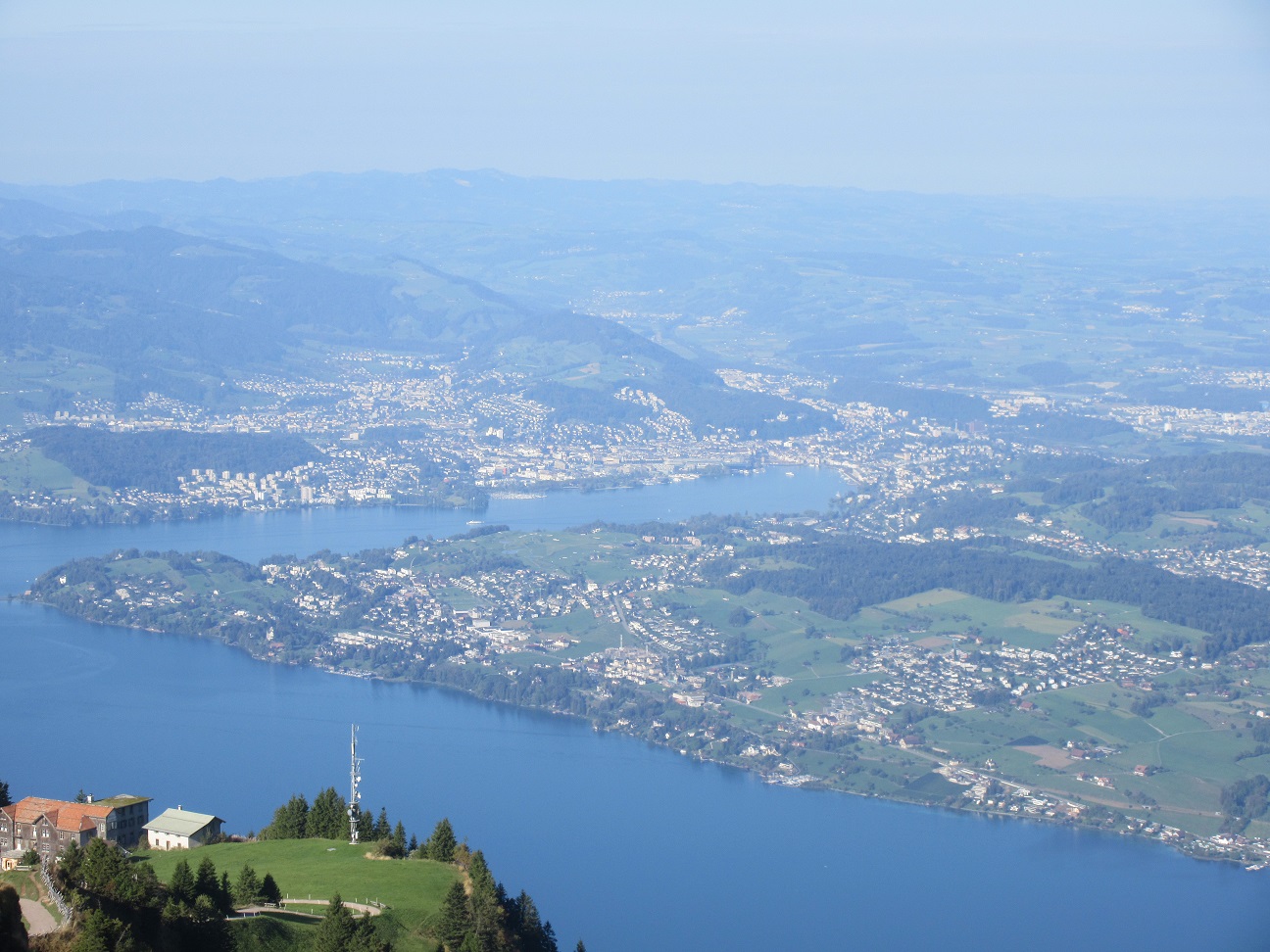
The other payoff, less easy to quantify but much more important to my well-being, is the sheer delight of an early-morning cruise on the placid waters of the Vierwaldstättersee.  You begin with a beautiful waterside panorama of Luzern as the ship pulls away from the pier.


Cruising slowly and easily across the calm waters, you have a succession of splendid mountain views which keep changing and shifting by the minute as you sail along.


The boat is fully equipped with a snack counter and bar.  Like a train, it's divided into first and second class sections, with the first class (on the upper deck or at the stern if a single deck) having more comfortable seats, both indoors and out, and a server who comes around to take drink and food orders so you don't have to line up at the counter.  Thank you, Swiss Travel Pass.

After an hour and a quarter, the ship arrives at Vitznau, the port for the Rigi railway.  By the way, if you really want to see it all, the same ship continues all the way to the southeast end of the lake at Flüelen, about 3 hours sailing time from Luzern including all stops.  You can return via frequent train services.  Vitznau, on the other hand, has no railway access so the ship is essential unless you really, really need to go on a long, twisty ride on a Swiss bus (but that's included in the Travel Pass too if you absolutely, desperately need a long bus ride -- you can tell how I feel about that!).

As soon as the 2-car train pulls away from Vitznau and starts up the incline, the views begin to open up before you.  Thank goodness for digital photography; you can easily take 200 pictures in 20 minutes and then sort through at a later date and discard all but the best, without paying for all that film as in the bad old days.


An awful example of what happens if you "forget" that you're on a rack railway and prop your camera on the windowsill for stability.


Eventually you reach the summit.  You'll notice that Rigi is nowhere close to being as high as, say, the Gornergrat.


The word "Kulm" means "summit" -- think of the related English word, "culmination."

What makes the Rigi viewpoint so spectacular is that it's far taller than anything else close by, so there are splendid views in every direction.  Downtown Luzern, on the zoom lens.


Pilatus, about fifteen kilometres away.


A panorama of the lake and mountains spreading out before you.  And because you made yourself get up good and early, the sun is southeast of the mountain and thus is behind you as you photograph the best views.


When it's time to leave, make sure to get on the proper train.  Hop on that blue train on platform 2 instead of the red train on Platform 1 and you'll find yourself in Arth-Goldau instead of Vitznau before you know what hit you (two different rack railways on the one mountain, remember?).


But not to worry -- Arth-Goldau is a major main-line railway station and you could very easily get back to Luzern by train from there.  But speaking of back to Luzern, it's time to head back down the mountain and -- from the Vitznau station -- just a few steps to board the boat for the return trip.

Back in Luzern, there's time to grab a light lunch of a sandwich and drink before heading for the next boat to the southwest corner of the lake and Alpnachstad.  Again, about a 75-minute voyage, but all new and different scenes to enjoy.


And then you come to the dock, walk through a tunnel under the railway tracks, and come up to the terminal of the Pilatus Bahn.  This mountain line climbs far steeper grades than any other rack railway in the world.  The secret is in the special rack designed by the line's engineer, Eduard Locher -- rather than a single cog wheel rotating vertically along a single toothed rail, the Pilatus rack uses two wheels mounted sideways on the two sides of the rack rail.  This set-up, with the flanges under the cogwheels' teeth, makes it virtually impossible for the cogs to disengage and come loose from the rack rail.


The cars are built like those of a funicular, staircase fashion, due to the steep grades of the line.  If one wonders why a funicular wasn't built, the technology of the day couldn't cope with the particularly sheer slopes of Pilatus since a funicular or rope-drawn car has to move along a fairly straight course with limited curves.  The Pilatus cog line has a number of wickedly tight bends to keep the gradient down to a mere 48%!  The cars travel singly, but with up to four cars each way at each departure time -- the all-important midpoint passing switch has room for a total of eight cars.  Here's what it looks like at passing time.


As the track climbs higher on the mountain and gets above the tree line, you begin to see just what a challenge this horribly steep mountain posed to the builders (particularly in the second picture where the following train car is visible, with a zoom lens close-up at a different point on the track in the third pic).


The summit station perches on a saddle between the mountain's two main peaks.  There's a pair of hotels, a cafeteria, a sit-down restaurant, a huge viewing deck, and the Drachengalerie (the "Dragon's Lair").  There's also the large cable car which comes up the north side of the mountain -- actually the topmost of a sequence of three separate cable cars which stretch up from the town of Kriens.


You can clearly see downtown Luzern at the left edge of this picture, and the sharp point of Rigi in the top centre -- and clearly see how much lower Rigi is (about 325 metres/1000 feet lower).


The sheer cliffs dropping down from the summit on two sides certainly helped me to understand why Eduard Locher's friends thought he was crazy when he said he would build a rack railway on this peak.

Speaking of those sheer cliffs, there's a long winding tunnel that's been bored through the rock wall of the north face, with multiple viewing windows cut through the rock on different angles.  If you make it through the whole tunnel, in spite of the periodic loud clanging noises (which prove to be the exit gate) you will come out on this narrow cliffside walkway.


You can then either climb a staircase onto the trail to the higher summit, or walk through another shorter tunnel to the terrace of the hotel for a drink. Congratulations -- you've survived the dreaded Drachengalerie.

And with that, it's a good time to catch the next train back down the mountain, connecting onto the 15-minute commuter train ride from Alpnachstad to get back to Luzern in time for dinner.  And there at last, on the walkway by the Kapellbrücke, my luck came back.  For the first, and probably last, time on this trip to Switzerland, I found a person playing an alphorn.


That was definitely worth celebrating with a farewell selfie in front of that beautiful old bridge, just as the sun was setting.


Yes, it was a long, crazy day but the combination of fresh lake air and clear mountain air, in alternate doses, certainly blew away the cobwebs in my mind, so it was well worth it.

Oh yes, the total price -- thanks to the Swiss Travel Pass -- CHF36 for the half-price ticket on Pilatus.  Everything else, except the food and drinks, was no-added-charge.  I've more than gotten my money's worth out of that pass already, and I'm not even done yet.

But first, I have to leave Switzerland for a few days on a side trip to another country.

Monday, September 17, 2018

European Epic # 14: Down the Big Hill to Italy for Lunch

With each spectacular experience, I keep thinking it couldn't get any better -- and then it does.  As I discovered all over again during my 2-night stay in St. Moritz.

St. Moritz, a world-famous, very high-end resort, lies in a scenic setting on the north shore of a small lake.  The slope up which St. Moritz climbs is very steep, and so a number of "streets" are actually staircases -- and many other narrow alleyways are now pedestrians-only.  Good thing too -- walking in St. Moritz is always either all acceleration uphill or all braking downbound.

The view from the sun terrace at my hotel is beautiful -- especially at a modest rate (for St. Moritz) in a modest but neat and clean hotel, the Hotel Eden.  The big castle right below me is the iconic Badrutt's Palace Hotel, one of the older high-end St. Moritz resorts (opened in 1896).  It's currently closed for renovations before the real high season here begins in September.


Although my hotel is barely 300 metres in a straight line from the railway station, it takes 15 minutes to walk there as the roads and stairs snake back and forth across the mountainside.  In St. Moritz, the concept of "straight-line distance" is totally meaningless.

So is the concept of "budgeting."  The two major stores nearest my hotel are Prada and Hermès, which pretty much says it all.  The area is full of restaurants offering main courses from CHF45-50 on up (about Cdn$60-65) -- and that's just the main course, no appetizer, no dessert, no drinks.  I lucked out and found a more reasonably priced pizzeria in another modest hotel nearby -- Hotel and Pizzeria Arte.  Very tasty and very reasonable (by St. Moritz standards).

So with all those financial obstacles, why stay in St. Moritz at all?  The answer: I hadn't learned yet that I didn't need to.  To be explained at the end of the post.

My reason for being here was to ride another but much less well-known scenic railway tour.  The line is very well-known to rail enthusiasts and train freaks of all nationalities, but the general public have been much slower to catch on.  Their loss.

This brings me back to the opening statement of this post.  I wasn't referring to St. Moritz in writing that sentence.  I had in mind the Bernina Express train tour which I took.  Although the train cars are similar to the legendary Glacier Express, the Bernina trip is much shorter -- a mere 2 hours and 20 minutes from St. Moritz to the Italian town of Tirano.  It's perfectly easy to ride down that long hill in the morning, spend 2 hours visiting and lunching in Tirano, and ride back up the same afternoon.

But what a ride!  Once again, straight-line distance means squat.  St. Moritz and Tirano are about 35 kilometres apart in a straight line, but the rail distance is 61 kilometres.  The difference is all due to the incredible numbers of curves and spirals and switchbacks which the railway has to take to get up to and down from the Bernina Pass over the Alps, and the fact that almost two-thirds of the line runs at a pretty steady 7% grade, forcing the trains to operate at very slow speeds.  

The map shows the Bernina line's location in the southeastern corner of Switzerland.


So, let's begin this spectacular tour with a peaceful morning on the shore of St. Moritz Lake, right by the station.


The climb up to the Bernina Pass is relatively short, but does include one spectacular view of the cluster of high peaks and glaciers known as the Bernina Massif.


The summit is a broad plateau, largely devoid of tree cover.  Even at this altitude, though, the Swiss cattle are busy with their summer grazing -- in accordance with centuries-old tradition.


This tiny stream marks the beginnings of the Bernina River which flows north from the pass.  In fact, this little stream is called Ova di Bernina.


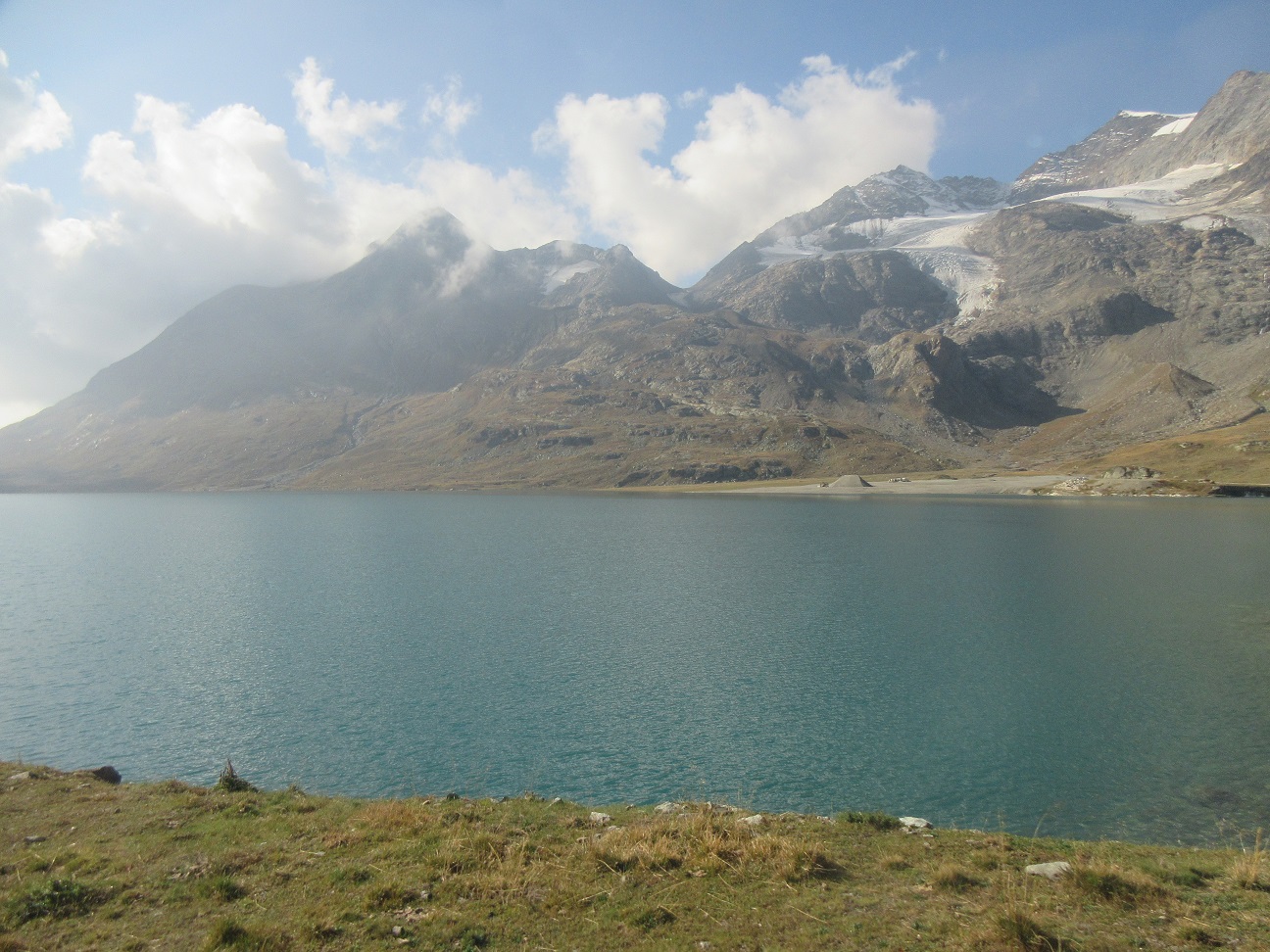
There are three lakes on the summit, and the biggest one -- Lago Bianco -- also bestrides the divide of land (thanks to a hydro dam).  Thus Lago Bianco feeds rivers flowing both ways from the pass, north to the Danube and so to the Black Sea, and south to the Po and into the Adriatic Sea.


The lake is dominated by the huge mass of the peak called Piz Cambrena, and its glacier.  That peculiar prefix "Piz" comes from Romansch, by the way, so it's not hard to identify any mountain called "Piz _ _ _ _ _ _ _" as being located in the Graubünden, the Romansch-speaking area of southeastern Switzerland.


Past the end of Lago Bianco, the line begins the long, steep, twisting descent to Tirano.  Just after the line starts down, there's a station at Alp Grüm, and we were lucky to be able to take a short photo stop there while waiting for an upbound train to pass.   Check out the parallel waterfalls draining from the face of the Palu Glacier, one of the lobes of the Bernina Massif's huge mountaintop icefield. 


Not far past Alp Grüm you get this spectacular view of the valley below you.  You can see part of the railway with a siding track far below on the left side of the picture.  A little higher up on the right side of the picture, you can see the Lago di Poschiavo, which is again much lower in altitude than the railway siding -- and even after the train gets all the way down to Poschiavo, the long haul downhill isn't over yet!


From Alp Grüm, the train has to descend a total height of 1662 metres in just 32.6 kilometres of track to reach Tirano. No wonder the grades are almost continuous at 7% for so much of the distance!

The descent is peppered with tunnels, including some spirals, open-air loops, snow and avalanche sheds, and bridges.  It's hard to get good pictures on this stretch because so much of the line is closed in by dense evergreen forests.  But in this picture, you can see how the train has to climb in a loop around a narrow valley, complete with a snowshed and a stone bridge.


You do get a good overview of Poschiavo and the lake beyond once you're down to the last 10 or 12 bends and curves before the town.


Eventually you come right down into Poschiavo itself, and find your train running along the dead-centre of the main street like a city tram on steroids!


Past the town, there are lovely views of the Lago di Poschiavo, daydreaming in the warm hazy sunshine.


As soon as the end of the lake goes by, the train resumes its steep descent towards the town of Brusio and the last and most eye-popping engineering work on the line.


Right below Brusio, the railway goes through a loop which covers roughly 420 degrees -- yes, that is considerably more than a full circle.  And because the train is descending all the way, the upper part of the loop has to be on a bridge to cross over the lower stretch.  Here's the Brusio Circular Viaduct.


For obvious reasons, the Brusio viaduct is hard to photograph while you're rolling around it.  So here's an Internet aerial photo showing a Bernina Express train going downhill around the loop.


All this way, the train has been running in Switzerland.  We've been passing Italian place names for three-quarters of an hour, but this is only one of a number of southern Alpine valleys which are Italian speaking, but remain part of Switzerland.  However, just below Brusio, the train crosses the border and after a few more kilometres (including more street running) arrives in Tirano, Italy.  


As you walk from the train into the station building, you pass a disused and closed Customs Office -- because Switzerland belongs to the Schengen Agreement for open borders, even though the country remains outside the membership of the European Union.

Tirano also has a second station, for the Italian state railways -- the two lines can't mix and match because the Bernina, like the Glacier Express, runs on a narrow gauge track with only 1 metre distance between the rails rather than the more conventional 1.435 metre standard gauge.  That narrow gauge, by the way, makes it possible for the trains to go around much sharper curves -- and after riding the Bernina line, I can certainly see why it could never have been finished as a standard-gauge railway.

Outside the two stations, there's a fairly routine Italian town -- no wildly exciting historic sites or major-league scenic beauties.  Thanks to the railways, there is a decent collection of shops, cafes, restaurants, and wine bars bidding for your tourist dollars.  The biggest difference I noticed was in the weather.  In St. Moritz, it had been a chilly 8°C fall morning (that's about 46°F), but 2 1/2 hours later in Tirano it was a warm, humid 25°C (77°F).

After a 2-hour break, you board the train again for the return trip to St. Moritz.  Especially in mountain country, it's no great surprise that the weather changes and clouds begin to move in as the day goes on.  This results in some very dramatic changes in the view compared to the morning trip down the line.


The Bernina Express packed more scenic drama and engineering wizardry into a little over 2 hours than the Glacier Express managed in a full day.  Several of us who had done both routes back to back agreed completely that both were great trips, but it was the Bernina Express that provided the truly unforgettable experience.

A couple of helpful hints if you choose to go on this trip.  Unlike the Glacier Express from St. Moritz to Zermatt, the Bernina Express is not the only way to travel this entire route at once.  Regular scheduled passenger trains of the Rhaetian Railways operate hourly throughout the day.

What does the Express offer that makes it different from the regular trains?  [1] Higher panoramic windows in the cars.  [2] Less solid wall space between the windows.  [3] All seats are reserved.  [4] There is a recorded narration which draws your attention to the major scenic highlights as they come into view.  [5] In summer, some trains operate with a choice of an open-air viewing car which may not be as comfortable but has no glass at all to wreck the work of the truly dedicated or fanatical photographers.  [6] The Express makes a faster trip because it doesn't stop at most of the numerous intermediate stations.  [7] The Express operates multiple trains from different stations in the Rhaetian Railways network, so you don't have to start from St. Moritz.  

And now you know why I realized that I didn't need to stay in super-steep St. Moritz with its super-steep streets and super-steep prices either.

The advantages of the local trains lie precisely in the fact that you can get off at more intermediate points to hike, to bike, to climb, to make your own more personal mountain experience.  And it will be more personal because the Bernina, unlike Zermatt, hasn't become nearly as widely known or popular -- or crowded -- for all of those activities.

Although the ride itself is exciting, there's another reason the Bernina route is unique -- it's the only railway route traversing the Alps which doesn't burrow under the high summits in a tunnel.  And the Bernina Pass is very high.  The train line tops out at 2,253 metres or 7,392 feet above sea level, and at the summit point you're surrounded by a windswept landscape not far short of being Arctic tundra -- just at the limits of the tree line.  Imagine it all covered with snow.  And yet, despite the sometimes massive snowfalls, the Bernina railway remains open all year, with trains running hourly in both directions.

Here, from the Internet, is a winter picture of a train approaching the summit of the pass -- and now that I've seen this photo, I really want to take both the Bernina train trip and the Glacier Express in winter!

By Kabelleger / David Gubler (http://www.bahnbilder.ch) - 
Own work: http://www.bahnbilder.ch/picture/7458, CC BY-SA 3.0, 
https://commons.wikimedia.org/w/index.php?curid=14027421