Showing posts with label commendations. Show all posts

Thursday, December 22, 2022

Christmas Getaway # 2: Life's a Beach... or a Boat... or a Pool

The first of two warm-weather stopovers on this trip is a place I've been a half-dozen times or more in previous winters: Fort Lauderdale Beach in Florida.
 
Why this resort area in particular? First and foremost, because Port Everglades in Fort Lauderdale is the Florida terminus of my favourite cruise line, Princess Cruise. I've sailed to Port Everglades from Rome, from Quebec City, from Southampton, and... from Port Everglades. On nearly every occasion, I've made time either before or after the cruise (or both) for some time here.

More years ago than I can count, I latched onto the hotel which has remained my go-to destination in Fort Lauderdale ever since -- the Bahia Mar Resort, A DoubleTree by Hilton. Right away, notice that the brand name "DoubleTree" doesn't appear before the specific hotel name, Bahia Mar, but after it. That, I assume, is because Bahia Mar is a historic landmark of sorts. The original low-rise hotel was built in the late 1950s, when I was still a toddler. The 16-storey tower was added in 1961, and loomed in solitary splendour over a neighbourhood of wooden cottages and a few single-floor motels. 
 
Today, Bahia Mar creates a rather more modest impression in between clusters of bigger, taller, bulkier, and more costly high-rise resorts. It's as famous now for its sizable marina and yachting centre, one of the key venues of the annual Fort Lauderdale Boat Show. 

So why do I keep coming back? Bahia Mar manages a great balancing act between big hotel services and small property friendliness. Like any major resort, it has multiple food and drink outlets, banquet facilities, a large pool area with a bar & grill right there on the deck and musical entertainment, and its own private footbridge access across Highway A1A to the beach, which is especially spacious at this point. And yet, it remains casually friendly. I got a big welcome back from the server in the main restaurant last night, who'd seen me three weeks ago on a one-night stay after my cruise. More surprising, I got another big welcome this morning from a breakfast server who would have seen me last in 2019. That, to me, speaks volumes.
 
So, to start with, a picture of Bahia Mar's distinctive trademark, here shown on the key card. The unique letter face of the name, complete with banner, also appears on top of the tower, drawing the eye as you drive towards it. The string of ship signal flags spells out the name "Bahia Mar."
 

Next, here are a few photos of the view from my room, which faced north. By the way, every room in Bahia Mar's tower has at least a partial ocean view -- there are no rooms facing west (away from the ocean).


Here's a look at the pool deck, which has been significantly upgraded since my 2019 visit, with new cabanas, new cushions for all the lounges, and a DJ stand for use in busier weekend or holiday periods.


The pool deck is on the upper level of a separate building, and can be reached by the connecting footbridges from the low rise and tower wings, as well as from the beach. Here are a couple of views from the pool deck of the two main hotel buildings.


As for what one can do in Fort Lauderdale, I've written more than one previous blog post about that subject. Here are links to two of the most detailed, from almost five years ago.


On this visit, I spent my first full day just lounging -- waking up late, taking my sweet time over breakfast, hanging out by the pool with multiple swims and lunch at High Tide, the poolside bar and grill. I also ate dinner in Breezes, the lobby restaurant, since the evening decided to be rainy, which for me is a good excuse to stay put. I had a lobster roll which was easily twice the size of the previous largest one I'd ever eaten, and a great side salad. I'm pretty sure I got the meat of a whole lobster in that roll.

The second day was devoted to a day's adventures on the Water Taxi, Fort Lauderdale's unique hop-on-hop-off bus tour on boats. 
 
 
I've taken quite a few good photos on this tour before, but here are a couple that help to fill in the gaps.


In town, I walked the full length of the beautiful Riverwalk from the Stranahan House....


...to the Broward County Arts Centre and back.


On the return walk I waited patiently for a few minutes and caught this video of a Brightline passenger train crossing the New River Bridge on the Florida East Coast Railway. Brightline is a fairly new private sector operator which runs more or less hourly from Miami to Fort Lauderdale, bi-hourly to West Palm Beach, and several times a day all the way up to Orlando. 


Once I got back to the hotel, I had a quick swim and then adjourned for a pre-dinner cocktail at High Tide. While I was enjoying that drink, a rain shower passed over but I didn't even notice, thanks to the broad roof over the bar. By the way, the hotel gives you a coupon for two free drinks every day as part of the daily resort fee. And no, they don't have to be alcoholic.

For dinner, I got back on the Water Taxi and rode to a favourite and fabulous seafood restaurant, the 15th Street Fisheries. It's in the Fort Lauderdale Marina, and one of the designated Water Taxi stops is right on the pier in front of the restaurant. 
 

 The lower deck pub is right on the dock, over the water, and you can see the fish swimming by as you eat -- plenty of smaller amberjack, and a fair selection of much larger tarpon. The restaurant will even give kids a cup of fish food if they want to feed the ravenous hordes.


As for feeding me, the server quickly set me up with a big bowl of steaming hot, spicy, Bahamian conch chowder. If you ever get to 15th Street Fisheries, this is a must-try. Unlike Boston clam chowder, it's based on tomato broth, and has ample chunks of tomato, potato, and other veggies as well as conch and fish. The closest I've ever experienced to it is the Bermuda fish chowder, which is similar but rooted in beef broth rather than cream or tomatoes. I followed the soup with a main course of the catch of the day, basa, which I had blackened -- and it was terrific too. For the quality of the seafood, 15th  Street Fisheries is a bargain of bargains. The live music most nights is an added bonus. By the way, the upstairs restaurant is much more upscale and hoity-toity -- fine dining. But the dockside is so awesome that going upstairs is superfluous, unless you really require an upscale experience. The two restaurants have largely different menus.

That pretty much covers it for this visit to Fort Lauderdale, since I was on the road again the morning after that spectacular dinner. As for the destination, well.... all in good time!

Thursday, June 30, 2022

Travel Close to Home # 13: Walking Through the Air

A few days ago, I discovered a unique new walking spot in Southern Ontario which had never before come to my attention. And I discovered it in a very odd way. I was driving south from London, past the western outskirts of the city of St. Thomas -- "the Railway City" -- and I knew that I would pass under a railway trestle over the river valley through which the road was running. Then I came up to the trestle -- and I noticed something very odd about its appearance.

 
Let's face it -- one does not normally see sizable trees and a giant weathervane standing on a railway trestle!

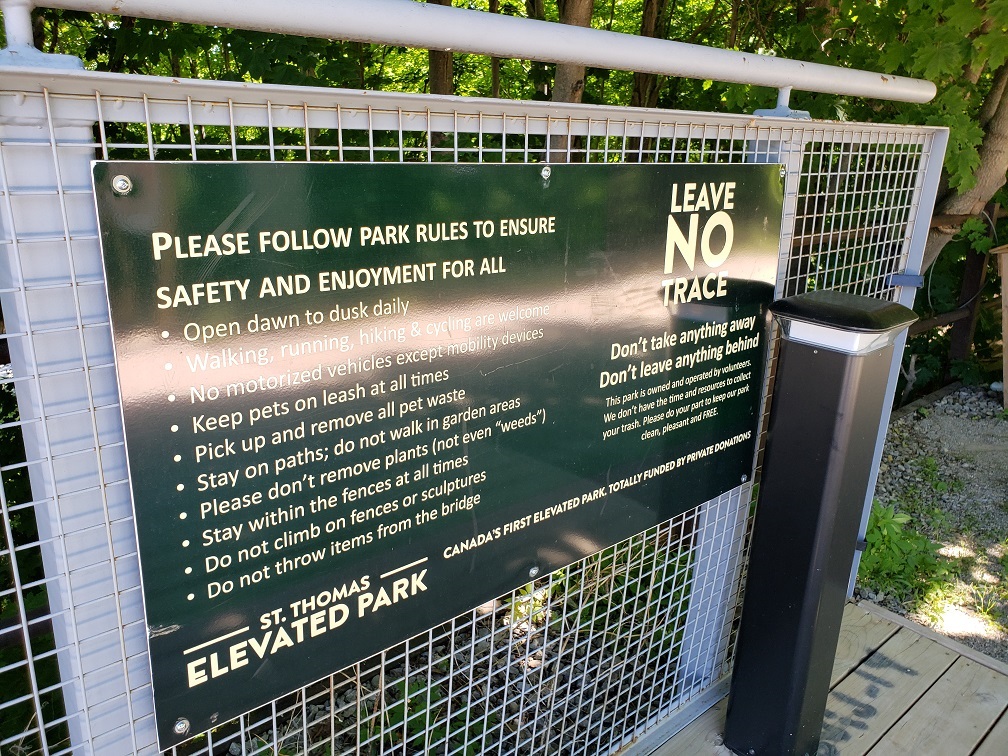
As I would discover, what I was seeing was the St. Thomas Elevated Park. I can guess that it might have been inspired by the success of the Highline in New York City, but this park reaches heights (thanks to the depth of the valley) that the Highline can only dream of.

To reach the park when coming south from Highway 401 and London, along either Sunset Drive or Wellington Road, exit along Talbot Street from the roundabout in the valley. 
 
 
You can't miss the exit, largely because of this distinctive and eye-catching sculpture by Scott McKay in the middle of the circle.


At various times, as many as 26 different railway companies have served St. Thomas. It's no wonder that the municipality brands itself as "The Railway City!"

Driving up the long hill out of the valley, you will turn right at the top onto Stanley Street, and then -- after one full block -- right again onto Centre Street. On the right hand side, 2 blocks along, is the gravel parking lot. Follow the gravel walking trail out of the lot and you will quickly find yourself on the dead-level and ruler-straight railway right of way. This was the route of the Canada Southern Railway (later owned by Michigan Central) which ran from Niagara Falls to Windsor, and -- at one time -- even briefly hosted an Amtrak train using the route as a shortcut from Buffalo to Detroit.
 
 
It takes about 5 minutes to walk from the parking area along to the bridge proper. Here's how it appears as you approach it.


The trestle was wide enough for two tracks to cross at once, so there's ample room for the path -- whether boardwalk or concrete -- to veer from side to side, with numerous park benches interspersed among a diverse collection of intriguing public sculptures.


In the last picture of that group, you can see a strip of unpaved gravel cutting across the concrete paved walkway. The gravel is on top of the expansion joint, a necessary feature of any steel bridge as the metal of the bridge's supporting structure will expand and contract with changes of temperature. If the walkway were paved right across the joint, the paving would quickly crack and break up as the bridge flexed.

At the midpoint of the bridge is this intriguing piece.


After painfully transcribing with the help of the internet, I came up with the line of letters which you see above as my reading of the Morse Code dots and dashes on the plain metal strip, from top to bottom. Each of the plain metal strips has a string of dots and dashes, but unless it's some kind of coded message I would assume it's purely a random assortment of letters. However, it does remind us of the "good olde daze" when railway companies transmitted messages up and down the line by Morse Code dots and dashes sent along the trackside telegraph wires.
 
Not far away stands a historic relic: a masonry milepost from the old railway line. The letters "N.F." strongly suggest to me that this was Mile 117 on the Niagara Falls Subdivision. Unlike major highways, the mileposts on a railway in North America begin numbering from zero again each time the line enters a new subdivision of the system.
 

As you reach the western end of the bridge, the Elevated Park comes to an end but the railway trail keeps going and going and going.... It's part of the Trans-Canada Trail system and, although I don't know for sure, I wouldn't be surprised if the trail sticks with the old railbed all the way to Windsor.


The meandering walkway across the trestle allows for lovely views on both sides of the river valley below.


Several of the artworks, as you undoubtedly noticed, were commissioned by such service clubs as Kinsmen, Kiwanis, and Rotary. As the dedication signs at the eastern entrance to the bridge make clear, this entire project was one hundred percent funded by private donations from organizations and individuals in the community. But note also the laconic statement: "Canada's First Elevated Park."
 

Quite an achievement, in this day and age when so many "experts" lament the demise of community spirit and volunteerism. Congratulations to the people of St. Thomas for joining forces and creating such a fascinating community public space!
 
My entire walk from the parking lot to the far end of the bridge and return took about 25 minutes, which included stops for pictures and to admire the views.


Wednesday, September 9, 2020

Travelling in the Age of Covid-19

It had to happen.  Sooner or later, my itchy feet were going to combine with Canada's relative success in containing the coronavirus outbreak.  Yep, that's right, folks -- he's hitting the road again.

I'll get up to where I'm going and what I'm doing in the next post.  For this one, I just want to share some first-person experiences of the business of getting around during this pandemic.

First and foremost.  Masks.  I'll say it again.  Masks.  MASKS.  

Everywhere you travel, the message is the same -- masks must be worn in airports, in hotel public spaces, on planes, on trains.  Also, bring your own hankies, sanitizer, wipes, magic amulets of chocolate dipped in a protective layer of carnauba wax* -- whatever makes you feel better.

And for further assurance, be aware that your hotel room, your aircraft, your restaurant table and chair, and everything else in sight have been thoroughly -- obsessively -- cleaned and sanitized.  Hotels usually put a room through this entire process and then leave it to rest for a day or two, or even longer, before renting it out again.  Airlines make use (among other techniques) of electrostatic sprayers, which add a slight electrical charge to the mist droplets of sanitizing fluid so they will migrate to and cling to all surfaces, even in hard to reach areas. 

Second key point: be ready to adjust and change your plans, and just roll with whatever happens.  Make sure that whatever travel arrangements you make are refundable, just in case.  Since I started booking this trip a few short weeks ago, I've had changes in flight schedules, in aircraft types, switched hotels several times -- you name it.

One of the biggest frustrations was the whole business of trying to find out which services were still being offered by which hotels.  Some have the restaurants open, but only at dinner time.  Some offer a grab-and-go counter food service, but only at certain hours.  Health clubs and pools may or may not be available.  Spas are even less likely to be open.  Room service?  Maybe yes, maybe no.  The complimentary breakfast buffet you used to get?  Not a chance.  The best you can hope for in the free-breakfast hotels is likely to be a limited selection of individually packaged food items like cold cereals, yogurt, and muffins.

Finding out what's what will be especially aggravating for the online generation because only some hotels in some chains post any information like this on their websites.  Just trying to find where that information is hidden among the numerous indexed pages would try the patience of Job pretty high.  At the end of a five-minute search you may conclude that yours is one of the many hotels that give you nothing to go on at all.  Result: if you really want to know, you may need to pick up the phone and call.

To give you an idea, here's a sample from the Marriott chain of a hotel page (not the hotel I'm heading to) which does let you in on the secrets before your arrival, and online.  I've highlighted the link for that kind of advance information.

If your hotel is one of the chains that offer a digital key through their app, use it.  You can simply go straight to your room without any need at all to stop at the front desk on arrival.

One of the big differences of the Covid-19 hotel stay is: no daily housekeeping.  If you're only in for a night or two, don't expect to see the housekeeper at all.  Any hotel room supplies that need replenishing can be ordered by phone from the front desk and will be dropped off outside your door.  I dare say most people would prefer this contactless model at this time.

A notable exception to this kind of stripped-down hotel experience is found in the major resort which is going to be the centrepiece of my trip.  The concierge office emailed me 2 weeks before my arrival date, giving detailed information about which facilities and restaurants on the property would be open, and on what terms and conditions.  The message also provided email addresses to confirm reservations for the health club, indoor pool, and all eating venues.  And, pointedly, the email reminded me that these reservations were essential due to the need to restrict capacity in all facilities and restaurants.  They even sent the email a second time at one week before my arrival, just to make sure.

This property doesn't have digital keys.  Instead, they offered an online advance check-in by email, which allowed them to pre-authorize my credit card before I arrived.  At that point, I just had to pick up a key card on arrival.

Now, the flying part.  Yes, it's too far to drive -- and that's all the hint you're getting!  

Unlike the hotels, Air Canada and other airlines have plenty of information available on their websites about changes in their normal services during the pandemic.  My own personal precaution was to take a flight in business class, using my Air Canada Aeroplan reward points (no, I still can't afford to pay cash for business class travel!).  The point here, of course, is that a larger seat with more elbow room is guaranteed and every little bit helps.  As it turned out, I had the twin seat to myself on the outbound flight.

One of the great perks of business class travel is getting access to the airline's deluxe lounge before your flight.  Air Canada's Maple Leaf Lounge in the domestic departure area at Toronto had just reopened a few weeks before my trip.  The biggest change here was the need to order food from your seat in the lounge, and have it delivered to you by lounge staff.  Ordering was simple: just point your phone's camera at the QR code on the table, and you get access to the food menu and the ordering website.  For drinks, you can walk up to the bar, where a bartender will serve you.  No more self-serve over-pouring with the wine.  Sigh.  The other huge change was the all-but-empty lounge, even with over half the seats taken out.


Going through the check-in and security processes at the airport included some interesting new and different wrinkles.  To make it all simpler, it is more critical than ever before to check in online from your phone, via the website or the airline's app, up to 24 hours before flight time.  Then you can get your boarding pass, and scan the QR code at the check-in kiosk which will then automatically print out your baggage tags.  The baggage drop-off belts have automatic scanners which read your baggage tag's bar code before the sending the bag on.

I could certainly have done that entire self-serve check-in with no human contact.  But on the other hand, having gotten a Business Class ticket, it would be a shame not to take advantage of the special premium check in area at Toronto.  And that was just as un-busy as all the rest of the terminal.  Actually, the whole airport was so empty that it made me feel like I was travelling on the day after the apocalyptic climax of a Hollywood disaster blockbuster.


Before entering security, I had to have my temperature scanned by an infrared camera, and inside the security area I had to scan my own boarding pass before preparing my bag to go through the x-ray.

Nothing sums up the whole difference of pandemic travel as much as the fact that my flight, originally scheduled with a 300-seat widebody jet, was operated with a 140-seater instead -- and went out barely half full, if that.  At least that meant that boarding happened very quickly.  At the gate, I handed my boarding pass and photo i.d. to the agent sitting behind a plexiglass barrier, and then had to pull my mask off my face for a moment so she could verify my identity.

Immediately after boarding, each passenger got a Clean Care + amenity kit with a half-size water bottle, a mask, a small bottle of sanitizer, a couple of sanitary wipes, gloves, an audio headset, and a packet of pretzels -- the go-to snack on Air Canada for years beyond count. 


During the first months of the pandemic, when the need to flatten the curve was paramount, there was no cabin service except for that water and snack.  If you wanted any other food or drink, you'd have needed to bring them aboard with you.  Now, there is a simplified cabin service in business class on domestic flights over 2 hours time, with a boxed cold meal curated by Antonio Park, one of the distinguished chefs on the airline's roster.  Here's the business class menu from my flight.  The meal wasn't outstanding but it was pretty decent -- considering the handicaps of trying to present a decent meal experience inside a box and in a series of disposable containers, while maintaining safety and health.  The best part was the appetizer -- the smoked salmon salad.

Economy passengers will have a similar but simpler meal box waiting for them -- but only if they pre-purchase it when buying their ticket, or if their fare includes it.

The business of renting a car went much the same as always, except that when I got to the vehicle it had a sanitary plastic wrapper around the steering wheel, and a sticky attached to the rearview mirror affirming that the vehicle had been thoroughly cleaned and sanitized.

That pretty much covers the details of changes in the travel experience.  The next few posts will detail where I've been and what I've seen.  Stick around for the good stuff!


* * * * * * * * * * * * * * *


* Footnote: "magic amulets of chocolate wrapped in carnauba wax" look like this:


Carnauba wax, by the by, is an extremely hard natural substance coating the leaves of a species of palm tree that is native to the northeastern part of Brazil.  It's used to give the M&Ms (or Smarties, or any other candy with a hard shell) the glossy finish on the coating.  It's also used in prescription and over-the-counter medications to make the surface of tablets/capsules smoother and therefore easier to swallow.


Sunday, December 29, 2019

Seasons in the Sun # 6: My Princess Cruises Top Ten

This year's Caribbean cruise is now in the history books.  I'm staying on in Florida for another week, but I've already thoroughly covered the areas I'm visiting in previous trips, so I don't expect to be doing any more blog posts on this trip.

Instead, I decided to answer a question that several people have asked me in recent months:  why do you cruise only with Princess Cruises, and no other companies?

The simple answer to "why no other companies" is that Princess Cruises are such a perfect fit to my personal style and comfort zone that I see no real reason to try anyone else.

If you're planning on cruising, it's important to be aware that every major cruise line has its own distinctive style.  While there are some common aspects to all cruises, there are many more differences which become apparent as soon as you try them out.

If you're thinking of taking a first-time crack at cruising, I strongly recommend that you spend a lot of time on this website:

You can make much better decisions about the cruise you want after reading reviews by other travellers, and reading the detailed editorial descriptions posted by the Cruise Critic staff of the different cruise lines and their assorted vessels.

I'm not the person to give you that kind of detailed overview of the industry, since I have never cruised with any other ocean cruise line but Princess.

So, instead, I'm going to give you the top ten reasons why a Princess cruise is my favourite.

[10]  Stateroom Decor

Princess staterooms are almost always decorated in light earth tones.  This may not sound like a big deal, but earth tones always put me in a good mood and too much blue drags me down a bit.


[9]  Unique Itineraries

Princess has some pretty intriguing itineraries with some unusual ports.  I think in particular of a transatlantic cruise four years ago which sailed from Rome to Miami, stopping at Genoa (Italy), Nice and Sete (France), Barcelona (Spain), Gibraltar (U. K. Overseas Territory), Madeira (Portugal), Bermuda (U. K. Overseas Territory), and finally Miami.  And then there was my cruise up north to Spitsbergen, on the edge of the Arctic Ocean.  My friend Mark still hasn't forgiven me for getting there ahead of him!  This map shows all the places I've cruised with Princess -- so far.  Don't miss the little loop around Tahiti and French Polynesia, out in the middle of the Pacific Ocean!


[8]  Fantastic Meals

Princess has great food.  Sometimes it's the little details that count.  The Princess breakfast buffet always has a number of foods that are special favourites of mine: smoked cheese, English bacon, half a dozen different kinds of bread rolls, and a great spread of smoked salmon with all the trimmings among the more conventional offerings.  In the evening, the main dining rooms have one unique dish created by celebrity chef Curtis Stone on every night's menu (along with a dozen other selections). Among the multiple dessert choices you'll find some incredible chocolate creations, courtesy of renowned patissier Norman Love, which are just to die for.  And the specialty Italian and steak house restaurants on Princess would give many land-based places a serious run for their money.  Yeah, I know I'm not supposed to eat a lot of that stuff (fats or sugars or both) but sometimes a man's just gotta do what a man's gotta do.

[7]  Top Quality Entertainers

Princess has great entertainers on board.  It's not just the production shows, which actually don't interest me that much.  It's the individual and duo acts, and Princess has a real knack for sniffing out classy and truly gifted musicians, and then getting them onto their ships.  It works for me, because I'd far rather sit with a drink listening to a top-notch vocalist or instrumentalist than watch a big, razzle-dazzle stage show.  To each their own.


One of my most unforgettable moments came when I booked an Alaskan cruise a couple of years back and then found out, less than a week later, that a former student from the school where I taught was going to be one of the onboard musicians!

It might surprise some of my close friends and family to know that my favourite performers aren't always the classical-music types either.  Some of the best shipboard artists I can recall have been duos with a keyboard or guitar player and a singer, or solo acts, in which the singer performs with such a uniquely personal style that she/he makes each song, even the covers, wholly their own.

[6]  That Italian Ambience

Princess has something of an Italian ambience.  Over the years, the ships' captains and chefs have often come from Italy.  But I'm referring here more to the design of the public spaces.  The main dining rooms of many of the ships have a distinct Italian feel to the space.  Even more this is true of the specialty Italian restaurant on most of the ships, Sabatini's.  At least one ship I sailed on had actual fountains outside the windows of Sabatini's, floodlit blue at night.  Most of all, it's about the Piazza, the elegant, multi-storey atrium amidships which tries -- and to a fair degree succeeds -- in evoking the atmosphere of Italy.  And what's not to like about Italy?


[5]  Cabin Size and Layout

Princess has good cabins.  I know, that's kind of subjective.  But a few years back, I was considering two other cruise lines as possibilities (the guilty parties shall remain nameless).  Their mini-suites or junior suites were smaller than the ordinary balcony cabins on Princess.  Nuff said.  By the way, I knew about the sizes because all those lines posted detailed cabin descriptions with square foot area of the cabins on their websites.  You can find out a lot about a cruise ship just by researching what the company has published about it.  A Princess cabin has well-planned space, with enough room to unpack all that you need. 

[4]  Shore Excursions

Princess has intriguing shore excursions.  I know, some experienced cruisers swear they would never take a cruise company excursion, but some of the Princess offerings just aren't out there on the open market.  That's particularly true of some of their more unusual tours and experiences that are co-branded with the Discovery Channel.  It's an aspect of the line that frequently wins awards.

[3]  The Princess Bed

This company has gone to great trouble, consulting extensively with expert sleep physiologists, and the result is an incredible bed which ranks as one of the two or three most comfortable beds I can ever recall sleeping in through my entire life.  And with all the travelling I've done, I've certainly hit far more than my fair share of different beds!

[2]  The Princess OCEAN Medallion

I still haven't given this thing a thorough test drive, but even the little I have done with it convinces me that this is the wave of the future (pardon the pun).


On this last cruise, my check-in and boarding after getting through security took all of 5 minutes with the Medallion and my room was ready for me just a few minutes after noon.  The best OCEAN Medallion trick is that the sensor by your cabin door detects the Medallion's approach and unlocks the door for you -- but only if the person approaching the door is the one whose photo is on file as being linked to that Medallion.  Thinking back on the days when I sometimes had to put stuff down and then swipe the damn key card three or four times to get the door to open, I think this is their greatest innovation.  It's also your payment device for all on-board purchases.  No more swiping cards and signing bar bills.  You just tap the Medallion on the point-of-sale terminal, and done.  And the seller sees your photo on the screen, so they can verify that it is actually you making the purchase.  The entire OCEAN Medallion system will be up and running on all Princess ships by the end of 2020.

And the big # 1 reason why I love Princess cruises so much is....  (drumroll, please)....

[1]  The Princess Vibe

How do I define that?  My feeling is that, even with scads of activities all around the ship, the essential character of Princess is that it's laid-back and relaxing.  The ships are well-provided with places suited to just sitting and letting the world go by, if that be your wish.  These range from quiet little bars to the library to the adults-only pool which doesn't offer music or shows to the ocean-liner-styled wooden deck chairs on the sheltered promenade deck or the big, comfy armchairs in the Piazza, and many more.  It's a nice blend of the "classic cruise" feeling with a more casual, modern atmosphere.  Other ships have more high-tech spectacle and hyperactivity, but Princess always has a selection of quiet little nooks for those times when I want to sit and watch, and think, or just tune out.

And I haven't even touched on the loyalty benefits available to multi-times repeat cruisers on this line.  Suffice it to say that, just as with the airlines and hotel chains, the loyal traveller gets enough perks to make it well worthwhile to keep coming back.  I figure the perks on this last 10-day cruise probably added up to $300 or more of freebies, and that's not even including the upsell bargain on my mini-suite cabin.


Thursday, September 27, 2018

Rail Travel in Europe

Another "helpful hints" post about the mechanics of travel by rail in Europe.
If you are already familiar with the subject, feel free to skip this one.

As I come to the end of my epic-length European trip, I find that I have learned a lot of important lessons about travelling by train in Europe.  Some of these things I mastered when much younger, and had forgotten, some of them are new lessons to be considered.  My comments are based on the idea of an extended trip involving a number of train travel segments.

My key advice can be boiled down into five main points:

[1]  Get a Rail Pass

The time you will save, as opposed to trying to buy individual tickets for each trip, will please you almost as much as the money you will save.  There is such a diverse range of travel pass products available now that it's almost foolish not to buy one.  Of course, there is the classic Eurailpass, but under that umbrella name there are numerous variants based on limited groups of countries, set or flexible time periods, and so on.  Many individual countries also offer their own national passes.  As my experiences in Switzerland clearly show, the national pass there covers even more travel options than the Eurailpass.  It's a point to check for whichever country you are heading to visit.

I bought an 8-days-in-a-month Swiss Travel Pass, and it had more than paid for itself before my sixth day of travel was over.  

Research is key.  Be sure to read all the fine print relating to whichever pass you are thinking of buying.  I didn't follow my own advice, and ended up paying almost $100 more than I needed to pay for one train route, simply because I didn't read that I could have gotten a discount on it with my Swiss pass.  Ouch.

Passes are almost entirely limited to travellers from outside of Europe, who must purchase the pass before they leave home.

Key point: the Eurostar trains through the Channel Tunnel between the U.K. and Europe are not covered by Eurailpass or any national pass.  That trip you have to book and pay directly through Eurostar.

[2]  Go First Class

A lot of people will just say, "I can't afford that."  Actually, in Europe, you probably can -- the fare difference is nothing like as great as one might expect in air travel.  The difference?  Trains generally have 4 seats on a row, 2 each side of the aisle, in second class, and three seats, 2 and 1, in first class.  Bigger seats, more leg room -- these you would expect.  The really big difference comes when you realize that second class often fills right up all the way, and then some.  Do you really want to spend three or four hours of your holiday standing in the aisle of a train because there are no seats available? 

First class rarely, if ever, fills up.  Euro trains love seats which face each other across a table.  On 27 train rides, I had a vacant seat opposite me on all but 5 trains.  On 2 of those 5, I had an airplane-style seat with a seat back in front of me.  Some trains also offer at-seat service of snacks, drinks, or even meals (depending on the travel time) if you are in first class.  Second class, you are most likely leaving your seat and walking how many cars to the buffet -- or lugging all food and drinks for the trip on board with you.

Another key point: many European trains have nowhere near enough space for baggage, as most passengers are making short local trips for only a day or two.  First class has fewer people competing for the limited available space.  Moral: arrive at the station early, and be ready to board as soon as the train arrives -- your chances of snagging baggage space are better.  And in first class, your chances are much, much better.

[3]  Reservations

Many trains require reservations.  Required!  No res, no travel.  This applies to popular tour trains like the Glacier Express, to most international trains, and also to virtually all high-speed train routes like the French TGV, the Eurostars through the Channel Tunnel, the Thalys, the German ICE, and others.  Some of these trains now have three classes of service, an added complication to life with a pass.  Again, read the fine print.  Reservations sometimes (not always) come at the cost of a reservation fee, which is additional to either your basic ticket price or your pass price.  The reservation fee does not upgrade your second-class pass to a first class seat (I saw one guy get evicted from a train for trying to argue that point and refusing to give up).

I booked tickets for this trip through a U.S.-based company called RailEurope, but I don't think I will go that route again. It seemed easy enough to get all my reservations and my pass through one source. But there were problems. The RailEurope system didn't include many stations, and also had less than complete information about trains and routes that were available. In reserving seats, I got much less favourable seat assignments than other passengers who booked directly with the train operators in Europe, even though they reserved long after I did.

I would have done better to make my reservations using the websites of the various railway companies, all of which have full English-language versions of their websites.

[4]  Schedules

Train schedules in Europe are clockwork-precise in many countries, and beautifully interwoven so that a change of trains rarely requires you to stop for any longer than 30 minutes -- and often much less.  So precise is the planning that the German railway, Deutsche Bahn (DB), actually hands out leaflets on their major inter-city trains which give the timetable of the train, and also list all connecting trains at every stop, complete with the numbers of the platforms where those trains will board.  In every station, you will find video display boards like those in an airport, listing departure times and the main destinations of each train.

[5]  Take the Train, Not a Car

I would never rent a car in Europe unless I had to travel in an area which doesn't have trains.  It doesn't matter that the German Autobahn has no speed limit (except when it does), when the German Inter-City Express train can cruise all the way at 300 kilometres per hour or more (180 miles per hour).  Even the more normal trains on conventional lines often cruise in excess of 150 kilometres per hour.  Despite those speeds, the real reasons to skip using a car are the crowded streets and growing numbers and sizes of pedestrian-only zones in cities, towns, and villages all over the continent.  Parking can be hard to find in many locations, and expensive.

And then there's the price of gas -- so high it can make you wonder why you ever thought gas was expensive in Canada.  It's a loser's game -- and those are only some of the very good reasons why so many Europeans don't travel by car. The people I really feel sorry for are the ones who rent a car at the airport to drive up to Zermatt -- only to find that they still have to park the car at Täsch and take the train the rest of the way!

Even for day trips, the trains are amazing.  I wanted to go from Zurich to visit the dramatic Rhine Falls at Schaffhausen.  Of course, there's a train station right there, made to order for the purpose.  No, wait -- there are actually two train stations, one on each side of the river.  Visit the northwest bank views of the falls, take a boat tour, then ride the train into Schaffhausen and come back out on the other line to visit the southeast side views.  Easy to do with a pass.

A Couple of Notes:

A special commendation to SBB, the Swiss Federal Railways.  Just as my first Swiss train was leaving Basel, some idiot tried to light up a smoke in the washroom -- with predictable results.  All of us were asked to decamp into the next car, and were glad to do it because of the raucous smoke alarm.  At the next station, police met the train and hauled the idiot away.  Right after that, the conductor came through and gave us all discount vouchers for the inconvenience -- CHF6 or near Cdn$10.  The voucher could be used for travel, or to buy products in station kiosks, or to buy food/drinks on trains, including the Glacier Express -- which is where I used mine.

And finally: European trains are much more modern, quieter, smoother-riding, comfortable, punctual, and easy on the nerves than any passenger trains in North America.  Only one problem: most of the trains have air-conditioning systems, but those systems were having trouble coping with the epic high temperatures which Europe experienced this summer.  Dress lightly -- this isn't going to be an Arctic expedition like so many long-distance air flights.

Tuesday, September 4, 2018

European Epic # 7: Bayern, Bier, und Bratwurst

Overnight between August 31 and September 1, we crossed the border from Austria into Germany and entered the state of Bavaria.  The latinized name of course stands in for the proud German Bayern, and as many readers will already know, this region is famous for its beer and its sausages (see title).  But first we had to get there.

To say that the night of August 31--September 1 was memorable would be an understatement.  For days, we'd all been concerned about the low water levels in the Danube River after a hot dry summer.  For the majority of the passengers, there was the fear that their 1-week cruise would be cut short if the ship couldn't pass through the shallow sections before and after Passau, at the border of Austria and Germany.  

For the 9 of us who booked a 3-week package, continuing on into the Danube-Main Canal, the Main River, the Rhine River, and finally the Moselle River to Luxembourg, there was the distinct possibility that our voyage would come to a grinding halt right here and the rest of the package would be offered as a coach tour -- according to the fine print.

At this point, I have to put this in: I simply cannot say enough about the excellence of the customer service at Avalon River Cruises, and in particular the hard work of our personable cruise director, Sabine.  They have been working as a team, madly calculating and recalculating water levels, booking and rebooking tours and hotels, shifting docking locations and tour times, to try to offer as much as possible of the original package under circumstances which made it difficult to keep offering anything at all.

When it looked like we might be stuck with the coach as an alternative to the cruise ship, this is what they were prepared to offer us:  the entire coach package, with deluxe 5-star hotel accommodations every night, and 3 meals a day, all for no charge.  You read that right.  They were prepared to refund every penny we paid in advance for those 8 nights of the cruise, while still giving us the entire experience as near as they could manage it, beds, meals, tours the whole nine yards -- all for free.  Or, as an alternative, they would simply allow us to end the tour with a full refund for the remaining portions.  Nothing in the terms of contract obliged them to go this far or offer either of those choices.  Now, that's what I call "Customer Service."

Just sign me "officially mind blown," and both ready and willing to sail with Avalon again!

But anyway, back to that memorable night.  There had been some rain, the river had come up somewhat, and even though there "officially" wasn't enough water, the company and captain together decided to give it a shot -- just in case the water levels started dropping again.  Result: we cruised through the night and the morning, travelling from Aschach to Straubing, a distance which got us through all the difficult shallow parts of the Danube River.  Of course, this posed certain hazards -- and as Sabine said last night before dinner, we had to be ready in particular for some noise as we would be "polishing the stones on the river bed" (her exact words) at many locations.  Here's what one stone-polishing area looked like -- broad, shallow, and we were moving very, very slowly as we sailed through here.


We certainly polished a lot of stones.  The noise was considerable, and sounded not unlike somebody scrubbing down the sides of the ship with a pressure washer, but -- WE GOT THROUGH!!!!  And so, the rest of the 15-night cruise is now a go.

During the night, we by-passed Passau -- and Passau is a place that no one travelling in this part of the world should ever by-pass.  So in the afternoon of September 1 we by-passed the by-pass by taking motor coaches back to Passau for our promised tour.  It was about an hour's drive.

Passau occupies a unique spot on the map -- the point at which two tributary rivers, one big, one small, enter the Danube simultaneously.  They are the Inn River, coming from Switzerland and Austria on the south side, and the Ilz River, flowing in from Bavaria on the north side.  In fact, the Inn River actually carries more water than the Danube at this point, but is much shorter -- which is why it's considered the tributary.  With the Inn (courtesy of the Swiss and Austrian Alps) also comes all of the sediment which colours the Danube to its characteristic grey-green hue for the rest of its journey to the Black Sea.

So one of the big sights in Passau is the Dreiflüsseeck, the park at the point of land where you can see all three rivers at once.  I didn't mind hiking down there, even if it was raining, but I was severely enraged when I found the view blocked by a cruise ship on the Danube side moored right at that spot, beside the point of land.  Grrr.  So, in lieu of my own efforts, an aerial internet view to show the three streams all meeting at one point.  If only it had been this sunny and clear when I was there.  Those striking colours in the water were invisible -- it all just looked grey.

http://passauerland.de

It's still a beautiful park right at the confluence, and the shade trees even kept off some of the rain.  I was able to get a couple of pictures once I walked upstream past that annoying cruise ship, of the upper and lower castles on the opposite bank of the Danube, and of the mouth of the Ilz River.


Also of interest -- the unique anchorage point of the suspension cables on the far end of the bridge across the Danube.


The town itself contains the usual assortment of houses, shops, churches, and the like dating from anywhere in the years since 1600.  Passau has a much great-than-usual budget of pedestrian walking areas and several attractive squares.  


We didn't go into St. Stephen's Cathedral (yup, another one!)...


...but we did detour into the bishop's palace where we saw on display the former console of the massive organ in the cathedral -- once rated as the largest church organ anywhere in the world (and now third-largest church organ).  


If anything could bring me back to Passau, it would be the chance to hear one of the regular recitals given on that extraordinary instrument with its 17,774 pipes.  Some day....

Well, that, and some sunny weather.  I have to admit that the rain, as badly as the rivers and farms need it, really took the edge off the day.

After our time in Passau, we returned to the ship which then sailed on to Regensburg.  I awoke to more cloudy skies and cool temperatures, but no rain.  That made me want to get out and walk, and after a quick look over a map, I shot across the gangplank, bent on a good brisk walk.  The Danube here actually splits into four channels, and we were moored in the one closest to the old town.  All I had to do was follow the cobbled walkway along the stone quay until I came to the Gothic-era Stone Bridge.  Built between 1135 and 1146, this bridge had the same effect on Regensburg as the Charles Bridge had on Prague: it turned the community into a major trade centre, a focal point of merchants travelling south to Italy or north to northern Europe, and the local merchants prospered exceedingly.


There'd be no chance for any ships today to squeeze in between those massive piers.  Fortunately, the fourth or northernmost arm of the river is actually a canal with a lock.  It's at the far end of the street in the photo above.  I walked across the entire length of the bridge, enjoying views of old houses (now a hotel) spanning the second arm of the river...


… or the third arm dreaming beneath the overhanging trees.


After crossing the full length of the bridge, I came back over again, this time photographing the gatehouse tower at the city end.


I then walked a short distance up into the old town to the majestic Gothic cathedral or Dom towering over everything else.  


In musical circles, this church is famous for the Regensburger Domspatzen (literally, "Regensburg Cathedral Sparrows"), the choir of boys and young men which is the oldest continuing choir in the world.  It was founded in 975 by the then-bishop, has made numerous recordings, and has toured in many parts of the world.

The best part of going out for a morning walk?  By the time the rain starts later in the day, you've had your exercise, seen the sights, and can crawl into bed for a nap with a clear conscience.

By the next morning we had sailed up the river, and entered the Main-Donau canal, which connects the Danube and the Main-Rhine river systems across the hilly height of land between them.  Our ship docked at the small town of Dietfurt, and everyone left.   The terminating passengers took coaches to be driven to Prague for a 3-day add-on package there, while our brave little group of 9 went south to Munich, the chief city of Bavaria, for a day visit.  

Booting south along the autobahn reminded me of two truths.  [1]  It's not always true that the autobahn has no speed limits.  Areas with risky curves, and heavily built-up areas are speed limited and the drivers respect those limits.  Even when the limit is lifted for cars, it still applies to trucks and buses.  [2]  It works because everyone, and I do mean everyone, knows not to drive in the fast lane unless actually passing, and no one passes on the right like the insane lane dodgers in Canada.  Amazing how well a highway works when all drivers, fast or slow, respect the rules and the other drivers.

Although I have been several times to Munich, I was looking forward to seeing it again.  Unfortunately, I had a bit of a run-in with something that didn't agree with my digestion, so that kind of killed any idea of sampling beer and sausages.  Pity.  But I still had a good time, with a mixed driving-walking tour that hit some of the highlights of the city.  

On the way into town we passed the 1972 Olympic Park and saw parts of the roof of the Olympic Stadium peeking over the hills along the road.  The similarity of the design to the German pavilion at Montreal's Expo '67 five years earlier was unmistakable.


We then drove through a richie-rich suburban area to Schloss Nymphenburg, the former summer palace of the Bavarian monarchy.  Like other ruling families across Europe, these royals didn't go on holiday to get away from it all; they brought it all with them.  This picture shows only the central 25% of the huge, sprawling complex.


We then drove on into the centre of the city, and got out for our walking tour.  One of our first sights was the world-famous Hofbräuhaus.  Originally a royal brewery, this huge beer hall is now city-owned.  Historic plaque should really be on the wall: I consumed my first mass (litre stein) of Bavarian beer on this site in 1979.


We then walked on into the Marienplatz (St. Mary's Square), the heart of Munich's historic and shopping district.  Our guide timed things to perfection; we arrived at 2 minutes to noon, just in time to watch the famous Glockenspiel in the tower of the New Town Hall do its thing.


No, that is not a misprint.  This really is the New Town Hall.  It was built in the tail-end of the 1890s, in the then-fashionable neo-Gothic fantasy style.


The Glockenspiel is similarly misleading.  It was built specially for this tower, and inaugurated in 1899.  So the "medieval" look is just more romantic fantasy -- but it's fun to watch as the pages and knights circle past each other, and the dancers twirl around.

At the east end of the square, the 1400s-vintage Old Town Hall manages to look surprisingly modern by comparison.


The Marienplatz is definitely another one of those "people places" that European cities do so well, and the best proof of that is the presence of street entertainers -- such as this mime.


He was posing like a statue, but a statue that often winked at passers-by, tapped them on the shoulder with his cane, stuck out his tongue, waved coyly at little children, often successfully catching people by surprise and making them jump or shriek.


He was also posing for photographs with anyone who wanted one.


A split second after the camera took the picture he tried to tickle my chin, but I was expecting something of the kind after watching him doing his thing for 3/4 of an hour.  Best street show I've seen in a long time!

On the way back to the bus, we detoured to the city palace of the Bavarian royal family, the Residenz, and the adjacent Munich Opera House.  Like much of the city centre, this building was reduced to smoking ruins during the saturation bombings of German cities in World War Two, and then lovingly rebuilt after the war.


All the time this was going on, our ship was sailing north without us through the Main-Donau canal, trying to get caught up on all the time we lost earlier.  We were taken by coach to Nurnberg for a hotel night, and then the next day we drove on north to Bamberg at the north end of the canal.

By the way, the cruise company did promise us each a refund for the unexpected one night in the hotel instead of on the ship.