Showing posts with label hotels. Show all posts

Saturday, March 9, 2024

Sunshine Supertrip # 1: The Cat's Out of the Bag

 Okay, folks: with this picture, the cat is officially out of the bag.
 
Holland America Line photo.
 
This is Holland America Line's flagship, newest and largest vessel in their fleet, the Rotterdam. And, yes, I am currently on board and off on another adventure.
 
This was the cruise I booked for myself after my December cruise on the Rotterdam had to be cancelled because of illness. This time, too, I was afraid illness was going to do the plan in, but this virus proved to be an exemplar of good taste, doing its dirty work and then exiting with commendable haste. And here I am, on the high seas again.

Once again, I have opted to travel down to Fort Lauderdale for embarkation via Montreal rather than on a nonstop flight. The reason is simple. Flying nonstop from Toronto with Air Canada during the winter, you either have to get up at 3:00 AM to catch the morning flight, or you have to arrive on the later afternoon flight after dinnertime. Going via Montreal takes longer, but you leave at a more civilized 9:00 AM and still land in Fort Lauderdale just after 5:00 PM.
 
First piece of advice: never, never fly to board a cruise on the day the cruise is leaving. Between weather, crewing issues, mechanical glitches, air traffic control backups, and so much more, the odds are getting longer and longer every year. Go the day before and you don't have to worry.
 
To prove the point, look what happened to my perfectly planned day before this cruise. I arrived at Toronto airport at 6:35 AM, ample time for a 9:00 AM flight to Montreal. And then I waited and waited and waited.... At 10:15, the flight was cancelled due to a mechanical problem. At 10:55 I got to the customer service desk after waiting a while in line. The agent was soon able to rebook me on the last direct flight from Toronto to Fort Lauderdale that night, since there was no way I was going to get to Montreal in time for the reserved flight. I paid no extra money for the rebooking, but took a massive kick in the value equation by ending up in a regular economy seat on Air Canada Rouge when I had booked and paid for Premium Economy on Air Canada mainline. Such are the perils of travelling at the peak of March school breaks. Since this flight too was delayed, it took until about 2:00 AM on Friday to get my bags and get to my hotel.
 
For the night-before-cruise stopover for those flying in, this hotel is a good bet. It has a free on-request shuttle 24/7 to and from nearby Fort Lauderdale Airport (even when arriving in the wee hours), a paid shuttle to and from the cruise ship docks (by reservation), and a decent restaurant on site for dinner and breakfast. This is the Crowne Plaza Fort Lauderdale Airport/Cruise Port.
 
 
The first four floors of the building are a parking garage. The fifth floor up holds the lobby, restaurant, bar, meeting rooms, and the outdoor pool. Then the six storeys of guest rooms begin above that point.
 
 
The restaurant is rather more straightforward than elegant, but has a more diverse menu than many hotel restaurants I have used in the past. The breakfast buffet is decent but not super-impressive, and the cost of the buffet at this writing is US$20 plus tax per person. With that number in mind, you may want to consider getting a breakfast-included rate.
 
Once I got to the dock, the check-in process took 20 minutes, and then I sat for perhaps 30 minutes more  in the large waiting area for my numbered group to be called to board. Since this was now just a few minutes before 1:00 PM, the rooms were available. Once I did get into my room, the rest of the day passed with unpacking, a time out to watch the video safety briefing, and then a quick walk upstairs to the theatre to show that I knew how to find the muster station for emergencies. 
 
By this time, I was decidedly hungry, and headed for an old favourite from my cruise on sister ship Nieuw Statendam last year: the Grand Dutch Cafe. And here's my light lunch:
 
 
For those not familiar with traditional Dutch snacks and light lunches, this is a Broodjekroket, which means a hot croquette on a crusty bread roll. Broodjes of all kinds were a huge deal in Amsterdam when I first went there in the 1970s, and even though the once-ubiquitous chain Broodje van Kootje is no longer in existence, there are other places selling them , and the croquettes here on Holland America are just as good. This one, by the way, is a vleeskroket, a croquette with a creamy filling of finely minced veal. The cappuccino is in a league of its own, made with rich, dark coffee from Rotterdam which would only be ruined by adding any kind of sweetening. The lunches and snacks (and the desserts) at the Grand Dutch Cafe are included in the standard menu, but premium drinks like cappuccino are surcharged. And notice the frequent use of the Dutch national colours of orange and dark blue.
 
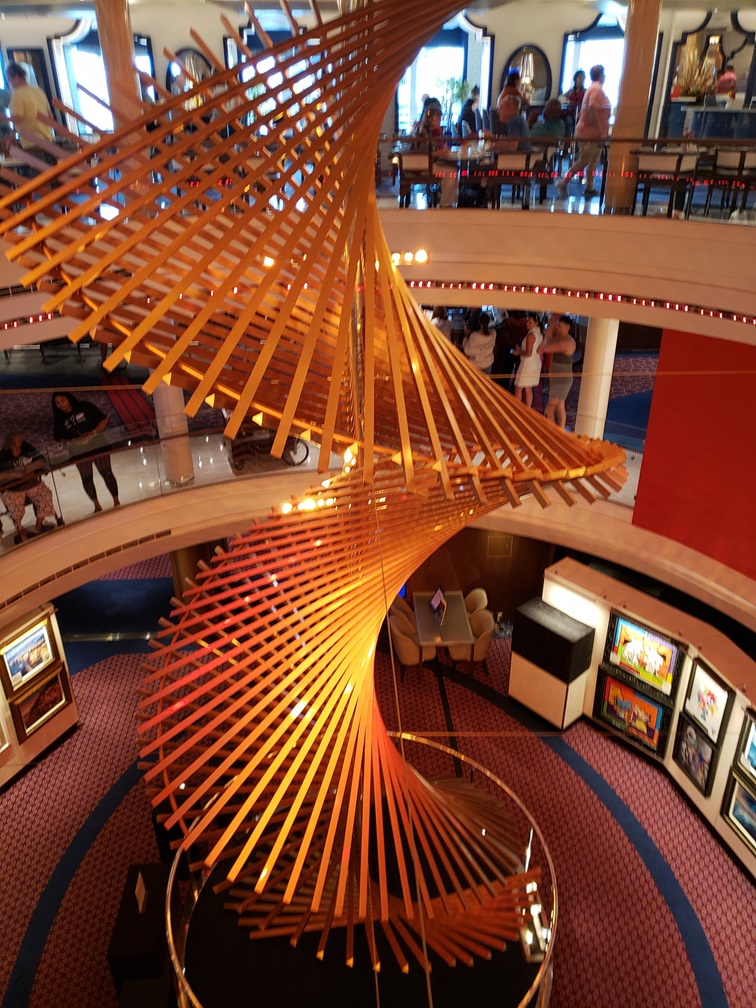
The Cafe is on Deck 3, overlooking the atrium. The tall sculpture in the atrium, unlike the massive piece on Nieuw Statendam, allows you to see the atrium around it!


After all of that, a tipple of prosecco from the minibar in my cabin was just the ticket to celebrate going to sea again. 
 
 
Just as I was about to pour it, my steward arrived with my big suitcase. A good thing, too, as the bow thrusters were fired up in preparation for departure right after he left. I'd be worried if my bag hadn't arrived by the time the ship sailed! And here's the view from my window as the ship pushed sideways off the dock, before gliding smoothly forward and out to sea.


The cabin I'm in is one of the dozen single cabins which can be found on Rotterdam, and on the almost identical sister ships Koningsdam and Nieuw Statendam. It's on the lowest passenger deck, all the way forward, and with a window for the sea view. Look at the picture of the ship above. You can see a row of windows just under the inscription of "Holland America Line" on the hull. My cabin is the third one back, but on the other (starboard) side.
 
Here's what it looks like. Yes, it's a full queen-sized bed as in any of the standard staterooms, but due to the smaller size of the cabin the bed has to be pressed against the outside bulkhead. These cabins are located where the ship's sides are curving in towards the bow, hence the deep well in the wall containing the window, and the decision to market them as singles.


It's a smart move. More and more singles are cruising every year -- many of them, like me, widows or widowers. Cruise companies are belatedly realizing that it's a bit of a dirty trick to force single travellers to pay a full double fare, as most of them do if you take a normal cabin. What percentage do you actually pay? That depends very much on the itinerary and the time of year. For this cruise, it was about 160% of the normal adult fare when two are sharing. 
 
The next question, on a Caribbean cruise, is naturally about the outdoor recreation spaces. Rotterdam has the new essential of the modern resort and cruise trade: a pickleball court which can be reserved for time slots throughout the day. The ship also has two pool areas. This is the midships Lido pool. It is equipped with a sliding glass dome which can be opened, as here, or closed. 


The Seaview Pool, at the stern, is my favourite -- it has much better sun exposure, and the best feature of all: signs at every entrance proclaiming it "Adults Only Pool." That fact alone tells you a great deal about the typical Holland America cruiser. 
 

Rotterdam is every bit as dramatic a floating art gallery as her older sister, Nieuw Statendam. One of the joys of cruising with Holland America is the huge and diverse range of artistic riches waiting around every corner -- all of them commissioned from various living artists for this ship (a long-standing Holland America tradition). Here are a few of the intriguing, whimsical, puzzling, or dramatic pieces I've spotted around the ship, in addition to  the big sculpture in the atrium.


There's only one holdover from Nieuw Statendam, and even the twin pieces outside the Tamarind Asian-fusion restaurant have different colours on them.


I'd like to say that the striking, sculptural main Dining Room is the biggest artwork of them all. It never fails to give me a sight to study.


It is identical to the Nieuw Statendam, as far as I can see, but how did I ever miss the impressive sculptural shape of the wine cellar, accessible from both decks of the Dining Room?


Well, that's enough about the ship. I chose this particular cruise because it includes four full sea days out of a nine-day cruise, and because of the selection of port calls. There will be more to see and report, and photograph, when we get to that first port in two more days. For now, relax and enjoy life at sea, a true pleasure in its own right for me!
 
Final note: I've made frequent references to my previous experience on Rotterdam's sister ship, Nieuw Statendam. If you'd like read more about that  vessel, and see some more photos of another floating art gallery, here's a link to that post from last year:


Tuesday, February 27, 2024

Out to the Mountains and Back # 1: The Beauty of Life in Kelowna

It's a natural fit. I've loved being around and near mountains for as long as I can remember. Kelowna is a modern city, surrounded by mountains, on the shores of Lake Okanagan in southern British Columbia. When my nephew, Robert Stephen, tells me he's got another commission to create a new work for Ballet Kelowna, that gives me all the reason I need to pack my bags. I had no part at all in making Robert the wonderful artist he is. I'm just extravagantly proud of him, and go to see any of his work whenever I can manage it. Call me a "Robert Stephen groupie."
 
So this trip began with an overnight stay in a hotel at Toronto airport, followed by a morning flight to Calgary and an early afternoon connection to Kelowna. On the main flight to Calgary, I had put in a request for upgrade using my credits, not with much hope, but at boarding time I got the upgrade to the last available seat in the Premium Economy cabin. On Air Canada, this means that the flight is being operated by a wide bodied aircraft, normally dedicated to overseas service. The Business Class cabin has individual pods with lie-flat seats that turn into beds. Premium Economy is not unlike the Business Class on a narrow-bodied aircraft: wider seats (seven across instead of nine), much better legroom, with the same or similar meal offering as Business Class, and free alcoholic beverages. 

That certainly made the flight much easier! The breakfast and coffee were delicious. And then, I walked off the plane in Calgary and my connecting flight was at the gate directly across the hall -- barely fifty steps' walking. Was I getting the breaks that day, or what? The 1-hour flight to Kelowna was on a commuter turboprop with 72 seats, so there was only a simplified beverage service, but that was fine.

I was soon checked into my go-to hotel in Kelowna, the Delta Grand Okanagan Resort. It has a splendid view over the waterfront park to the waters of the lake, especially so when you get an upgrade to a higher floor with the view. The view to the south from my room takes in the huge marina and waterfront promenade. You can also see the outdoor portion of the hotel's pool, the hot tub, and the covered outdoor pool which will be opened and surrounded with lounge chairs  when the warmer weather comes.
 
 
To the east, you see more mountains with snow.

 
The view to the southwest gives a clear sight of the bridge across the narrows of Lake Okanagan. This vital link not only continues the highway southbound down the valley to Penticton and on to the U.S.border, but also leads to the freeway which runs west through the mountains to the Coquihalla Highway, the main route of the Trans Canada Highway towards Vancouver.


The resort has a lovely indoor-outdoor pool, plus a sizable outdoor-only pool which will open in warmer weather. There are indoor and outdoor hot tubs, although the indoor one was out of order. I'm not surprised. So many hotels are pulling the things out altogether. They're a royal pain in the you-know-where to keep running because people keep dumping drinks and food into them, "by accident" of course, and clogging the jet pumps. Nor does it help when people decide to bring the shampoo and wash their flipping hair in the hot tub! Yes, it happens.
 

As soon as you step out the door of the hotel, you see this view across the lagoon towards the mountains on the far shore of Lake Okanagan.
 
 
The hotel also looks impressive when looking backwards from across the lagoon in the park.
 
 
I did a lot of walking in that park, and along the waterfront walking path as a whole. Yes, the weather was a bit chilly, but with hardly any wind, the outdoor walking was a delight. Here are a few pictures of the outdoor park area north of the hotel. 

 
On top of a small hill in the park is this artificial spring, which feeds two small streams tumbling downhill over rocky beds into the lagoon. 
 
 
A panorama of the lake and mountains from the slopes of that small hill. 


The trees show fascinating sculptural silhouettes in winter when stripped of vegetation.


What looks like clear, calm water at a first glance proves to be a very thin skin of new ice with an equally thin layer of liquid water lying on top of it. The true open water is riffled by the breeze.


At noon on my first full day, I walked north a bit from the resort, and at the first bend in the road found this impressive and evocative sculpture.
 

In another couple of blocks, I came to the Train Station Pub. I ate there twice, and highly recommend it as both meals were fantastic. So was the service. Here's the exterior of the old station.

Here's a better view of the delightful statue of an old-school train conductor standing on the corner outside the pub.
 

 The interior of the pub shows a thoughtful mix of the old and the new.


In the area south of the resort, there are some further striking public art sculpture installations.


One of them actually appears as a location on Google Maps. "Ogopogo" is the name of the mysterious water beast which lives in the lake. Ogopogo is quite likely a first cousin of the Loch Ness Monster, and like Nessie is lengthy, serpentine in form, and shy to the point of being reclusive. The map label, "Ogopogo Statue", sounds impressive, but the result is better described as whimsical and user friendly.  Parents are always coming to perch their little ones on Ogopogo's back or head for pictures.

 
There's also a sizable outdoor skating rink, and a sunny weekend day like this with the high temperature just below freezing was perfect for skating. 


Just inland from the promenade lies the Kelowna Community Theatre, and here it is from the outside, with the advertising sign for the ballet's production plainly visible on the right. 


Here's a picture from Ballet Kelowna's social media of the cast after the performance of Robert's new work, Mustard, inspired by the play of the same name by Kat Sandler. Robert is standing second from left in the back row. The entire show was fantastic, both Mustard and the other premiere, Delicate Fire, by the company's Artistic Director, Simone Orlando.

Ballet Kelowna photo.
 
The afternoon after the final performance, I flew down to Vancouver. The takeoff from Kelowna's airport showed both an intriguing cloud pattern in the sky and a clear and detailed view of the city centre on the shore of the lake.  


I spent a relaxing night at the Westin Wall Centre hotel near the airport, another location I recommend highly. A top floor room gave a spectacular view over the industrial district near the airport to the majestic mountains on the north shore of Burrard Inlet, including the two angular peaks of the Lions of Vancouver.
 

The next day, I rode the hotel's free shuttle back to the airport and then took the Skytrain downtown, changing trains at the Waterfront station to get out to the Main Street station. From there, it was a short one-block walk to the Pacific Central Station on Terminal Avenue, the point of departure for my trip home.


Thursday, January 18, 2024

The Springtime Escape Part 1: Coastal Cities

It's getting to be very old news, this long spell of cloudy, drizzly, foggy, icky weather which now seems to be the new norm for winter in my part of the world. Once again, it's gotten to be more than I can handle, and once again I've turned to my favourite form of retail therapy to help me out. Travel shopping!

A big part of the problem was caused when I had to cancel my planned holiday right before Christmas due to catching a wicked virus which was likely RSV. Well, I'm over that now. I am so over it, and so over this winter.

This one is a bare bones holiday, less than a week long. In it, I will make a return visit to a favourite area of Florida which I have not visited now for six years, the west coast between St. Petersburg Beach and Clearwater Beach. 
 
"Florida!" I can hear people saying. "Lucky you!" 


Well, yes -- but not perhaps in the way you are thinking. There's a reason why the pool is dead empty on such a gorgeous sunny day. It's because the air temperature was only 8 C (46 F). The weather here in January is more comparable to an Ontario spring than anything hotter. That is actually why I like being here. I can enjoy long walks without getting overheated, and all my favourite restaurants and shops are much less crowded.

So is Tampa International Airport, which remains one of my all-time favourite airports due to its relatively compact design and layout. From Tampa International, you can reach almost any destination on the islands in under an hour of driving. I needed just 30 minutes. Also serving the area is the smaller St. Petersburg/ Clearwater International Airport.

And the pool is heated!
 
The long stretch of barrier islands reaching from Clearwater to St. Petersburg comprises no less than eleven separate and distinct municipalities. None of them have a population greater than 10,000 people, while several have less than 2,000. The smallest is Belleair Shore, which was established in 1955 and has a population of just 109 people. Most of these communities are called "cities" (which I find a bit laughable, given their small size) while a couple more modestly stick to "town." These communities are certainly distinct and distinctive in more ways than just in name only.

To get in between these places you travel north and south on Florida Route 699 (Gulf Boulevard), which is the "main street" of all these island communities. Here are the eleven, in order from north to south. The locations marked with the >< have direct road links to and from the mainland via a bridge or causeway.
 
 
>< Clearwater Beach (including the adjacent island of Sand Key):
 
 This is the high-rise capital of the coast. Much of this high-rise construction has taken place in the last decade, crowding out the older and smaller motels and family-run businesses which used to occupy this island. 
 
The white-and-blue Opal Sands Resort on Clearwater's South Beach was under construction when I last came here. It's appears to be already expanding with not one but two new buildings under construction on the inland side of the beachfront road, a construction site which looks as if it could double or even triple the existing generous capacity of the hotel. That's if all the new construction is in fact part of the Opal Sands. Certainly, one of the two new structures is being connected to the existing resort by a footbridge over Gulfview Boulevard.
 
 
The brand-new and definitely eye-catching Hiatus wraps around and completely overshadows an old traditional Florida eatery, one of the very few survivors of the high-rise building rampage: Frenchy's South Beach Cafe. 
 
 
The huge pink Hyatt Regency and the Wyndham Grand just beyond it are also fairly new arrivals. 
 
 
The beach itself is a broad expanse of fine sugary sand, which is well known for becoming airborne and drifting like snow on windy days. The city has to use heavy equipment to get the sand under control on the parking lots which serve the beach area. Even on a cold, windy January day, you'll always find a few people determined to enjoy the beach, and the sizable Pier 60 Clearwater, while they're here.


Clearwater Beach is the place you should come, not to get away from it all, but if you want to find it all waiting here for you. And the prices certainly reflect that fact.
 
 
>< Belleair Beach: 
 
This town is more devoted to private homes than to visitor accommodations. Gulf Boulevard gets a bit wider here, and there are attractive grassy boulevard strips of land between the street and the sidewalks.
 

Belleair Shore:  
 
This municipality with just 109 residents occupies only the ocean side of Gulf Boulevard for a short distance south of the Belleair Causeway, being surrounded on both east and north sides by Belleair Beach. From the look of houses as shown in satellite photos, the residents here are 109 very wealthy people, which may explains why they felt they "needed" a special municipality all to themselves.
 
 
>< Indian Rocks Beach & Indian Shores: 
 
A dramatic contrast to Clearwater Beach, Indian Rocks Beach and its neighbour to the south, Indian Shores, show many smaller homes and accommodations, and a diverse assortment of old Florida architecture, with many commercial and residential buildings dating back to the post-World-War-Two era or perhaps even earlier. Very picturesque. Note that the road through both of these communities is narrow and crowded to the extreme with limited or no shoulders or sidewalks. Vehicles making deliveries have to stop pretty much right on the road since there's nowhere else for them to go. Drive slowly and with much caution!


Redington Shores: 
 
Suddenly Gulf Boulevard blossoms to four lanes wide, and stays that way. While some high rises appear in this area, most of the tourist accommodations (far more condos than hotels) are in the area of six or seven stories high. These buildings line the ocean side of Gulf Boulevard almost without a break anywhere.
 
 
North Redington Beach: 
 
This area is a little bit less built up, but with similar sized buildings, as well as a number of older and smaller ones. This area is the home of my favourite Florida hotel, the Doubletree Resort North Redington Beach. It's currently closed for renovations, but due to reopen in a month or so. The major change visible from outside is the new pale grey paint. The building used to be painted all in a pleasant shade somewhere between orange and pink, which can still be seen on the balcony dividing walls. The biggest advantages of a small hotel like this one versus the high-rise giants of Clearwater Beach: [1] the staff get to know you and vice versa. [2] In the beachfront rooms you can hear the sound of the ocean rolling up onto the beach with no trouble, especially at night. There is no more soothing sound to help you get a relaxed, refreshing sleep. I can't wait to stay here again!


Redington Beach: 
 
This one is more or less a continuation of North Redington Beach in appearance although perhaps with less high rises.
 
 
>< Madeira Beach: 
 
The condos are getting bigger now, and the shopping is getting a bit more diverse. This view is taken from the crest of the Tom Stuart Causeway looking west. It shows how the areas east of Gulf Boulevard are often built up into a series of "fingers" of land with channels of water in between them, so that homes can have a garage in front and a dock in the back for every house.


As in almost any one of these communities, if you're near the water and look around, you're sure to find a patient fishing bird waiting for a chance to scoop in any snack that comes swimming by.
 
 
The hotel I'm staying in, the fairly new Courtyard by Marriott, is officially listed as being in Madeira Beach, although it's physically located just across the Tom Stuart Causeway in Bay Pines on the mainland. 
 
 
The big feature in Madeira Beach is the tourism-focused "village" and fishing harbour on the north shore of John's Pass, the channel separating Madeira Beach from Treasure Island. 


Waltz Fish Shak is about as authentically old Florida as an eatery could possibly get.

 
The boardwalk at John's Pass is a great place to walk, and to watch pelicans and the occasional heron or egret waiting for elevenses from the active fishing boats. 


The "Pass" itself was carved out by a massive hurricane in September of 1848. It needs to be dredged every so often to keep the channel open. A multi-storey parking garage provides ample parking, but it still pays to arrive early before the village gets crammed with visitors.

 
>< Treasure Island:  
 
This one really has a dual personality. The north end of Treasure Island holds many of those classic old Floridian houses from the 1940s and earlier. Drive down the island for a few minutes though, and the scene changes dramatically. Now the accommodations are soaring into the higher price ranges, and the road meanders gently along between many new buildings, lacking only the gigantic proportions found in Clearwater Beach. Traffic is now building up, too, with the higher population density.
 
 
>< St. Pete Beach (including Pass a Grille Beach): 
 
The biggest municipality on the islands, this is where you are most likely to have encounters with the wild and crazy drivers or the drivers whose vehicles move in pairs at slow idle, thus blocking up the entire road. This is one community with distinctive residential neighbourhoods which appear well separated from tourism facilities. You'll also find here the most diverse range of stores and restaurants of any of the island communities. One noteworthy sight in the northern part of this city is the St.. John Vianney Catholic Church, in a modern interpretation of traditional Spanish architecture.
 

Another modern nod to the Spanish tradition is the elegant "pink palace" of the Don CeSar Resort, the ancestor of all the other big resorts on these islands. I can find no reference to a reason for the curious spelling of the name with the capital "S" in "CeSar", since the name of the literary character it evokes is simply spelled "Don César de Bazan." This resort opened in 1928, was heavily used by the U.S. Armed Services during the second World War, then by the Veterans Administration after the war, narrowly escaped demolition when the V.A. no longer required it, and was renovated and reopened in November of 1973 -- since when it has undergone numerous further upgrades and renovations.
 

And finally, when Route 699 ends at the junction with the Pinellas Bayway, you drive on down into the narrow streets and distinctive atmosphere of St. Pete Beach's southern end, Pass a Grille Beach. There are numerous older buildings here, including what may well be the oldest homes on any of the islands. In fact, history is the keynote of the old centre of town, and especially of 8th Avenue.


And then there's the beach itself, one of the few that has ample visitor parking available nearby -- well, at least it's ample in the winter! This beach shows the definite impact of the hurricanes in recent years, and the critical need for replanting dunes with vegetation to anchor them.
 
 
So there you have it: pick a town, find your place, and settle in for a relaxing winter holiday, in the Gulf Coast's spring-like winter weather. Here's a map to help you get oriented.