Showing posts with label Italy. Show all posts

Friday, May 2, 2025

European Circle Tour Part 7: The Cruise Begins

You just knew there had to be a cruise coming up, didn't you? 
 
This cruise is one of many billed as starting and/or ending at Rome. But there's a catch to that. It's an hour or more of open highway driving to get from the city of Rome to the cruise port at Civitavecchia. Taxis from Rome charge a flat rate of over 100 euros, which means that anyone travelling alone -- like me -- is definitely ahead of the game by taking the cruise company's transfer service. Plenty of others agreed with me, and the Princess transfer team filled up four coaches! Boarding was quick and efficient and I was onto the ship, bags dropped in my cabin, and eating lunch within about 40 minutes after we got to the pier. And here's the ship, Princess Cruises' Emerald Princess. It's my second time sailing on this vessel.
 
Princess Cruises photo.

The ship has just come off a 2-week drydocking which I assume took place at the Fincantieri shipyard in Trieste, where so many cruise ships, including this one, have been built. Regular visits to drydocks for safety checks and various maintenance issues are a routine part of all cruise ship operations. Sometimes a longer period in drydock will be scheduled to allow for a top-to-bottom refurbish of the public spaces or passenger cabins.
 
A voyage right after the ship comes from drydock might be considered a bit risky in terms of things not working, but so far the only glitch I've noticed with the ship is that there still isn't enough water to open all the pools. They're hoping to have all three pools ready by the end of Day 4. Otherwise, there are minor hassles with service on board since (I suspect) many of the crew may be new to their jobs, or new to this ship, or both. This is a 9-day transit cruise from Rome west, out of the Mediterranean, and north to Southampton in England, where the ship will be based for the summer season. Here you can see my entire route for the whole trip.
 

The first short leg took us from Civitavecchia to Livorno. That's the port for Firenze (Florence) and Pisa. Smart money says that hundreds of my fellow passengers took the 90-minute drive to Florence and spent the day there. Smug me says: I didn't have to. I'd just been! Instead, I went on a half-day excursion to the city of Lucca. If it wasn't as spectacular as the more famous places, it also was not nearly as packed full of visitors -- a definite bonus.
 
The old quarter of Lucca is a walled city. Here's an internet aerial view which depicts the relationship of the walled city to the much larger modern city which encloses it.
 
Photo/Map: Arne Müseler / arne-mueseler.com / CC-BY-SA-3.0 / https://creativecommons.org/licenses/by-sa/3.0/de/deed.de
 
Our coach had to park outside the walls of the old city.


We walked through one of the several gates in the walls, and convened outside the tourist information office. I'm not sure what purpose this building originally served.
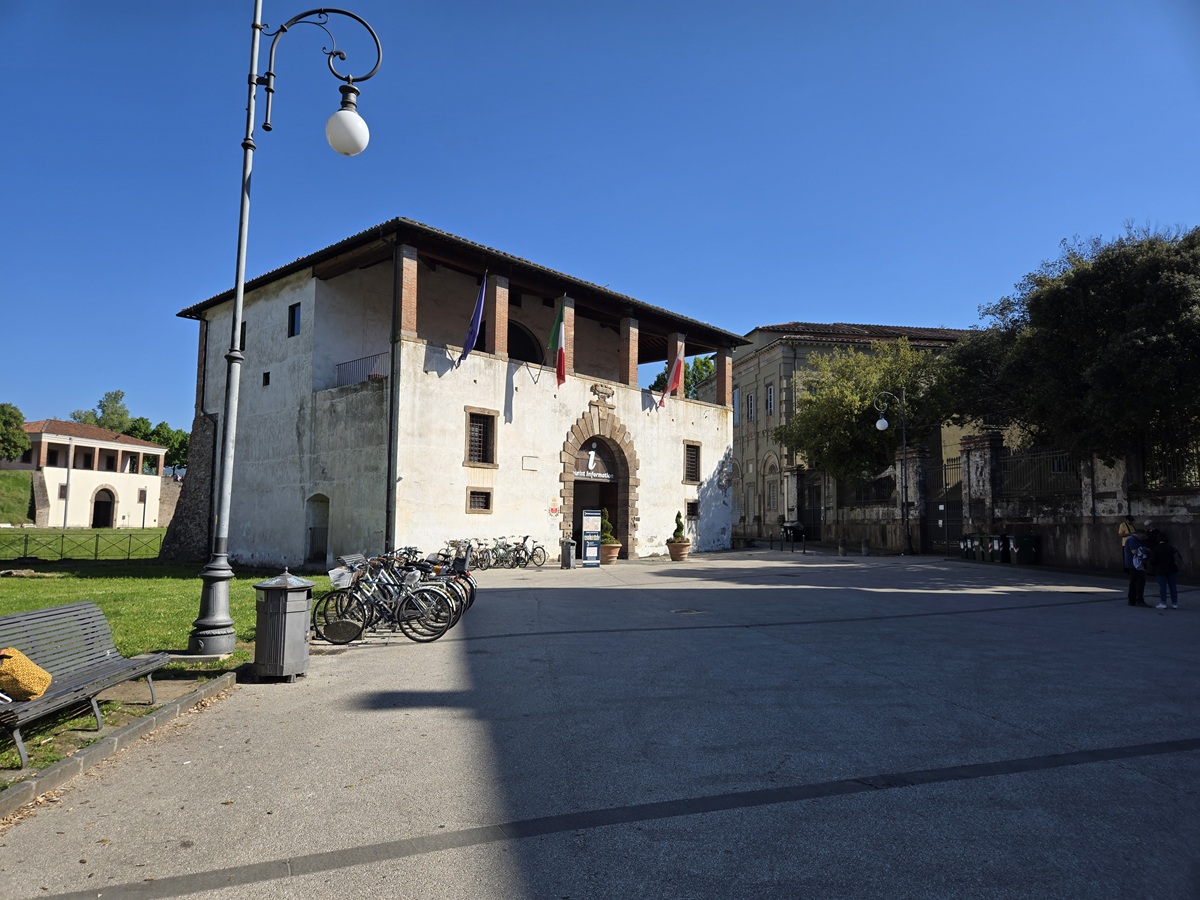
 
 
I'm tempted to compare Lucca with the walled city in southern France, Carcassonne, which I have also visited, but there are more differences than similarities. One common feature, though, is the narrow cobblestone and flagstone streets. The cars and delivery vans which try to negotiate these narrow roadways have their work cut out for them at the best of times. When they find a party of tourists in the way, well....
 

We had one stop on the way into the heart of the old town, in a small square where a man sculpted in bronze was seated outside a typical multi-storey apartment house. Our guide informed us that this was the renowned Italian opera composer, Giacomo Puccini, creator of such legendary characters as Madame Butterfly, Tosca, and Turandot. The sculpture stands outside his birthplace, now a museum of his career.


We then moved on a short distance to the Piazza San Michele, site of one of the strangest looking churches I've ever seen. 


The real pride or hubris of that towering multi-arcaded facade becomes obvious when you go around the side of the church and then look back and up.
 

Any takers for climbing that crumbling staircase which seems to cling precariously to the back of the false front? For me it was a little too reminiscent of horror stories about staircases to nowhere. I don't think it is open to the public in any case, and this is likely a very good thing!
 
What is noteworthy about San Michele is that it continues to the full the Tuscan tradition of incredibly elaborate ornamentation and decoration. I suspect a bit of overt nose-thumbing at Pisa and Florence when Lucca was fully the equivalent of those cities in the wealth of its leading inhabitants.


It seems a bit ironic that the interior of this ornate structure is relatively plain to the point of severity. At one time, our guide informed us, the walled city of Lucca contained a total of 93 churches. Many no longer exist, while others (like this one) have been converted to other uses.
 
 
There are a couple of other interesting sights around the Piazza. One is this former palace, now a bank office, but still displaying some sculpture in the covered loggia on the front of the building.
 

Another commercial building now housing a bank plainly shows the brickwork of the centuries-old original -- and bear in mind that this is structural brick masonry, not just a brick facing or veneer as in modern construction.
 

One of the fascinating things about Lucca is that the tourists haven't taken over the town. There are still plenty of shops geared to the needs of the local residents. Clothing, hardware, shoes, food items, all are on display as you walk through the streets. And there's scarcely a souvenir shop to be seen anywhere. Of course, for a group of visitors who had to eat breakfast far too early, and won't get to lunch for quite a while yet, the food shops are especially intriguing! For example, the window display in this bakery...
 
 
...or the various sizes and shapes of pasta on show at this combination store and restaurant. The Tordelli Lucchesi in the upper picture is a particular local delicacy.


Near the bakery was this random piece of ornamental ironwork embedded in the wall, apparently "just because."


Our final stop of the organized tour was outside another church, San Frediano, dedicated to a particular local saint. The mosaic artwork on the exterior was the real eye-catcher here. Parts of this church date back well over 1,000 years.


Outside San Frediano was another lovely display. I took my time to enjoy this before it was time to head for our meeting point back at San Michele.


 An attractive final memory to carry away from an intriguing brief visit to Lucca.


Saturday, April 26, 2025

European Circle Tour Part 4: To Lean is Divine

So, I've landed in Tuscany, in Florence, and I'm talking about leaning. I'm sure almost all of my readers will have already guessed what happened next. It was, of course, a day trip to Pisa.
 
It's a popular day outing from Florence, taking as little as 50 minutes each way by frequent and comfortable trains, and costing just €9.30 each way. Now for the trick. The Florence-Pisa-Livorno route functions as a kind of self-contained unit within the larger Trenitalia national network. It has its own ticketing procedure. You can book tickets ahead of time online. You can buy them from ticket machines at the station. Or, you can simply tap a card as you get on and as you get off. Here's the machine, photo taken on my return trip:
 

The silver tap area for cards in the centre is easy. Paper tickets have to be inserted into the black slot under the tap area, and then withdrawn after being stamped and punched, in order to be valid. Is the black thing at the bottom where you scan a QR code on your phone if you paid in advance online? I'm not sure. The point is, whichever way you are travelling, you need to validate at the machine on the platform before you get on the train. If you don't, you are laying yourself open to the possibility of a hefty fine when a ticket inspector comes by and checks. When, not if. My trains were checked by inspectors both outbound and return. If you are tapping your card, you of course have to tap at another machine after you get off.
 
The challenge was to find a machine at Florence station, in the boarding area for these local region trains, that was working. I had a paper ticket, stuck it into the machine once -- and then again -- and then again, and nothing happened.I finally walked up to an agent on the platform, and he validated it by hand. By the time he had done that, six more people were waiting with the same problem. Ah, technology!
 
Although the morning train was well filled, it was a smooth and comfortable trip. We stopped at two stations on the way to Pisa Centrale. Some of the slower trains stop a good deal more often.
 
And then we arrived in Pisa, and it was time to get out and walk. The first site, in a piazza just north of the station, is this statue of King Victor Emmanuel II. Somehow it seems a trifle disrespectful to plonk down a Ferris wheel right there. The second picture takes a slightly more solemn viewpoint. Slightly.


After leaving the piazza, it was a simple matter to walk more or less due north along streets lined with old apartment buildings, some with stores or restaurants on the ground floor. 
 
 
This first half of the walk continued until I ran into the banks of the Arno -- the same river as in Florence, here approaching its mouth. In fact, Pisa was founded as a seaport on the shore of the ocean, and has gradually lost ground to all the silt poured out every year by the Arno's boisterous waters. It's now nine kilometres inland.
 
Right away, it's impossible to miss the extra height of boards backed by sandbags on the riverside wall. The Arno had one of its dangerous floods just last month after a period of steady and intense rain when the ground in the mountains to the east was already saturated.
 
 
I had to detour a few hundred metres to the west here to reach a bridge. On the way, I came to this delicately beautiful structure, all in the pale grey local marble: the church of Santa Maria della Spina (Saint Mary of the Thorn). The name derives from a relic, long kept here, which was believed to be a thorn from the Crown of Thorns forced onto Jesus' head during his suffering before the crucifixion. The relic is now housed elsewhere.
 

Crossing the nearby bridge gave me a first chance to see the waters of the Arno. I was impressed to think that this broad river could rise up in a matter of hours to the tops of the walls along the riverbank.

Continuing straight on beyond the bridge, I passed on the right the entrance to the Botanical Garden, pausing only long enough to lean in a snap a couple of quick pictures.


Beyond the gardens, it took me about 10 more minutes to reach the open space around the Cathedral, a space often called the Piazza dei Miracoli, although its formal name is Piazza del Duomo. Here's an internet photo which gives a panoramic view of the whole complex.
 
Photo/Map: Arne Müseler / arne-mueseler.com / CC-BY-SA-3.0 / https://creativecommons.org/licenses/by-sa/3.0/de/deed.de

The four buildings are shown below in this order: the Baptistery, the Monumental Cemetery, the Cathedral or Duomo, and of course the world-famous bell tower. 


The admission charges to the various buildings are scaled more or less by popularity, with the admission to the Tower being greater than all the others combined. Surprise, surprise. Fair warning: you need to book reservations well in advance if you've always wanted to climb the tower. Numbers are kept small because of the narrow and steep curving staircases. The revenue from the admission charges is used to maintain all the buildings in the complex, a very expensive task.

Because of the loose, spongy soils (silt from the Arno, remember?), all the buildings in the complex have settled or tilted at least a bit. The tower has just been more diligent at settling and tilting than its companions. In the 1990s, it had reached an extreme tilt of 5.5 degrees, leaving its future in doubt, particularly following the sudden collapse of a tower in another town. A lengthy and expensive remediation project removed all the bells, anchored the tower firmly during the work with steel stay cables, and lowered the high side with the removal of soil, reducing the tilt to 3.97 degrees. Incidentally, for the first time since detailed observations have been taken, the tower has stopped moving -- a definite good sign. But that tilt still makes a lot of people nervous. 


Just kidding. I thoroughly enjoyed my visit.


It was enjoyable not least because I devoted my time here to prospecting for the fascinating details, sculptural and otherwise, incorporated into these buildings. This sculpture appears above the entrance of the Monumental Cemetery.

Mosaic artwork above two of the doors of the Cathedral.


And two quite different sculptured columns:


Photos which I've seen of the interiors show that the same intricacy of design and decoration pervades every inch of all the structures. It makes some of the great cathedrals of northern Europe and the United Kingdom look sombre and plain by comparison.
 
In a way, it's a pity that I passed on the admission charges to at least the Baptistery and the Duomo, where I could have enjoyed more artistic riches. My younger self would have loved to climb the Tower, but that's no longer as big a Big Deal as it would have been way back when. 
 
But Pisa had one more grand surprise for me. As I was leaving the Piazza dei Miracoli, I was more than a little hungry -- ravenous, in fact. I got an outdoor table in one of the restaurants right on the short pedestrian street which leads to the entrance gate. I know -- in a location like that, it has to be a tourist trap, right? Well, you be the judge. I was browsing the wines by the glass, at prices from €12 to €15, and then I spotted it: the house white or red wines at €10 for a half litre! It wasn't schlock, either. In Europe, a "house" wine is often a personal pick of the owner or manager, usually local or regional, and very much not  from the bottom shelf. I don't know if any of that was the case here, but the house white wine accorded perfectly with my tastebuds!
 
Toss in a bottle of water, and a dinner-plate-size pizza quattro formaggi which stood comparison with the best I've ever had, anywhere. This place actually got the thin crust completely crisp, all the way from the rim to the centre. That's an art form in itself for you! And then there was the bill for all that deliciousness: a mere €29, including tax and service. Well worth every penny.
 
And just to underline the point that there's more than one treasure in Pisa, I caught a glimpse of this on the way back to the station to return to Florence.