Showing posts with label Germany. Show all posts

Monday, December 16, 2019

Stuttgart Postscript and Another Mini Language Lesson

Just a quick final note as I head back to North America -- but not to home!  (yet....)

Westbound trip began with an 8:20 AM Sunday flight from Stuttgart to Zurich.  Since it was somewhat clear and sunny, and since I had a window seat, I got some decent pictures on the way.

A couple of views of Stuttgart on takeoff.


Some Swiss countryside, landscape, villages and larger towns on the approach to Zurich (the second picture even complete with a rainbow).


And a spectacular panorama of the distant Swiss Alps, all clothed in pristine winter white.


And now for the language lesson.  On Swiss International Airlines, this is the message displayed on the cabin video screens as you board at the beginning of the flight.  But what of all the repetitions?


What you are getting is a welcome in English, followed by the same message in each of the four official languages of Switzerland.

Yep, that's right.  FOUR official languages.  And there are so many Canadians who think two languages create an unmanageable country.

But it's the last one that undoubtedly puzzles the most people.  It looks much like French and Italian, but it's not.  That last line is in Romansh.

Here are two other examples from two of the other posted notices:

Buon sgol  =  "Have a good trip"

A revair  =  "Goodbye" 

It's an archaic language descended directly from Latin, hence the stem "Roman--" in the name.  It's spoken only in the large canton in south-eastern Switzerland known as the Graubünden in German or the Grisons in French -- usually rendered in English as the Grey Cantons.  Only about 1% of the entire not-large population of Switzerland speak Romansh as a first or common-use language, but it is so closely tied to history and culture in the Graubünden that it has had official language status ever since 1938.

A revair!


Saturday, December 14, 2019

Just Can't Get Enough of Stuttgart

Okay, so it's like this.  After I got my winter holiday all planned and reserved, I found out all about my nephew Robert's pre-Christmas show with Gauthier Dance in Stuttgart.  That programme sounded really tantalizing, so I bought another trans-Atlantic air ticket and arranged it so that I would fly to Stuttgart, and then land back in Toronto the night before I was going to leave for Florida and my cruise.  So the whole thing becomes one single trip, but in two segments.

Since I am continually talking about my nephew and his dance company (can you tell I'm frantically proud of him?), I figured the least I could do was finally post a couple of pictures of the theatre.  It's a great instance of a repurposed building: an old factory of 1930s vintage, by the look of it, now converted into an arts centre with studio and rehearsal space and three theatres of varying sizes.


The seven vertical windows in this picture actually form the back wall of the stage in the largest theatre, and have even been incorporated into the scenic design for one of the dance works performed there this week.


So, obviously, here I am back in Stuttgart yet again.  I hope that all the material I'm posting about this city will tempt some of my readers to check it out when they get to Germany.  You certainly should!  Stuttgart offers intriguing sights, diverse shopping, an increasingly growing selection of restaurants at various price points, and some beautiful parks for those who love to get out and walk.  There's at least one big mineral spa with hot pools and the like and a busy local culture scene.  This city continually achieves top-20 ratings on lists of the world's most livable cities -- and, I would say, with good reason!

If you've missed my previous posts about this intriguing place, here are the links:


Before getting into this latest Stuttgart post, a little geography lesson.


The anarchic-looking street layout in Stuttgart isn't mere caprice.  The city sprawls over a whole series of hills, and while the downtown area (shaded) is pretty level in its valley, you can't go far in any direction without having to climb.  And that's when the streets have to start turning and twisting all over the place.  A neat grid layout this is not.  I'm glad that I don't have to navigate it by car.

That's because -- fortunately -- Stuttgart has a really superb transit system, comprised of dozens of S-Bahn suburban train routes, U-Bahn trams in the downtown and surrounding areas, and bus routes to cover the thinner spots.  Here's a U-Bahn train, made up of two double-unit trams, at an outdoor station in the city centre.


I'm calling the U-Bahns "trams," but they are really 2-car or 4-car light rail trains.  Even when they are operating on the streets, they stop at stations with raised platforms.  In busier areas, the U-Bahns plunge underground and run under the traffic, and many of the street stretches are on separated medians.  The S-Bahn trains are wider and longer, and operate on completely separate railway rights-of-way, again with multiple stops at fully-constructed stations.


The coloured lines on this chart are all the U-Bahn and S-Bahn routes.  The grey lines represent only a selection of the connecting bus routes.  Now you can see just why the Europeans are light-years ahead of us in the field of public transit!

The system runs on a zone chart, but most of the main city (apart from the airport) is one single zone.  You can even get a discount on the one-zone fare if you travel 3 stops or less.  The base adult fare for a one-zone ticket is €2.50 and you can cover two zones (which gets you to or from the airport) for €2.90 one way on the S-Bahn.  A full-day pass in one zone is €5.20.  In the centre of the city, multiple lines join together on two busy underground trunk routes, with the crossing points of U-Bahn and S-Bahn under the Hauptbahnhof (main railway station).

Coming in from the airport the other night, I had a 28-minute ride on the S-Bahn from the station right under the airport terminal to the Hauptbahnhof station, then less than a 2-minute walk to the U-Bahn platform,  short one-stop ride on the U-Bahn, up an elevator to the street, and 30-second walk to the entrance of my hotel.  How's that for convenience?

On my first full day, the weather was sunny enough -- in spite of scattered showers -- that I decided to go up to the Fernsehturm on a hill south of the city centre.  Fernsehturm, literally "far-seeing-tower," is the German name for "television tower."  Like its cousins in North America (Toronto's CN Tower, for instance), this one was built to hoist broadcast antennas high into the air.  Even though it's not needed for that purpose any more, it continues to be a major visitor attraction.

You can get up there on either the U7 or U15 from downtown.  The U7 is faster, running up the hill in an express tunnel, but the U15 has the more interesting and scenic trip as it runs a snaky course on the street right up to the peaceful hilltop forest park where the tower is located.  Both U-Bahn routes stop at the Ruhbank station, and from there it's a 7-10 minute walk along a level footpath through the forest to get to the tower.


And here are the views.  The first one shows the Ruhbank station with both a U15 and a U7 in view on their separate but adjacent tracks.


This sports ground below the tower would be the envy of nearly every sports coach I know in Canada.


A perfect illustration of the rumpled landscape in and around Stuttgart.


Sadly, none of my pictures of downtown turned out very well -- too grainy.  But for what it's worth....


Another nearby transmitting tower figures in this view to the east.


Looking south, you can see the airport in the distance and, far beyond, the higher mountains towards Switzerland.


I had come up the hill on the underground U7, so I decided to go back down on the U15 which runs along the street.  


 On the way down the hill, there were interesting views of downtown in the valley through the gaps between the trees and the houses.  One thing's for sure: plenty of people living on this hill have a great view!


There's also the occasional quaint older house along the way.


Among the newer buildings, this one definitely caught my eye.  I'm not sure, though, just why a Werbeagentur ("advertising agency") needs a giant, multi-coloured-striped Thing like that on its roof, nor am I sure whether the Thing is a lampshade, an umbrella, or a water tank.


Back downtown, I hopped off for some more walking before heading back to base.

Language lesson of the day: the German word Backstube looks suspiciously like the English "backstab" but it's nothing of the kind.  Back is the cognate of the English "bake" and a Stube is a cafe.  So:  Backstube = bakery cafe.  Kamps is a popular chain in these parts.


And then, I continued my walk along the pedestrian shopping mall of the Königsstrasse ("King's Street"), with the dignified tower and facade of the Hauptbahnhof (main railway station) in the background.  Apart from the barren trees, you'd hardly guess it was December.  Turned out to be a beautiful afternoon.


The second day I was busy with catching up on lost sleep, then attending the daily class which opens the dancers' day each workday.  The third day turned out to be exactly like the first two: sunny and brilliantly blue sky one minute, and dense clouds dropping rain the next.  As I write this, it's just started raining again.  At least the temperature is a few degrees warmer than yesterday, but it's plain that apart from above-freezing temperatures, winter in Stuttgart is just like winter in southern Ontario -- wacky and unpredictable to the max.

This time, I decided to pay a visit to the Fahrradbahn (rack railway), and quickly found out that I was actually visiting a true historic relic -- the oldest surviving link in Stuttgart's transit system.  The single car on the Fahrradbahn may look like the regular U-bahn cars, but it's a law unto itself in other ways.  Inside the car, a poster illustrates the history of this steep line up the hill to Degerloch, which went into operation in 1882. 


This unique journey begins at the Marienplatz, shown here.  


Coming up the stairs from the U-bahn station, you will see the base station of the rack railway ahead and to your right.  The tilt is built right into the station platform, and the train instantly has to climb across a bridge that goes right up in the air between the houses on the south side of the square.  The passenger vehicle pushes in front of itself a flatcar equipped with racks for eight bicycles.


Like all rack railways, this one moves at a speed that is stately rather than energetic -- this to avoid any possibility of the cogwheel jumping of the rack rail, with disastrous results.

During the ride up the mountain, the best views are on the left hand side of the car.  At certain key moments, you get a striking panorama of the city centre spread out below you.


There are some stretches where the rack railway runs along one side or down the middle of a street, while in other parts it has its own right of way.  I think those streets were probably all built after the railway line was already in place.  Then there's the occasional moment when the train crosses high in the air above a suburban street.


At the top of the mountain, the tram stops at a station called Fahrradbahnhof, plainly the original terminus.  But that historic poster in the car explains that the line was extended a few hundred metres to the current terminal at the major intersection of Degerloch in 1931.  As you approach that station, this structure on the right displays the kind of colourful quirkiness in design which you can discover in bits and pieces all over Germany, and in wholesale quantity in Berlin.


As you may have guessed, the canopy structure is a bus stop.  Then, right alongside the Degerloch platform is this quaint older building housing a pub and restaurant.


From Degerloch, it's a simple matter to hop the U-bahn back into town.  The U-bahn station was built right under the rack railway station in 1977.  Of course you are welcome to take the Fahrradbahn back down the hill, and at no extra charge if you're using a day or week pass.


Wednesday, October 30, 2019

European Musicruise # 10: A Tale of Two (German) Cities

The last main installment of my European adventures came after I left Switzerland, spending 3 nights in each of two cities in Germany: Stuttgart and Berlin.  

I had visited both cities before: Stuttgart last year, and Berlin back in 2004.  Because both suffered from the bombing raids late in World War Two, these are predominantly modern, post-1950 cities, although both have a number of salvaged or reconstructed historic areas and buildings.

Berlin is, of course, far bigger.  The history of the last century also played a far bigger role in the development of Berlin, with its role as the German capital before and after the Cold War, and with its unique position as a city divided by a wall between two mutually hostile great powers during the years 1961-1989.

Stuttgart is less often noticed by tourists, and that's part of the attraction.  You don't spend your entire day dodging lollipop-waving tour guides and hordes of their eager followers, nor do you have to weave back and forth like a 3:00 a.m. drunk to duck all the eager beavers trying to sell you sightseeing tours.

The train from Zurich to Stuttgart takes 3 hours, and it's a pleasant ride through the hill country of the Black Forest, and along the upper course of the Neckar River which flows past Stuttgart and Heidelberg before emptying into the Rhine.  This pretty countryside is hard to photograph from a moving train, but I did what I could.


Anyway, it was Stuttgart first, and the nice weather really moved in to stay -- sunny every day, with the temperatures consistently rising to 20 C (68 F, pretty darn good for anywhere outside the tropics this late in October).  So, sightseeing we will go.  Not a lot, but some.  One of the most striking older buildings is the Stiftskirche.  The name "Stift" signifies that the building stands on land which was originally a gift to the church from the local ruler, the Duke (or, later, King) of Württemburg.


The small square behind the church is called the Schillerplatz.  No bonus points will be awarded for anyone who guesses the identity of the statue in the centre.  Since it was a Saturday morning, the weekly outdoor market in the Schillerplatz was going full steam ahead.  Pivot 180 degrees from the spot where the picture was taken, walk about 100 metres, and you find yourself on the much larger Schlossplatz (Castle Square).  This major public open space is framed at opposite ends by the old and new palaces of the Dukes (or, later, Kings) of Württemburg.  On the north side is a sight which is actually pretty common in post-World-War-Two Germany -- an elegant old building which has been attached to, and subsumed into, a modern building, in this case, a shopping mall.  Stores and restaurants within the mall can be accessed through the dignified old colonnade or via entrances in the modern structure to which it's attached.


Speaking of stores, just down the street from the Schlossplatz the world's next retailing revolution has come to Stuttgart, and nobody in the media except me seems to have noticed it.  It's not just a question of the illuminated sign being in error; this store really is closed even when it's open.


As some of my readers may recall, there's a reason why I have now visited Stuttgart twice in less than a year, and plan to do so twice more in the next 6 months.  And here it is.


I'm getting quite a reputation as a fan of this spectacular modern dance troupe -- particularly with my nephew Robert, who just happens to be a member of the company.  Here we are in the lobby of the Theaterhaus Stuttgart after the show.


After seeing two performances, it was time to slide off to Berlin, a somewhat longer ride of 5½ hours, but on a larger, faster train, an Inter-City Express of the German state railway company, Deutsche Bahn (DB). After several far-too-late nights in Stuttgart, I dozed off and on for a good part of the trip, but that was also because it was raining.  Pity, because the line goes right through the centre of Thüringen (Thuringia), a region which has justly been called "the green heart of Germany."

We arrived in Berlin at the massive Hauptbahnhof which is new since my last visit there in 2004.  It's five stories tall altogether, with an underground station at the bottom serving long-distance and north-south regional trains, a top floor serving east-west regional trains and a few long-distance ones, and in between the top and bottom are two shopping floors sandwiching the ground level which gives access to buses, taxis, bicycles, you name it.

Berlin is a city of huge contrasts, historic versus modern, businesslike versus playful, solemn versus quirky.  The quirky declared itself almost immediately after I walked out of my hotel the first morning.  Having a little trouble understanding why this particular street cafe is called the "Schlemmer Pylon"???


Here's a picture of what the place looked like in 2004.  Now, it's completely plain where the name came from -- even if the purpose of the, umm, "unique" architecture is less clear.


Old or new, the Schlemmer Pylon is just a warm-up act.  Nearby, in the broad central boulevard of the Tauentzienstrasse stands this eccentric, yet emphatic, sculpture.


Whichever way you look through it, you get an interesting view down the street.


Looking straight up through the thing just makes the matter even more mysterious.
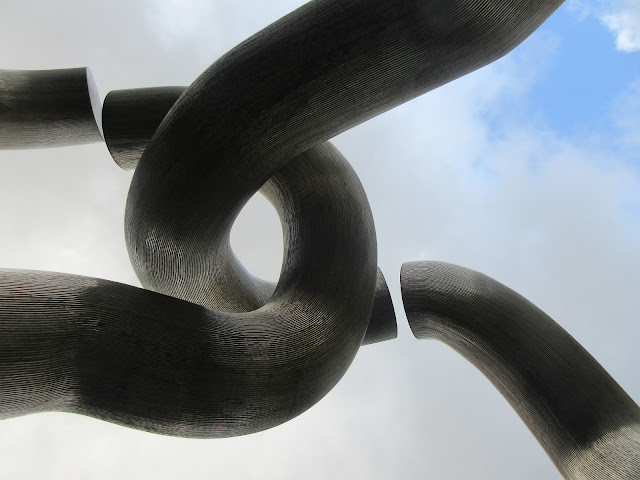


According to the plaque placed nearby, it has 2 artists who created it but no name.  Okayyyy....

Down the street from the thing, you can catch a glimpse of this curious amalgam of old and new.


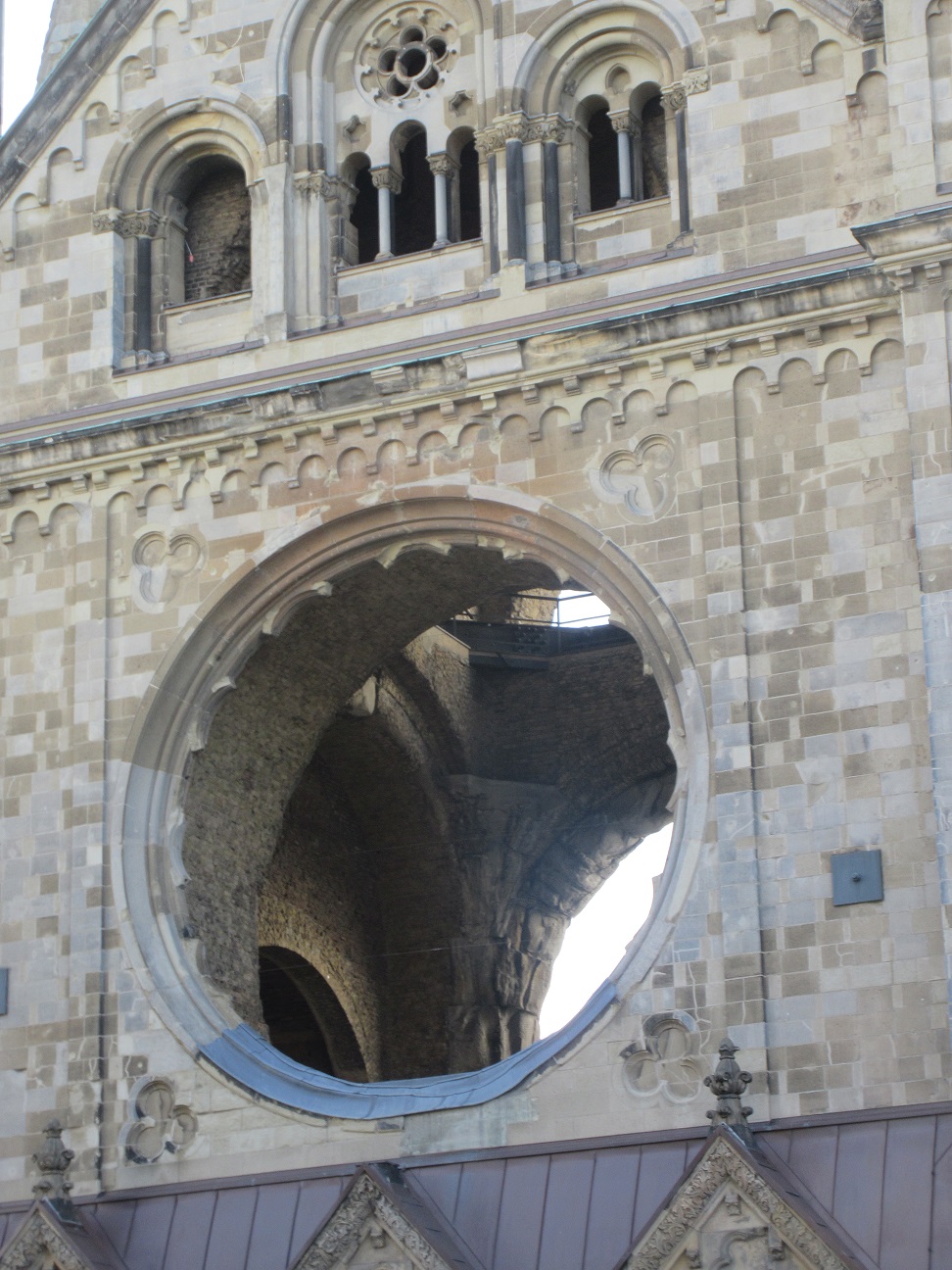
In this case, it isn't mere whimsy.  The Kaiser-Wilhelm-Gedächtnis-Kirche ("Kaiser Wilhelm Memorial Church") was for decades a mammoth landmark in the centre of the city, until it was bombed into near-oblivion in 1943 during World War Two, leaving only the burnt-out shell of the giant tower.  Here's an old picture to show what the full building looked like.


It's obvious from the historic picture that this view today shows the old west front and main entrance of the church.  Even with nearly a third of its height missing, it's still an imposing landmark. 


The concrete structure in the foreground on the left is a modern church of the same name.  Every hollow square in the structure is filled with a square of blue and white coloured glass, shedding a veritable waterfall of light into the interior.

Internet photo

In the first picture of the church above, the tall tower next to the ruin is a bell tower for the modern church, built in the same kind of honeycomb pattern as the modern church proper.  The remaining fragment of the original church stands today as a memorial to loss and, equally, as a prayer for peace.


It stands right at the head end of the famous boulevard called Kurfürstendamm ("The Street of the Prince-Electors").  Often compared to the Champs-Elysées in Paris, the "Ku'damm," to give its colloquial nickname, is one of the central fixtures of Berlin, and a great shopping district -- provided you have plenty of money.

Another significant site in Berlin today is this location, called Topography of Terror.  It summons together in one place the two great horrors visited on the world by totalitarian rulers in the twentieth century.  The top level is one of the remaining stretches of the Berlin Wall, which divided the city and the country in half under the so-called Communist regime from 1961 to 1989.  Below it are the foundations of the Prinz Albrecht Hotel, which -- along with its neighbouring buildings in this block -- housed the Gestapo secret police and the S.S. elite extermination squads of the Nazi regime from 1933-1945.  Historic plaques along the walkways give a bit of background, and the small museum gives more.  Since fewer and fewer people still alive can actually remember what those times were like, it seems more and more likely that the world is going to fall into the same trap and have to learn the same horrendous lessons over again.

"Where have all the flowers gone?"


The office block in the background was the headquarters of the STASI, the secret police of the dictatorial East German regime during the years of the great divide. 

When I walk through the Topography of Terror exhibit, I can almost sense that the monstrous evils done here still linger in this place.  It's not a comfortable feeling.

Berlin continues to surprise at every turn.  From that grim slice of the past, you move on to the grand square called Gendarmenmarkt, a masterpiece of symmetrical town planning, from right...


 ...to centre...


...to left...


...except that it's a fraud, because the two identical domed cathedrals really aren't.  The domed porticos were added to existing churches after the fact to create the illusion of symmetry -- as the rear views of the two churches readily show.


In the middle presides the dignified Schauspielhaus, now a concert hall.  Believe it or not, this building with the majestic statue of the poet Schiller out front, also has a link with the Berlin Wall. 


In 1989, when the wall fell, a grand concert celebrating the occasion was planned for this hall.  It included singers and players from both the former West and former East Germany, plus several other countries, and was conducted by Leonard Bernstein.  The work chosen was Beethoven's immortal Choral Symphony, with its finale setting Schiller's Ode to Joy.  Feeling "empowered by the moment" as he put it, Bernstein directed the singers to replace every occurrence of the word "Freude" (Joy) with the word of the moment, "Freiheit" (Freedom).  And so it was done.  The Berlin Freedom Concert was telecast live in dozens of countries, is still available on DVD, and is by a very long head-start the most intense, emotionally riveting performance of the famous Choral Symphony which I have ever heard.

You just knew some musical reference had to sneak in here, didn't you?

Not far away is this fountain, a wildly Baroque fantasy of Neptune surrounded by swirling naiads.  Please pardon the pun, but "whatever floats your boat."


The fountain stands close to the Alexanderplatz, a major centre of commerce in East Berlin during the days of the separation.  The "Alexplatz" is the starting point of Karl-Marx-Allee, intended as the socialist answer to Kurfürstendamm.  This street, though, was lined with towering apartment and office buildings, very monolithic in emphasizing the superiority of a culture of the workers over one of decadent capitalist extravagance (photo from my previous 2004 visit).


Today the Alexplatz is still a lively centre for shopping (capitalist), and is also the home of the television tower, officially called the Fernsehturm (television tower, literally "far-seeing tower"), and unofficially and irreverently named "Telespargel" (TV toothpick).  Berlin nicknames are renowned for being irreverent -- or worse.


Not far away is the island in the River Spree (pronounced "Shpray," by the by) which is referred to as "Museuminsel" because of the cluster of major museums housed there.  The classic revival art museum and the massive, neo-Romanesque Berliner Dom (cathedral) are here, both covered at every possible spot with impressive statuary.


By the way, just because a church is called a Dom doesn't mean it has to have a dome.  The name "Dom" is adapted from the Italian word "Duomo," which similarly signifies a cathedral.  The root then extends backwards to the Latin "domus," a house.  In church parlance, it's the "house" of a bishop who presides over the churches of a particular region called a diocese.  Think of the modern English word "domestic" as a related example for "Dom."  Since there are many neo-Romanesque churches in Berlin, it's not entirely surprising that a Dom has a "dome" -- it's just not a prerequisite.

Got you thoroughly confused yet?  No?  Try this one for size.  From the square in front of the Dom, you also get a view of the tower of the Red Town Hall.  Although this picture doesn't show it, the Red Town Hall stands right across from the Old Town Hall, which is actually newer than the older Red Town Hall.  The same weird confusion of timing occurred with the old and new Town Halls in Munich, where the so-called Old Town Hall is actually newer than the New Town Hall -- but looks older.  Is it really that hard to get the dates right?  Just take all the time you need on this one.


The Spree has a control dam and locks at Museuminsel which created Berlin's harbour.  Although not such a major port today, Berlin really got its start as a crossing point of land and water transport.


The neoclassical style comes to the fore again with the Catholic cathedral, St. Hedwig's.  Obviously modelled after the Pantheon in Rome, it's not quite a copy of the original model.  The dome is higher in relation to its width, the shape tending more towards the egg than the orange.


Nearby, we see the majestic, world-renowned Brandenburg Gate -- because what's a European capital without a triumphal arch or two?  Some of the most iconic images from the fall of the Berlin Wall were recorded right here, as crowds of people pushed over the massive slabs of concrete and rushed through to greet each other effusively below this iconic gateway.


It's not just gateways or arches.  Victory columns are a long-standing tradition in Europe too, and this flashy model was built after the victory of the Franco-Prussian War in 1871 and the final unification of Germany.


During the American occupation after the end of World War Two, the G.I.s used to refer to this as "the chick on the stick."  It ain't only the Berliners who come up with irreverent nicknames.

The Victory Column stands on the north edge of the Tiergarten, a large tract of urban forest park which was originally the hunting park of the Electors of Brandenburg.  The name actually means "animal park."  It's still a popular getaway from urban hassles.


Continue west of the Tiergarten and you come to another sizable park which contains the Berlin Zoo.  This Elephant Gate is one of the two main entrances.  Our tour bus guide told us to come here if we wanted to visit the zoo, to avoid the lines at the other gate.  He lied.  There's a line here as well.


One incident sums up Berlin more than anything else -- the city's commitment to the environment, to the future, the live-and-let-live philosophy, and the daily routines pursued amongst so much scenic magnificence.  This is a memory from 2004.  Picture me sitting after dark on a warm summer evening in a sidewalk cafe under the trees of the elegant, sophisticated Ku'damm.  Suddenly I hear police sirens, and then mingled with the sirens come bells and toy whistles.  A police car drives by, siren blaring and lights flashing, and then behind it a mass of perhaps as many as 60 or 70 cyclists, all pedalling at top speed, ringing their bicycle bells, blowing on toy horns and whistles left over from the last New Year's Eve or birthday party -- and not a stitch of clothing on any of them.  Another police car with sirens and lights brought up the tail end of the parade.

Now, that's Berlin.

And, with that, I'll close with another absolutely pointless image of Berliner idiosyncratic eccentricity.  Die Welt is a hot-air balloon advertising a popular national newspaper.  The rest of the collection?  Who knows?  You figure it out.