Showing posts with label Huahine. Show all posts

Sunday, March 13, 2022

Polynesia, Here I Come!

In less than two weeks, I'll be taking off on a late winter vacation in Polynesia. 


But where exactly is that?
 
Polynesia, a cultural rather than a national or political identity, sprawls across a vast area of the Pacific Ocean, encompassing hundreds of islands and dozens of island communities. The main political entities in Polynesia are Hawaii and American Samoa (USA); French Polynesia and Wallis/Futuna (France); New Zealand, the Cook Islands, and Niue (New Zealand); Easter Island (Chile); Tuvalu, Samoa, and Tonga.

Matters get blurry around the edges of the region, as neighbouring island groups like Fiji and Kiribati may be the home of peoples of Melanesian or Micronesian ancestry, yet share some common linguistic and cultural features with the Polynesians.


How did these diverse cultures become so widely spread across such a vast distance of water? With their sail-driven dugout outrigger canoes, the Polynesians were mighty seafarers. 
 
With no aid from compasses or maps, and only the action of wind, waves, clouds, seabirds, and the eternal stars to guide them, they learned how to cross the trackless oceans again and again. They didn't just explore from island to island; they continued to travel, sending repeat parties of colonists when informed that new land had been found and settled.

The result is that, whichever part of Polynesia you visit, you will encounter a fair degree of familiarity as compared to other Polynesian societies and cultures: familiar words, familiar foods, familiar styles of music and dance, and much more.

So far, in this region, I've visited Fiji, New Zealand, Hawaii, and (in French Polynesia) Tahiti, Huahine, Moorea, Bora Bora, Raiatea, and Rangiroa.
 
Every year, a few cruise ships will sail through the regions of Polynesia, stopping at a number of different islands. This is now the easiest way to get a cross-section view of the entirety of Polynesia (unless you own a private yacht or jet). Other cruise ships do shorter regional trips, like the 10-day cruise around French Polynesia which I took in 2015, starting and ending in Tahiti.
 
Otherwise, travel across Polynesia is mainly via air travel -- and the options for island-hopping are severely limited. This isn't just due to the pandemic. Ever since airliners were developed that could fly nonstop from North America to Australia, the number of planes stopping over in the islands on trans-Pacific flights has dropped to a mere fraction of the flights in earlier years.  Trying to plan an air trip to multiple destinations in Polynesia in an exercise in skill and patience alike.

I'm not trying. Much as I'd love to see more of Polynesia, I'm sticking to just one limited area of Polynesia for my upcoming trip. I'm looking forward to feasting on quantities of fresh fruit and fresh fish, to enjoying sun and leisure...,


 to watching traditional dance and listening to traditional music...,


to admiring brilliantly coloured tropical flowers...,


and to immersing myself in the rugged beauty of the volcanic mountains.


Yes, all the islands in Polynesia are volcanic in origin. Active volcanoes are still part of life here, as Hawaii has experienced for years and Tonga has recently discovered again. 
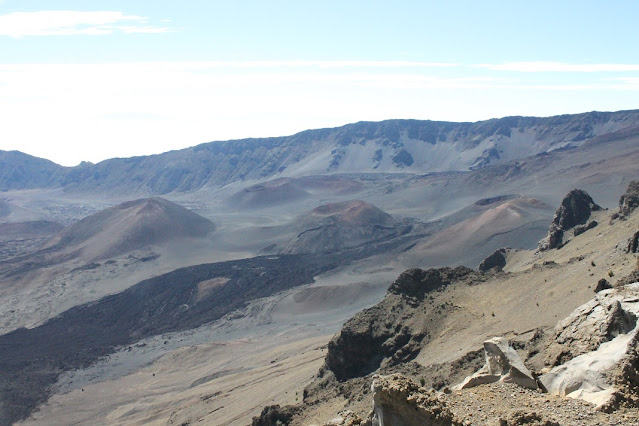
 

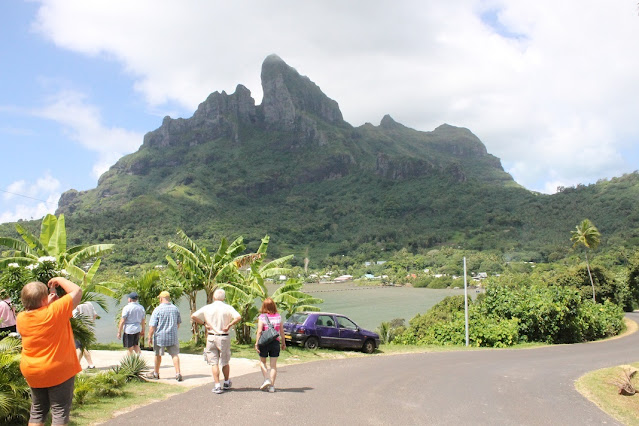
The less recently active volcanic islands (within the last 500 millennia or so) will still have jagged mountain peaks and spires thrusting up here, there, and everywhere. 


The very oldest of all will have eroded down to a flat-topped platform under the ocean with coral reefs growing all around the edges, and sandbar islands (called motus in French Polynesia) forming in a ring within the shelter of the reefs -- and thus, you have the popular image of a Polynesian island composed of nothing but sand, shells, and coconut palms, all caressed by warm, gentle tropical breezes.


Getting to Polynesia from my home in Eastern Canada is a time-consuming exercise. To give you some idea from my past travels: Toronto to Vancouver takes 5 hours, and you're still in Canada. From Vancouver, the nearest corner of Polynesia is Honolulu, 6 hours flying time away. The farthest corner is New Zealand, and Auckland is another 9 hours beyond Honolulu. Tahiti is 6 hours flying time south of Honolulu and Fiji about the same. These are not short hops! You have to cross multiple time zones, and -- in the case of a few of the more westerly Polynesian countries -- you also cross the International Date Line and arrive on a different day from the day you departed.

Oh, which part of Polynesia am I heading for? To be continued....

Note: all pictures in this blog post are taken from previous adventures in one part or another of Polynesia, in 2015 and 2017.

Saturday, January 31, 2015

Two More Very Different Worlds

Those who are following my travels in this blog will recall that I identified the island of Kauai (Hawaii) as a different world from Honolulu.  Well, the same difference exists, in even more dramatic fashion, between Tahiti and the outlying islands of French Polynesia.

Overnight, we sailed from the bustling metropolis of Papeete to the quiet, placid Maroe Bay in between the two halves of the island of Huahine:  Huahine Nui (Big) and Huahine Iti (little).  


The ship anchored there for the day, and passengers had a choice of numerous different shore-side excursions.  The one I chose was interesting and unusual: a boat cruise into the lagoon, a lunch eaten while seated in the lagoon, a program of music and dancing (also taking place in the lagoon), and a beach excursion with swimming and snorkeling.  All this was taking place on a motu, one of the sand islets that grow up in the shelter of the encircling reefs.  I can truthfully say that this was the coolest lunch I’d had since leaving Woodstock, because the water was so refreshing compared to the hot, humid air!


 Like Tahiti, Huahine is classified as a “high island”.  It consists of tall, rugged mountains which are the worn-down remains of an ancient volcano.  On these mountains you see an extraordinary cover of tropical trees in many different shades of green. 

The coral reefs form on the rim of the island wherever conditions are favourable.  As the high island slowly sinks, a larger lagoon grows around a smaller island and conditions then allow for the formation of the chain of motus.  Eventually, the central island will disappear altogether and what will remain is a collection of motus inside a completely encircling reef, which is then called an atoll.

At the beach, I kicked myself for forgetting my underwater camera!  I had to settle for my regular SLR and in the process I either invented or discovered a new art form by photographing corals through the heaving, wind-blown water surface.


The most remarkable difference you notice on arriving in Huahine is the quiet.  There are some cars, but not many places to drive them, so there is little traffic.  You actually notice when a single car passes along the shoreline on the road!  There are scattered houses here and there along the shore, and a small village clusters around the boat dock, but there’s no heavy-duty construction up into the hills as in Tahiti.  Life here is very laid back, relaxed, easy-going. 

One striking thing I realized, as we all compared notes back on the ship over dinner – although the people at my table had been on three different tours, not one of us had seen a souvenir store, or even a grocery store!  We knew there was a grocery store because we were told that.  But the people of Huahine live close to the land and sea.  They grow a great deal of food for themselves, and catch fish enough for their needs.  As far as selling souvenirs like pareos and black pearls, the enterprising sellers set up shop at key tour stops and at the boat dock.  So, on my tour, the family that hosted us were doing a lively business in selling hand-painted pareos and the like right outside their home as well as the lunch and dancing and boat ride!  Under these conditions, an actual brick-and-mortar store isn’t really necessary.

From Huahine we sailed eastwards for 2 days to reach our next stop at Rangiroa.  Nothing highlights the vastness of the ocean as much as the fact that, although you are sailing through a region containing hundreds – thousands – of islands, you scan the horizons from the top deck and see no sign of land anywhere.  More than ever, I’m absolutely awed at the achievements of the ancient Polynesians who colonized the Pacific Ocean from Fiji and Samoa east to Tahiti and Easter Island, south to New Zealand, and north all the way to Hawaii.  All of this travel was accomplished with no specific navigating tools, just an outrigger canoe and a wealth of hard-earned knowledge passed down from generation to generation.  Their navigating skills were based on knowing about which birds and fish lived what distances from land, and which stars to follow and for how long.

Rangiroa is a different world again, a genuine atoll – the largest in French Polynesia.  The first thing you notice is the flatness.  No mountains, no high-rising islands, just the strings of low-lying land crowned with trees and some buildings.  Within its encircling reef are found over 400 separate motus!  Only a few of the motus are inhabited, and the total population of the Rangiroa atoll is only about 2500 people.  Although they have access to some modern services thanks to the French government, this is still a remote location.  Remoteness is underlined by the fact that air service “schedules” to the smaller island airports change frequently – even daily – according to need, demand and weather conditions.


We were fortunate in sailing into the lagoon on a gloriously sunny morning.  The trick is often to take advantage of the sunshine while it lasts, as things are apt to get cloudy and perhaps wet as the day warms up.  A late riser in the tropical wet season may never see much of the sun!  This day proved to be very much the exception to the rule during the week I have been in Polynesia, as it stayed sunny for the full day.

This day I had my morning excursion on a semi-submersible vessel to sail to a nearby reef and watch the fish go crazy when fed.  They did, and the view through the underwater plexiglass windows was splendid, and I got plenty of video footage.  Sadly, though, much of the reef in this area is dead or dying.  That’s increasingly true of many coral reefs around the world.  If you have always wanted to see one, you’d better go sooner rather than later because later could be too late.  The first of the two pictures above shows the snorkeling boats and the semi-submersible (orange) over the reef.  And here is a video clip to show the feeding frenzy that ensued when the pilot of our vessel tossed some dead fish pieces (called "chum") into the water.


I spent the rest of the day relaxing on board ship.  When we sailed at 5:00 pm, we first sailed a couple of miles farther into the lagoon, then we turned around to take a good run at the “pass”, the narrow channel between two motus leading through the reef and into the open ocean.  This was to make sure we had enough headway to beat the incoming tidal current which was quite strong.