Showing posts with label Hawaii. Show all posts

Saturday, April 9, 2022

Return to Aloha # 4: Helpful Hints for Hawai'i

It's been a remarkably low-key holiday, but I'm in no doubt that this is exactly what I needed. I've been off the property a couple of times, but have no more spectacular photos to share -- far too much pool and chill time this week! And the views....
 
 
What I can share is the following helpful hints, the product of five separate experiences with Hawai'i over a period of 25 years:
 
[1]  Bring lots of money (or credit limit on your cards). Hawai'i is out in the middle of the Pacific, and Honolulu is located farther away from the next nearest city of a million people than any other city of that size on the planet. This map gives you the overview.
 
 
Likely three-quarters of everything you will eat, the linens your hotel will provide, the furniture you will sit, eat, and sleep on, the gas in your car or tour bus, the vehicles themselves, all will have been shipped in from outside. It's easy to take for granted the bottle of Heinz ketchup on your table at breakfast time, but when you stop to think that the ketchup -- like you -- has travelled many thousands of kilometres from its place of origin and crossed up to six time zones to land on your table in time to go with your scrambled eggs, bacon, and potatoes... well, suffice it to say, prices in Hawai'i are high, and "expensive" is likely the most common criticism levelled against Hawai'i's restaurants, shops, and hotels.
 
[2] Be patient. Hawai'i may be an American state, and it may look American on the surface, but at heart, deep down inside, it is a tropical island culture. Take-it-easy is much more than just a cultural manifestation, it's a survival skill in the tropics, especially for those who work out of doors. The result is that much of what you will see and do in Hawai'i runs on "island time," and there's nothing to gain by expecting/demanding that service personnel keep up to your expected standards of mainland speed and punctuality. And anyway, aren't you here on holiday?
 
[3] Be realistic. You are not going to see everything Hawai'i has to offer on one trip, any more than for any other destination you might visit. My advice? Confine yourself to a maximum of two islands for your first time. Make O'ahu one of them, and pick any one of the other big three (Kaua'i, Maui, or the Big Island) to go along with it.
 
[4] Enjoy the gifts of the islands. These include the fresh fish and shellfish, the tropical fruits and vegetables, and the coffee. Oh, that Hawaiian coffee. Not many people who've never been here have any idea that Hawai'i grows some absolutely incredible coffee beans, and right here is the place to enjoy the results. I've been in heaven for over a week, brewing up a fresh cup of mouth-watering Hawaiian coffee in my room every morning, and then enjoying even more of it with my breakfast. You can imagine how I pity the people who think they're better off walking to the nearest Starbucks for their morning java. Perfume? Clothes? Liquor? Nope -- my shopping is for a stash of Hawaiian coffee to bring home with me!
 
[5] Speaking of shopping, as an American state, you can find all sorts of familiar American brand stores here, ranging from the Targets and Walmarts in the residential districts all the way up to the top-end luxury brands in the tourist areas. But why? It's actually easy to find shops and stalls selling the products of local makers and crafters, and those are the places to seek out.

[6] Lu'au. You probably want to do one, and so you should. Many hotels and resorts in the main tourist areas offer lu'aus. Many of them are good, but light years ahead of them all (for my money) is the one offered at the Polynesian Cultural Center in Laie, on O'ahu. I've been there twice and will certainly go again (just didn't make it on this trip). 
 
The ideal choice is to take one of the full-day tours which picks you up from your hotel in Waikiki, drives you to the center (about an hour away), gives you the day to visit the outdoor exhibits, shows, and demonstrations which sum up the cultures of all the main Polynesian island nations (not just Hawai'i), and then culminates with the lu'au dinner and the landmark evening show, staged in a large amphitheater with full theatrical lighting and sound effects. What makes this entire day event so special is that the participants are all residents of the various Polynesian cultures which they present to you. All have come to Hawai'i as students and faculty of Brigham Young University of the Pacific which is built entirely around the preservation and dissemination of these remarkable cultures of the islands. The PCC wrote the book on authenticity in Polynesian culture, arts, and food. If you can only do one thing on O'ahu, let this be it.

[7] Speaking of tours, Pearl Harbor is one place where a tour is advisable. The number of visitors to the USS Arizona memorial has to be limited each day, and by turning up on your own you might find you need to wait for a long time. On a busy day, especially on the weekend, you might not get in at all if you don't arrive early enough. Tours, of course, have space pre-booked and get in with no waiting. It matters because the memorial is reached by boat from the landside parking, museum, and exhibition.

[8] On being early. Hawai'i consists of tropical islands, and the temperatures ensure that clouds build up over the islands as the day goes on. Every day. Depending on location, if you are a chronic late riser, you might not see much sun at all. Trust me on this. In the tropics, you are far better off to cut your big nights short and get up each morning in a timely way. Case in point: the pool area was filled with gorgeous sunshine this morning; by 3:00 pm the sky was clouding over. Also, there's the rain. Little sprinkly showers can happen almost any time of any day, but are certainly more common, and sometimes more forceful, in the afternoon. Just as a by-the-way, I read years ago that islanders refer to these frequent little showers as "liquid sunshine."
 
[9] Rental cars, like everything else, are pricey. On O'ahu in particular, I recommend doing without your own wheels.  The traffic in and around Honolulu is heavy-duty, not surprising in a city with nearly a million people in the metropolitan area. Now, really, did you have to travel all this way just to sit in traffic jams? Especially this is so when the range of coach tours on offer is so enormous, and when the island's own transit bus service (laconically called "The Bus") runs on an unbelievably cheap fare of just $1.00 per ride.

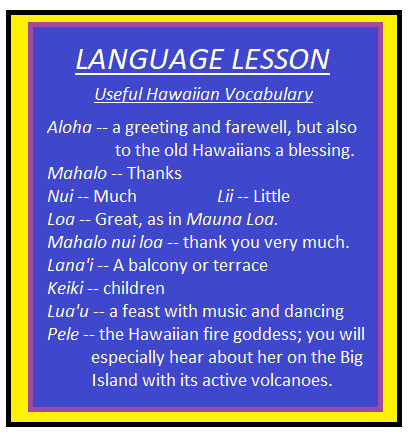
If you ever decide to go to Hawai'i, I hope these hints will help you. I can guarantee you that Hawai'i is not just "another resort" like Cancun or the Dominican Republic. To close this off, I'm going to wrap up with a collection of useful Hawaiian words that you should certainly know if you are going to come here. Some of them have already cropped up in earlier posts.
 
Well, that's a wrap. Hope I will see you in Hawai'i the next time I choose to go!

Saturday, April 2, 2022

Return to Aloha # 3: A Hike Around the Hawaiian Village

In my last post, I mentioned that some guests can probably spend a week at the Hilton Hawaiian Village and never go off the property (except, perhaps, onto the beach, which is of course a public beach and not private to the hotel). Some readers may think, "Isn't that kind of boring?" Well, it is and it isn't, and in this post I want to introduce you properly to this resort which is definitely like no other I've ever visited. For certain, I've never seen another resort hotel looking like this one!


To start yourself off right, you need a map. These maps appear on signboards in various places around the property, and always include a recommendation that you photograph it yourself to keep a copy. It's very good advice. (this map is a slightly outdated version, but close enough)
 

By the way, if you click on any photo in this blog, it will enlarge.

Calling this walking tour a "hike" is a slight exaggeration, but the distances involved are such that you can get in quite a bit of exercise just going from place to place on this property. As an example, just yesterday I went for a walk after breakfast from Tropics Restaurant at the base of the Ali'i Tower, along the beachfront, all around the Duke Kahanamoku Lagoon, back out to the beach and around to the side of the Rainbow Tower facing the Super Pool to go up to my room. Fifteen minutes.

Let's begin with that walk, which shows two of the three main private swimming venues in this resort village. The first is the Lagoon, which can be used for all kinds of watersports opportunities -- SUP boards, giant waterbikes, kayaks, and just plain swimming. This was an early morning walk; the lagoon will get much, much busier as the day goes on. Notice, too, that you are looking at one of the very few private beaches in Hawai'i. Because the lagoon and its beach are artificial, they don't fall under the state's jurisdiction.


Now, I ask you: is that a poetic view of the extinct volcano Diamond Head or what? And could there be a more lovely, evocative place to do morning yoga on a paddleboard?

On this walk, you also pass by the Paradise Pool which is fitted very creatively into the limited space between the Lagoon Tower and the edge of the property. It's actually a series of several pools of varying sizes, all edged with natural-looking volcanic rock formations, and with the upper and lower levels connected by a kid-sized waterslide. There are also two bigger waterslides which empty into the upper main pool, and are open at specified hours each day. The entire Paradise Pool is really a kid's paradise, and a must-visit for families with children.


Completing that walk around the lagoon, you come back to the beach front and pass by the Rainbow Tower to the Super Pool -- the heartpiece of the resort. It's actually two pools -- a huge main pool, and a smaller but still healthy-sized shallower pool for "keiki" -- children. This means, of course, that all of the kids are normally in the main pool. This is the pool that features in the view from my "lana'i" (balcony or terrace -- note that this is again a three-syllable word!).


It just looks like there are a lot of vacant lounge chairs. Vacant chairs are dark chocolate brown. The grey chairs have grey pool towels draped on them. Just like a cruise ship, the Hilton Hawaiian Village has an ongoing problem with greedy, selfish people who hog lounge chairs for hours on end without actually using them. The real problem, though, is that there just aren't anywhere near enough lounge chairs for the sheer size of the place.
 
Going around the far side of the Super Pool, you come to Tropics Restaurant, my personal favourite among the resort's food outlets. It has outdoor and indoor portions, both huge, and a regular army of servers who work very hard at seeing that their guests are happy at all mealtimes. The outdoor portion is draped with mesh nets to deter the many and aggressive pigeons and gulls which haunt the resort at all hours. Smaller birds have figured out how to get inside the nets and hop around after crumbs, but they do not harass diners as the pigeons and gulls would do if given half a chance.
 
The real delight of Tropics is that it has a number of tables-for-two arranged along the outer edge, with the best views of the beach, the beachfront walkway, and the endless array of people going by. 


 Turning inland at this point, you walk past the Ali'i Tower, the resort's most deluxe section. "Ali'i" is a word designating the traditional and hereditary nobility of the peoples of Hawai'i. The Ali'i Tower has its own concierge service, a private bar and food outlet, and a private pool.
 
You then walk into the Ali'i Plaza, between the Ali'i Tower and the Diamond Head Tower. This is the first of several collections of shops you'll encounter as you walk through the resort, although there are in fact shops in every tower of the complex. 
 

 The shops range from high-end clothing, perfume, and jewellery purveyors to ABC convenience stores, and all points in between. Passing through the Ali'i Plaza, bear to the left and you will come to the Village Green and the Akalā Chapel (formerly called the Ocean Crystal Chapel).


It's not hard to guess that this beautiful place is meant to host weddings. But, you may wonder, what about beach weddings? Remember, though, that here in Hawai'i every beach is public property. You can try to have a beach wedding, and the resort will help you to arrange it if you wish -- but there is no legal way to prevent the immediate world from dropping in and watching.
 
From the chapel, you pass by the Tapa Tower (tallest in the resort), cross the driveway, and enter the Rainbow Bazaar. You'll find a great deal crammed into a small space here, from architecture inspired by the traditions of Japan, China, and colonial America to shops and restaurants of all kinds. At one time, the Hawaiian Village was proposing to tear down the Bazaar and replace it with yet another high-rise tower. I hope they've abandoned that plan permanently, as the Rainbow Bazaar is truly one of the most unique features of the property.


Here in the Bazaar is where you will find many of the independent food outlets, including a pizza place, a deli, a seafood restaurant, an Italian restaurant, and more. When you've walked through the entire Bazaar, you come out onto the driveway and find yourself again facing the long, low building which houses the front desk, concierge, tour desk, and other such services. It's really a building in name only, for the most part, as so much of it is a roof covering an open-air space.

Turn right, away from the front desk building, pass the Rainbow Tower, and you come to the Great Lawn. In the past, this has been used for receptions and events of one sort or another. Now, it is the venue for the resort's "lu'au" -- a Hawaiian feast with singing and dancing, which is one of the better-known cultural features of Hawai'i. The name specifically refers to the hole in the ground, lined with lava rocks, which is first preheated with fire, then filled with food to be baked, and then covered over with palm leaves, rocks, and sand to trap all the heat and steam/smoke the food. 
 
In the Hawaiian Village's version, there is no lu'au oven -- but there is an excellent mixture of traditional and modern dishes, an ample supply of mai tais, wine, and other refreshments, and a spectacular post-dinner show. I did my best to get some pictures, but without a flash it was tough -- even though I paid a premium price to be seated in the front section.


The second picture shows the dancers wearing a traditional skirt made out of ti leaves. I particularly like the last picture because it captures something of the grace and beauty of the classic Hawaiian dance, the sacred hula -- a poem in music, movement, and gesture.


Thursday, March 31, 2022

Return to Aloha # 2: On to Legendary Waikiki

The contrast is so huge, it's almost laughable. I've moved from a hotel a whole four stories tall into a forest of high-rises. 
 

Nor is that the only contrast. To get here from Kaua'i, I had to take a short inter-island shuttle flight on Hawaiian Airlines. And here's a picture of the bus.
 
Hawaiian Airlines photo
 
Readers of the previous blog post may recognize the setting, as this is an airline publicity photo taken over the Na Pali Coast in Kaua'i. Old-timers among my Canadian readers may recognize this Boeing 717 as the lineal descendant of the old McDonnell-Douglas DC-9 which used to fly with Air Canada to so many cities of all sizes across Canada. It's far too small and too short-ranged to operate flights from Hawai'i to anywhere else, so it spends its whole working life shuttling between the islands on a busy schedule of commuter flights -- like this one.
 
 
To those who may ask, "Why not ferries?", the answer is that the distances are considerable and the open-ocean waters around the islands of Hawai'i are often not as placid as the name "Pacific Ocean" would suggest. A ferry would have to be designed for full open-ocean operations, and would likely require five or more hours to make the voyage from Kaua'i to Honolulu. It's hardly surprising that the people of Hawai'i have embraced the air age when it comes to travelling between their islands.

Anyway, welcome to the island of O'ahu, home of the mid-Pacific crossroads metropolis of Honolulu and the world-renowned Waikiki Beach.

Although Waikiki may look, in pictures, much like many other famous resort areas around the world, it is actually a resort with a difference -- and in North America, only Fort Lauderdale (in my experience) is at all comparable. It's an urban resort, a resort area integrated right into a major city. You are driving down the streets of Honolulu, you cross a short bridge over the Ala Wai Canal, which you might not even notice, and there you are in the resort district of Waikiki.
 
By the way, notice anything about these place names? Honolulu? Waikiki? Duplicate syllables like this have a specific purpose in Polynesian languages like Hawaiian.
 
 
I'll go out on a limb and assume that Honolulu is an extremely calm port while Waikiki almost certainly means loads and loads of fresh water.
 
Waikiki resembles Florida beaches in another way. As the English translation of the name suggests, the area used to be a wetland fed by fresh-water springs and fronted by a natural dune separating it from the ocean. Modern development led to the construction of the Ala Wai Canal to drain the wetlands, and the importation of huge amounts of sand to build up the dune into a solid mass of land with a beautiful sandy beach at the front. Virtually all modern beach resorts in Florida were created in much the same way. This aerial shot shows clearly how the beach district is separated from the rest of the city by the Ala Wai Canal.
 
Licensed from vecteezy.com
<a href="https://www.vecteezy.com/free-photos">Free Stock photos by Vecteezy</a>
 
Alas, nature is determined to reclaim her own, and the beach keeps eroding and washing away with the shoreline currents despite the best efforts to preserve it -- also a problem at many Florida resorts.
 
Only at the west end of the iconic crescent of sand, Duke Kahanamoku Beach, has the sand managed to hang on and widen. And that just happens to be where I am staying. Here's the view from my room.


Anyone who has ever stayed there will recognize this right away as a room view from the iconic Rainbow Tower of the Hilton Hawaiian Village Resort. Beyond a doubt, this building, with its spectacular mosaic rainbow mural on each end, is the most prominent and the most instantly recognizable high-rise on Waikiki.
 
Cheat -- sunset photo from my previous stay here in 2015!
 
It's also the most expensive part of the resort in which to stay. How did I afford it? Well, I didn't. My regular readers will recall that I have often talked about the benefits of loyalty. Here's another one. I had reserved the cheapest available room, a king-bed room with a resort view. That would have been in one of the back towers of the complex. On check-in, my Hilton Honors status entitled me to an upgrade to the best available room that's not a suite, and here I am. Here's an aerial view of the entire complex to give you an overview. The Rainbow Tower is the tall one casting its shadow over the lagoon.

 
In all, there are eight towers in the complex. The four marked "V" are the ones housing hotel rooms, while the four marked "G" are now branded as Hilton Grand Vacations, meaning that you pay even more for the use of suites, condominiums, or timeshares of one sort or another. Rooms in those buildings can also be booked as hotel rooms, but the rates are much higher than the hotel proper. 

Within the complex, there are half  a dozen assorted eating outlets belonging to the hotel, including a super-deluxe steak/seafood restaurant, a more casual beachfront restaurant, poolside cafe-bars and more. In the resort's marketplace, there are other independently operated restaurants, so that in total you have over a dozen choices of places to eat without leaving the property at all. 

There are also two large swimming pools and three smaller ones, an enormous artificial lagoon for water sports of all kinds, and that beautiful broad beach out front. I'm sure many people who come here on holidays never leave the complex at all!

This might seem an unusual place for a guy who claims to hate crowds, but the odd thing is that, in spite of its sheer size, the Hawaiian Village is much less crowded than many other areas and resorts where I have stayed at one time or another -- and that includes the Sheraton in Kauai which I just visited for four nights.
 
In the next blog post, a quick tour of some of the major features of this city-within-a-city resort.


Monday, March 28, 2022

Return to Aloha # 1: Back to Kauai

Well, here I am, and the secret is out. My late winter holiday is a return to Hawai'i, which I last visited five years ago, in 2017.
 
Getting to Hawai'i is all about the jetlag for residents of eastern North America. It's no less than six time zones away from Toronto or anywhere on the U. S. east coast. I left my hotel in Toronto at 6:45 am on Friday, and after 3 flights and 2 stopovers of about 3 hours each (and several other hassles), I finally reached my hotel room in Kaua'i at 10:30 pm (which is 4:30 am in Toronto). Think of it -- over 24 hours in transit. Needless to say, I'm going to be living in a jet-lagged fog for quite a few days.
 
But it all became worth it when I woke up in the morning to this sunrise view from my room.
 

Honesty compels me to admit that I spent a fair chunk of my time in Kaua'i lounging by the pool, soaking up local colour in the lounge, and otherwise decompressing after two solid winters at home without a single hot day anywhere. But I did get out to see a few scenic highlights. Kaua'i has many.

Kaua'i, often called "The Garden Isle," is the oldest in geological time and the least developed of the four major Hawaiian Islands for tourism. That second point may not remain true for much longer. The mere fact that it is more rural and less built up seems to be attracting more and more visitors, competing for the available hotel rooms and driving up room rates accordingly. Comparable resorts in Kauai are selling for easily twice the cost of properties on Waikiki Beach in Honolulu. Five years ago, Kauai was notably cheaper than Waikiki.
 
One look at this map is enough to tell you that this is a rural island.
 

I'm referring, of course, to the one single road running all the way around island, State Highway 50/56, most of which is only two lanes wide. No freeways here! There is one major airport at Lihu'e, with a runway long enough to accommodate medium-size twin-engine flights from North America. The secondary airport at Princeville can handle inter-island flights on smaller light twin aircraft and helicopters.

The three main resort areas are Princeville in the north, Kapa'a and Wailua in the east, and Poipu on the south shore. I'm staying at the Sheraton Coconut Beach Resort in Kapa'a. Here are a few pictures of the property to give you an impression.


In the last picture above, the wide paved walkway/cycle path marks the limit of the hotel property. To the left of the path is public land, including the beach, since by state law there is no such thing in Hawai'i as a private beach (except for beaches inside military reserves). There's a public beach access point on the south side of the hotel.

A fourth-floor corridor window on the landward side of the hotel gives this panorama of the island's mountainous interior, all of which has eroded down over untold millions of years from the two primordial volcanoes which gave birth to Kaua'i. On the far left side, behind the nearer peak and partly hidden in clouds (a normal condition) is the summit of Wai'ale'ale, the highest mountain on the island, and one of the wettest places on the entire planet.

We've barely got started, and it's time to begin language lessons.


Yes, I know that the apostrophe is actually turned around and has another special name but we're not going to get too technical here.
 
My first full day was spent just lazing around the pool, the restaurant, the bar, the pool, the bar.... Well, you get the picture. I still keep feeling sleepy at the weirdest times on the clock, thanks to the six-hour time zone displacement. On the other hand, simply lazing around the pool is very good for the soul in its own way.

On my second day, I went for a drive. Kaua'i is one island where a rental vehicle becomes essential, to put it mildly. Distances look deceptively small on the map. Also, traffic increasingly poses problems, especially in and around Lihu'e. So it took me almost exactly one hour to drive from Kapa'a all the way around to Kekaha and Highway 552. Along the way, I took a brief stop at the overlook for the Hanapepe Valley. You have to be alert, it's easy to miss on the highway.


Why not Highway 550 from Waimea? There are road signs directing people to use 552, and I would say with good reason. From Waimea up to the junction with 552, Highway 550 is one of the most sadistic roads I have ever driven. It has grades and bends that would do justice to a modern roller coaster, and is especially nasty at the upper end where you hit incredibly steep downgrades whichever way you're going, as the road climbs in and out of several deeply-gouged stream valleys. Highway 552 may take a bit longer, and cover a few more miles, but it's positively civilized by comparison. Certainly, anyone unused to driving mountain highways is better off to do the slightly longer route via Kekaha. 
 
Either way, by all means stop for a few minutes in Waimea to have a look around at the unique historical architecture of the main street, rather than just driving through.


As a bonus, if you carry on to Kekaha you get this distant, enticing view, just before entering the town, of the so-called "forbidden island," Ni'ihau, to the southwest of Kaua'i. 
 

Here's a link where you can read something of the fascinating history of Ni'ihau on Wikipedia -- it's quite the eye-opening story.

 
After you turn onto Highway 552, another twenty minutes of steady climbing brings you to the first main viewpoint in Waimea Canyon State Park. Here you will purchase admission and parking passes to the park at a ticket machine, which accepts only credit cards. For car and driver, not residents of Hawai'i, the fee is $15, with $5 additional for each further passenger. Similar ticket machines can be found at all major parking areas, and by April 19, 2022 all will be updated to sell both admission and parking tickets.
 
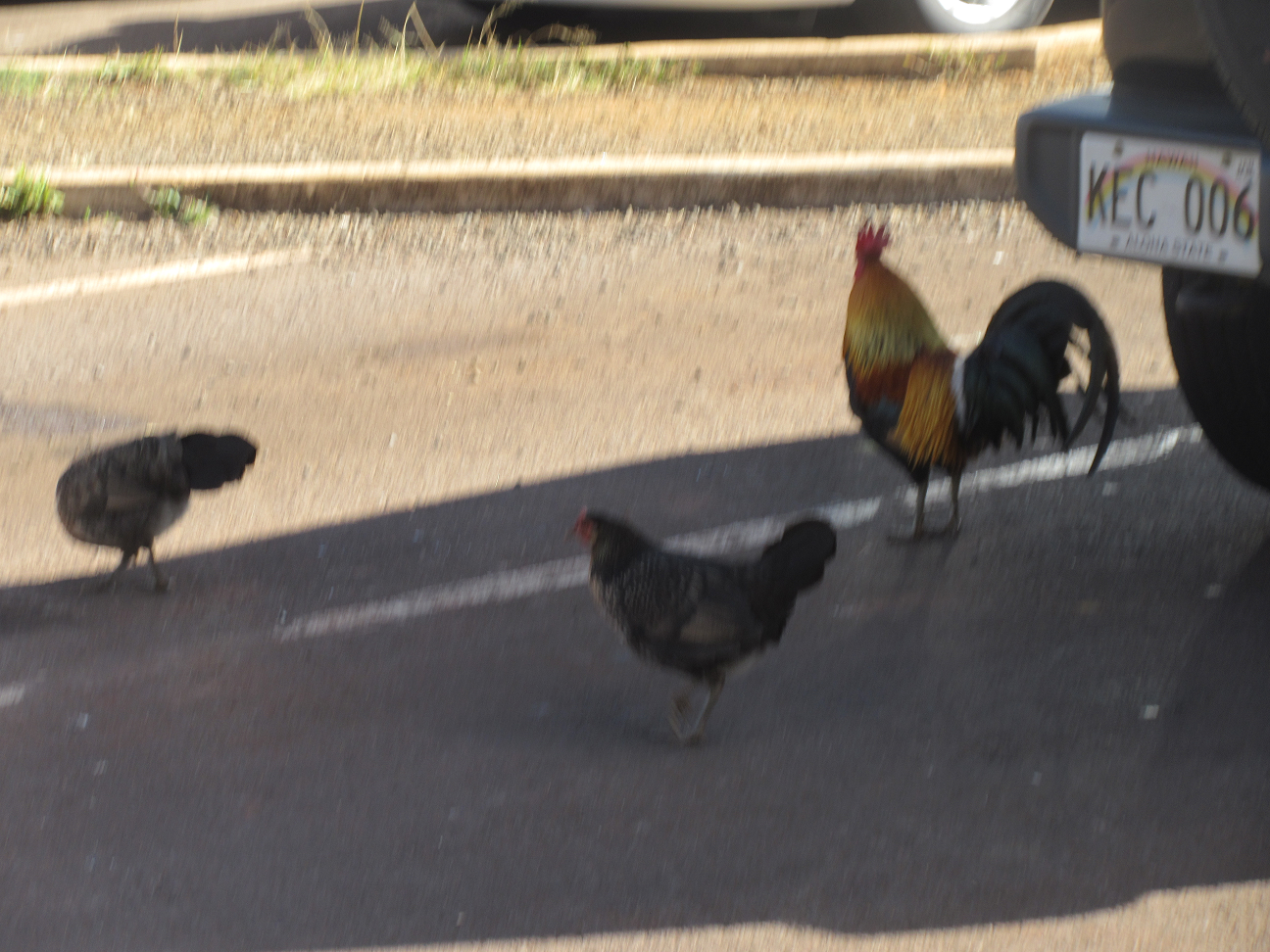
You will also, almost certainly, encounter Kaua'i's dominant form of "wildlife" if you haven't already done so -- the hordes of feral roosters, hens, and chickens. The crowing of roosters is a common background sound all over the island.


These clucking, crowing critters are almost everywhere in Kaua'i, and the song of the roosters runs from before sunrise all throughout the day.

Once you've paid your fee, you are covered for all parking areas in Waimea Canyon State Park and Koke'e State Park, both of which you will certainly visit while you are up on this mountain to begin with. Yes, it's a mountain. You are well over 3,000 feet above sea level, and the temperature -- which was 75F at Waimea -- dropped to somewhere between 60F and 64F, and held that level consistently throughout my visit. The main lookout points all have handicapped-access viewpoints.

With that, here are some choice pictures of the breathtaking Waimea Canyon, which is itself not far short of 3,000 feet deep. No wonder it's called "the Grand Canyon of the Pacific."

Look in the distance at the top left of this next picture. That height of land seen far away is Wai'ale'ale, seen from miles away and, for once, not covered with rain clouds. It's about 2000 feet (600+ metres) higher than the Canyon viewpoint. I think this was the first time I'd ever seen the mountain in the clear in three visits to Kaua'i.


It's a challenge photographing the canyon from the west side. In the morning, you are facing the sun, which explains why some of the pictures can look a bit washed out. Come back in the afternoon, and the canyon might not even be there any more if the rain has moved in.
 
Who knows, you might even encounter this particular "wild" critter, although that's a different story from the poultry.


After visiting the Canyon lookouts, you continue up the road and into Koke'e State Park. But be warned! After you pass Koke'e Lodge, the road has a number of rough spots, with one stretch so bad that matters have gone far beyond the "pothole" stage. I think they should borrow the name of a scenic road on the Big Island, and call that bit of road the "Chain of Craters."

Eventually you arrive at two more lookout points which offer differing views of the Kalalau Valley as it stretches downwards to the north shore of the island, again well over 3000 feet below you. This is the famous Na pali Coast. There is no road access along the Na pali Coast, only a tough hiking trail, and so less athletic visitors have to view it from the edges, as it were, or from a tour boat or helicopter. By the way, "pali" is the Hawaiian word for "cliff." You can see why.


By the way, you mustn't be surprised if you drive all the way up those twisting mountain roads to find one or more (or all) viewpoints socked in with fog, cloud, and rain. It can happen, but I've been lucky on each of my three visits to the Canyon -- or so it seems. It's not all luck. After only a few days in Hawai'i, or any other tropical island, you will soon learn that sunshine is more prevalent in the morning but afternoons often cloud over. I've always driven up to the Canyon as early in the morning as I can go. You should too.
 
More active visitors should certainly check out the opportunities for trail hiking in both parks.

After that set of breathtaking photo calls, I headed back down the mountain, and turned east, then south to the next destination, in the Poipu resort area on the south shore. 
 
 
Doesn't look very exciting? Wait till you see the interior.


"Restaurant meets Theme Park." Most restaurants look for an exciting or beautiful location to set up shop. Keoki's Paradise built its own. To all appearances a tropical jungle miles from nowhere, what you are actually seeing is an artificial garden which backs directly onto the main road through Poipu. There are a few seats in the bar area from which you can see the odd vehicle through gaps in the trees. Otherwise, the only clue comes when some especially loud motorcycle or hot rod guns its engine in the middle of the forest.
 
So in I went, and was ushered to a table neatly tucked in between two boulders of volcanic rock emerging from the floor. 
 
 
I was there for the Sunday brunch, so I missed out on the fresh fish which is the specialty of the house at dinner time -- as they say in their menu, "The fresh Hawaiian fish we serve are available according to their season in keeping with Hawaiian fishing traditions and respect for the sea (kai)." On the other hand, weekend brunch is one of the times they feature live music, and the singer was a definite asset to the meal.

The setting becomes even more magical at night, when tiki torches are lit and a few carefully placed lights among the trees highlight key features of the gardens. Some people might call it kitschy. I find it a refreshing change from the loud canned music in most restaurants, the endless repetitions of certain basic dishes like wings, fries, ribs, pizza, and the like. Keoki's Paradise is different, and I value that difference -- especially when every meal in this setting feels like an event. It's my one must-visit restaurant destination in Kaua'i and never disappoints.

Just talking about it is enough to make me hungry! I'm going to knock off now to look for some dinner, and post this before I go, because this marks the end of my Kaua'i adventures. Tomorrow, I'm off to Honolulu and the world-famous Waikiki Beach. See you there!