Showing posts with label trans-Pacific. Show all posts

Saturday, April 9, 2022

Return to Aloha # 4: Helpful Hints for Hawai'i

It's been a remarkably low-key holiday, but I'm in no doubt that this is exactly what I needed. I've been off the property a couple of times, but have no more spectacular photos to share -- far too much pool and chill time this week! And the views....
 
 
What I can share is the following helpful hints, the product of five separate experiences with Hawai'i over a period of 25 years:
 
[1]  Bring lots of money (or credit limit on your cards). Hawai'i is out in the middle of the Pacific, and Honolulu is located farther away from the next nearest city of a million people than any other city of that size on the planet. This map gives you the overview.
 
 
Likely three-quarters of everything you will eat, the linens your hotel will provide, the furniture you will sit, eat, and sleep on, the gas in your car or tour bus, the vehicles themselves, all will have been shipped in from outside. It's easy to take for granted the bottle of Heinz ketchup on your table at breakfast time, but when you stop to think that the ketchup -- like you -- has travelled many thousands of kilometres from its place of origin and crossed up to six time zones to land on your table in time to go with your scrambled eggs, bacon, and potatoes... well, suffice it to say, prices in Hawai'i are high, and "expensive" is likely the most common criticism levelled against Hawai'i's restaurants, shops, and hotels.
 
[2] Be patient. Hawai'i may be an American state, and it may look American on the surface, but at heart, deep down inside, it is a tropical island culture. Take-it-easy is much more than just a cultural manifestation, it's a survival skill in the tropics, especially for those who work out of doors. The result is that much of what you will see and do in Hawai'i runs on "island time," and there's nothing to gain by expecting/demanding that service personnel keep up to your expected standards of mainland speed and punctuality. And anyway, aren't you here on holiday?
 
[3] Be realistic. You are not going to see everything Hawai'i has to offer on one trip, any more than for any other destination you might visit. My advice? Confine yourself to a maximum of two islands for your first time. Make O'ahu one of them, and pick any one of the other big three (Kaua'i, Maui, or the Big Island) to go along with it.
 
[4] Enjoy the gifts of the islands. These include the fresh fish and shellfish, the tropical fruits and vegetables, and the coffee. Oh, that Hawaiian coffee. Not many people who've never been here have any idea that Hawai'i grows some absolutely incredible coffee beans, and right here is the place to enjoy the results. I've been in heaven for over a week, brewing up a fresh cup of mouth-watering Hawaiian coffee in my room every morning, and then enjoying even more of it with my breakfast. You can imagine how I pity the people who think they're better off walking to the nearest Starbucks for their morning java. Perfume? Clothes? Liquor? Nope -- my shopping is for a stash of Hawaiian coffee to bring home with me!
 
[5] Speaking of shopping, as an American state, you can find all sorts of familiar American brand stores here, ranging from the Targets and Walmarts in the residential districts all the way up to the top-end luxury brands in the tourist areas. But why? It's actually easy to find shops and stalls selling the products of local makers and crafters, and those are the places to seek out.

[6] Lu'au. You probably want to do one, and so you should. Many hotels and resorts in the main tourist areas offer lu'aus. Many of them are good, but light years ahead of them all (for my money) is the one offered at the Polynesian Cultural Center in Laie, on O'ahu. I've been there twice and will certainly go again (just didn't make it on this trip). 
 
The ideal choice is to take one of the full-day tours which picks you up from your hotel in Waikiki, drives you to the center (about an hour away), gives you the day to visit the outdoor exhibits, shows, and demonstrations which sum up the cultures of all the main Polynesian island nations (not just Hawai'i), and then culminates with the lu'au dinner and the landmark evening show, staged in a large amphitheater with full theatrical lighting and sound effects. What makes this entire day event so special is that the participants are all residents of the various Polynesian cultures which they present to you. All have come to Hawai'i as students and faculty of Brigham Young University of the Pacific which is built entirely around the preservation and dissemination of these remarkable cultures of the islands. The PCC wrote the book on authenticity in Polynesian culture, arts, and food. If you can only do one thing on O'ahu, let this be it.

[7] Speaking of tours, Pearl Harbor is one place where a tour is advisable. The number of visitors to the USS Arizona memorial has to be limited each day, and by turning up on your own you might find you need to wait for a long time. On a busy day, especially on the weekend, you might not get in at all if you don't arrive early enough. Tours, of course, have space pre-booked and get in with no waiting. It matters because the memorial is reached by boat from the landside parking, museum, and exhibition.

[8] On being early. Hawai'i consists of tropical islands, and the temperatures ensure that clouds build up over the islands as the day goes on. Every day. Depending on location, if you are a chronic late riser, you might not see much sun at all. Trust me on this. In the tropics, you are far better off to cut your big nights short and get up each morning in a timely way. Case in point: the pool area was filled with gorgeous sunshine this morning; by 3:00 pm the sky was clouding over. Also, there's the rain. Little sprinkly showers can happen almost any time of any day, but are certainly more common, and sometimes more forceful, in the afternoon. Just as a by-the-way, I read years ago that islanders refer to these frequent little showers as "liquid sunshine."
 
[9] Rental cars, like everything else, are pricey. On O'ahu in particular, I recommend doing without your own wheels.  The traffic in and around Honolulu is heavy-duty, not surprising in a city with nearly a million people in the metropolitan area. Now, really, did you have to travel all this way just to sit in traffic jams? Especially this is so when the range of coach tours on offer is so enormous, and when the island's own transit bus service (laconically called "The Bus") runs on an unbelievably cheap fare of just $1.00 per ride.

If you ever decide to go to Hawai'i, I hope these hints will help you. I can guarantee you that Hawai'i is not just "another resort" like Cancun or the Dominican Republic. To close this off, I'm going to wrap up with a collection of useful Hawaiian words that you should certainly know if you are going to come here. Some of them have already cropped up in earlier posts.
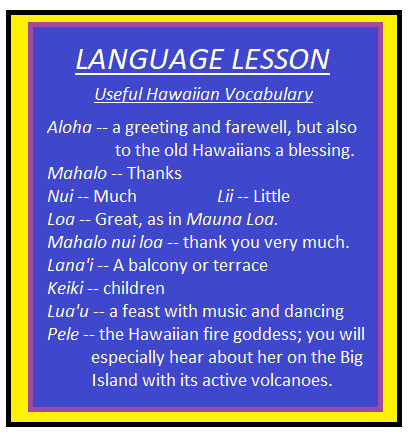
 
Well, that's a wrap. Hope I will see you in Hawai'i the next time I choose to go!

Sunday, March 13, 2022

Polynesia, Here I Come!

In less than two weeks, I'll be taking off on a late winter vacation in Polynesia. 


But where exactly is that?
 
Polynesia, a cultural rather than a national or political identity, sprawls across a vast area of the Pacific Ocean, encompassing hundreds of islands and dozens of island communities. The main political entities in Polynesia are Hawaii and American Samoa (USA); French Polynesia and Wallis/Futuna (France); New Zealand, the Cook Islands, and Niue (New Zealand); Easter Island (Chile); Tuvalu, Samoa, and Tonga.

Matters get blurry around the edges of the region, as neighbouring island groups like Fiji and Kiribati may be the home of peoples of Melanesian or Micronesian ancestry, yet share some common linguistic and cultural features with the Polynesians.


How did these diverse cultures become so widely spread across such a vast distance of water? With their sail-driven dugout outrigger canoes, the Polynesians were mighty seafarers. 
 
With no aid from compasses or maps, and only the action of wind, waves, clouds, seabirds, and the eternal stars to guide them, they learned how to cross the trackless oceans again and again. They didn't just explore from island to island; they continued to travel, sending repeat parties of colonists when informed that new land had been found and settled.

The result is that, whichever part of Polynesia you visit, you will encounter a fair degree of familiarity as compared to other Polynesian societies and cultures: familiar words, familiar foods, familiar styles of music and dance, and much more.

So far, in this region, I've visited Fiji, New Zealand, Hawaii, and (in French Polynesia) Tahiti, Huahine, Moorea, Bora Bora, Raiatea, and Rangiroa.
 
Every year, a few cruise ships will sail through the regions of Polynesia, stopping at a number of different islands. This is now the easiest way to get a cross-section view of the entirety of Polynesia (unless you own a private yacht or jet). Other cruise ships do shorter regional trips, like the 10-day cruise around French Polynesia which I took in 2015, starting and ending in Tahiti.
 
Otherwise, travel across Polynesia is mainly via air travel -- and the options for island-hopping are severely limited. This isn't just due to the pandemic. Ever since airliners were developed that could fly nonstop from North America to Australia, the number of planes stopping over in the islands on trans-Pacific flights has dropped to a mere fraction of the flights in earlier years.  Trying to plan an air trip to multiple destinations in Polynesia in an exercise in skill and patience alike.

I'm not trying. Much as I'd love to see more of Polynesia, I'm sticking to just one limited area of Polynesia for my upcoming trip. I'm looking forward to feasting on quantities of fresh fruit and fresh fish, to enjoying sun and leisure...,


 to watching traditional dance and listening to traditional music...,


to admiring brilliantly coloured tropical flowers...,


and to immersing myself in the rugged beauty of the volcanic mountains.


Yes, all the islands in Polynesia are volcanic in origin. Active volcanoes are still part of life here, as Hawaii has experienced for years and Tonga has recently discovered again. 
 

The less recently active volcanic islands (within the last 500 millennia or so) will still have jagged mountain peaks and spires thrusting up here, there, and everywhere. 


The very oldest of all will have eroded down to a flat-topped platform under the ocean with coral reefs growing all around the edges, and sandbar islands (called motus in French Polynesia) forming in a ring within the shelter of the reefs -- and thus, you have the popular image of a Polynesian island composed of nothing but sand, shells, and coconut palms, all caressed by warm, gentle tropical breezes.


Getting to Polynesia from my home in Eastern Canada is a time-consuming exercise. To give you some idea from my past travels: Toronto to Vancouver takes 5 hours, and you're still in Canada. From Vancouver, the nearest corner of Polynesia is Honolulu, 6 hours flying time away. The farthest corner is New Zealand, and Auckland is another 9 hours beyond Honolulu. Tahiti is 6 hours flying time south of Honolulu and Fiji about the same. These are not short hops! You have to cross multiple time zones, and -- in the case of a few of the more westerly Polynesian countries -- you also cross the International Date Line and arrive on a different day from the day you departed.

Oh, which part of Polynesia am I heading for? To be continued....

Note: all pictures in this blog post are taken from previous adventures in one part or another of Polynesia, in 2015 and 2017.

Thursday, February 2, 2017

Inside Out and Upside Down

There are few experiences I've ever had in my travels that are more disconcerting and disorienting than flying between Canada and Australia or New Zealand.

I went for the first time in 1994 and as you read this I am ready to leave and go again.

To grasp the scope of the problem, you really need to take another look at a map of the world: a kind of map such as you rarely see in North America although it's common in Australia and New Zealand.


The first key fact is that the Pacific Ocean is humongous -- the Atlantic shrinks almost to the dimensions of a puddle by comparison.  We aren't normally aware of its sheer size in North America because it always appears in two separate chunks out at the edges of our traditional styles of world maps.  But yes, it's huge.  A nonstop flight from the west coast of North America to Sydney in Australia will take 14 or 15 hours, give or take a bit.  

And that's only the beginning of the problem.  Depending on route and time of year, you're going to cross anywhere from five to eight time zones on the way down -- cue the massive jetlag.

And as if that weren't enough, you're going to cross two imaginary but nonetheless very significant lines on the map: the Equator and the fiendish International Date Line.

Take the Equator first.  As soon as you cross that line into the southern hemisphere, things began happening that can disorient you mightily.  I found out about the big Number One on my first day in New Zealand 22 years ago.  I was on a driving trip along the coast, and stopped for a swim and quick power nap at a beach.  Since I'd been driving south when I stopped, I turned south out of the parking lot when I got rolling again.  But something was wrong.  After a few minutes I could see that I was passing road signs and a village that I'd already driven through before my stop.  And that's when it hit me: in the southern hemisphere, the sun parades across the NORTH side of the sky.  Thinking "south", I automatically turned towards the sun -- when I should have turned away from the sun to keep travelling southwards.  

You can get a distinct feeling that everything is backwards in other ways too.  The sun still crosses the sky from east to west but, as you stand facing the sun, it is travelling from right to left, not from left to right.  This all took a few days to get used to.  Less confusing, but still a bit odd, is the reversal of the seasons, so that the dead of winter in Canada coincides with the height of summer in Australia and New Zealand.

And then there's the pesky, man-made Dateline.  When the system of universal time zones was developed in the late 1800s (by, among others, Canadian engineer Sir Sandford Fleming) it became necessary to set a point at which each day would officially "begin".  Since there was already extensive traffic of ships across the Atlantic Ocean, the decision was taken by an international conference to follow Fleming's suggestion and set the starting point in the middle of the Pacific, along or near the 180 degree meridian of longitude, where it would inconvenience the smallest number of people.

Well, that's no longer true because of the development of longer-range aircraft and the vast increase in trans-Pacific trade.  But we're stuck with it now.  

The workings of the International Dateline baffle many people, but the concept is actually quite simple.  Let's zoom in on the map and have a closer look.   All the zigzags are just to allow the entire territory of one country or another to be on the same side and therefore on the same day.  Each day, then, actually begins first in New Zealand and the Pacific island countries of Samoa, Fiji, Tuvalu and Kiribati.  The real champion among inhabited territories is the island of Kiritimati (that's pronounced "Christmas", by the way), the easternmost inhabited island of the nation of Kiribati.  It's in that big jog to the south of Honolulu.


As you cross the Dateline going west, you set your clocks ahead by one entire day.  Going east, you set your clocks back by one entire day.  People in Australia and New Zealand are much more used to this gimmick than we are, and will say, ever so casually, "We're eighteen hours ahead of you" or whatever the exact time difference may be. When you get right down to it, that's the easiest way to calculate the time difference between home and where you are in those countries.  I quickly caught the habit when I was there before.

The one time when the relationship becomes really clear is on New Year's Eve, when the television shows the fireworks going off in Auckland and Sydney long hours before the ball drops in Times Square in New York -- in fact, around sunrise New York time on December 31!

When the Dateline gets really weird, though, is when you fly across it.  Going west, many nonstop flights travel through the night.  So you will leave, let's say, Los Angeles on a Monday night.  During the flight your clock will advance to Tuesday at midnight and then as you cross the Dateline it will advance again and you'll arrive in Auckland or Sydney early on Wednesday morning.  Tuesday has simply vanished from your calendar.  This could be excessively bizarre if you happened to have your birthday on that Tuesday!

On the return flight, because of the direction the time zones are rolling, you can leave Auckland or Sydney on Thursday around 1:00 pm, fly through the rest of the day, evening, and night, and land in Los Angeles in the morning in time for a late breakfast -- but it will still be Thursday, so you will actually get almost all of Thursday twice.  Obviously the only sensible thing to do is to fly home on your birthday and be sure to have your cake in Australia and eat it too in North America!

As for me, the mere thought of a 14-hour nonstop flight is enough to exhaust me (once when I was 40 years old was quite enough).  If you look again at the map, you'll see that convenient cluster of islands about a third of the way across the ocean from the U.S. West Coast.  It's called "Hawaii", and that gives me my cue.

Even a two and a half hour stopover in Honolulu is a huge benefit on such a long trip, giving you a chance to stretch your legs, rehydrate, breathe fresh air (sections of the terminal at Honolulu are linked by outdoor walkways) and generally wind down before the next leg.  Not only that, but it becomes simplicity itself to throw in an extended stopover in Hawaii at next to no extra charge on your ticket, as I am doing on the way home.

Best of all, it gives me my excuse to fly again with one of my all-time favourite carriers: Hawaiian Airlines.  You have to try this airline to believe it.  The service is always outstanding, attentive and friendly, and the food is a far cry from traditional "airline food".  The menus offer an intriguing fusion of various Pacific cultures, just as Honolulu itself is a city populated by almost all the nationalities of the Pacific Rim.  If you want to see what I mean, go to their website and you can find menus for the meals served in business or first class and in economy class on all their major routes.  Indeed, Hawaiian Airlines (as far as I know) is the only airline that gives free meals to all passengers (not just the premium cabin) between the U.S. mainland and Hawaii.  A trip on Hawaiian always makes me wonder why anyone would want to fly across the South Pacific with any other airline.