Showing posts with label Bora Bora. Show all posts

Sunday, March 13, 2022

Polynesia, Here I Come!

In less than two weeks, I'll be taking off on a late winter vacation in Polynesia. 


But where exactly is that?
 
Polynesia, a cultural rather than a national or political identity, sprawls across a vast area of the Pacific Ocean, encompassing hundreds of islands and dozens of island communities. The main political entities in Polynesia are Hawaii and American Samoa (USA); French Polynesia and Wallis/Futuna (France); New Zealand, the Cook Islands, and Niue (New Zealand); Easter Island (Chile); Tuvalu, Samoa, and Tonga.

Matters get blurry around the edges of the region, as neighbouring island groups like Fiji and Kiribati may be the home of peoples of Melanesian or Micronesian ancestry, yet share some common linguistic and cultural features with the Polynesians.


How did these diverse cultures become so widely spread across such a vast distance of water? With their sail-driven dugout outrigger canoes, the Polynesians were mighty seafarers. 
 
With no aid from compasses or maps, and only the action of wind, waves, clouds, seabirds, and the eternal stars to guide them, they learned how to cross the trackless oceans again and again. They didn't just explore from island to island; they continued to travel, sending repeat parties of colonists when informed that new land had been found and settled.

The result is that, whichever part of Polynesia you visit, you will encounter a fair degree of familiarity as compared to other Polynesian societies and cultures: familiar words, familiar foods, familiar styles of music and dance, and much more.

So far, in this region, I've visited Fiji, New Zealand, Hawaii, and (in French Polynesia) Tahiti, Huahine, Moorea, Bora Bora, Raiatea, and Rangiroa.
 
Every year, a few cruise ships will sail through the regions of Polynesia, stopping at a number of different islands. This is now the easiest way to get a cross-section view of the entirety of Polynesia (unless you own a private yacht or jet). Other cruise ships do shorter regional trips, like the 10-day cruise around French Polynesia which I took in 2015, starting and ending in Tahiti.
 
Otherwise, travel across Polynesia is mainly via air travel -- and the options for island-hopping are severely limited. This isn't just due to the pandemic. Ever since airliners were developed that could fly nonstop from North America to Australia, the number of planes stopping over in the islands on trans-Pacific flights has dropped to a mere fraction of the flights in earlier years.  Trying to plan an air trip to multiple destinations in Polynesia in an exercise in skill and patience alike.

I'm not trying. Much as I'd love to see more of Polynesia, I'm sticking to just one limited area of Polynesia for my upcoming trip. I'm looking forward to feasting on quantities of fresh fruit and fresh fish, to enjoying sun and leisure...,


 to watching traditional dance and listening to traditional music...,


to admiring brilliantly coloured tropical flowers...,


and to immersing myself in the rugged beauty of the volcanic mountains.


Yes, all the islands in Polynesia are volcanic in origin. Active volcanoes are still part of life here, as Hawaii has experienced for years and Tonga has recently discovered again. 
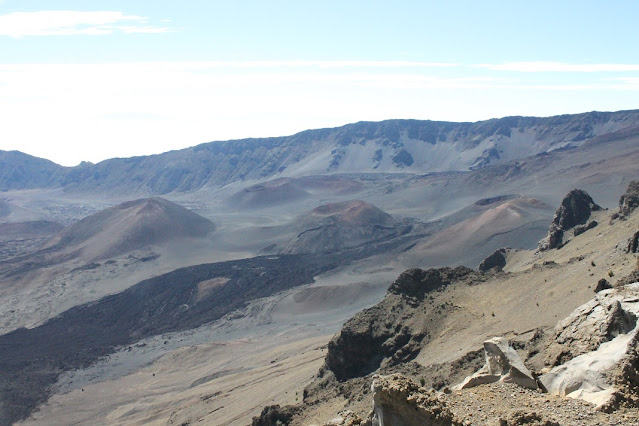
 

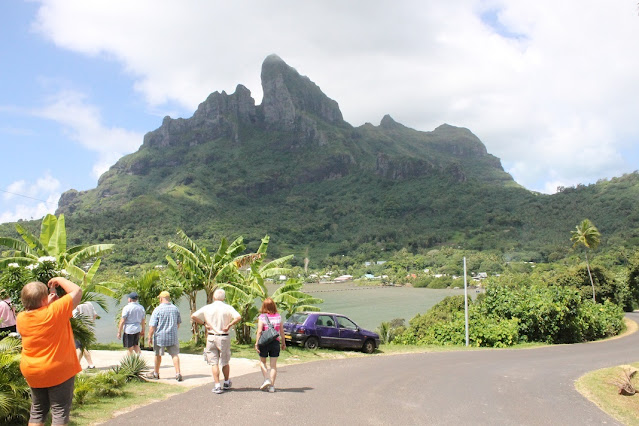
The less recently active volcanic islands (within the last 500 millennia or so) will still have jagged mountain peaks and spires thrusting up here, there, and everywhere. 


The very oldest of all will have eroded down to a flat-topped platform under the ocean with coral reefs growing all around the edges, and sandbar islands (called motus in French Polynesia) forming in a ring within the shelter of the reefs -- and thus, you have the popular image of a Polynesian island composed of nothing but sand, shells, and coconut palms, all caressed by warm, gentle tropical breezes.


Getting to Polynesia from my home in Eastern Canada is a time-consuming exercise. To give you some idea from my past travels: Toronto to Vancouver takes 5 hours, and you're still in Canada. From Vancouver, the nearest corner of Polynesia is Honolulu, 6 hours flying time away. The farthest corner is New Zealand, and Auckland is another 9 hours beyond Honolulu. Tahiti is 6 hours flying time south of Honolulu and Fiji about the same. These are not short hops! You have to cross multiple time zones, and -- in the case of a few of the more westerly Polynesian countries -- you also cross the International Date Line and arrive on a different day from the day you departed.

Oh, which part of Polynesia am I heading for? To be continued....

Note: all pictures in this blog post are taken from previous adventures in one part or another of Polynesia, in 2015 and 2017.

Monday, February 16, 2015

Last Words on the Pacific

Throughout my month-long trip to Hawaii and Tahiti, I was periodically shooting film footage on my new mini-video cam.  I managed to upload just one of those clips into the blog, and it took so long that I decided to do the rest after I got home.  This involved a lot of updating of the various original posts.  Follow the links below and you'll come to the appropriate posts, where you can scroll down to find the video clips now embedded.

To start with: some coastal surf and bodyboard surfing in Tahiti.

At Sea in Polynesia

Next, an amazing clip of a feeding frenzy induced by tossing some dead fish into the water, all filmed from the semi-submersible sightseeing vessel in the atoll of Rangiroa.

Two More Very Different Worlds

Then a look at the shores of the main island of Bora Bora.  As well, on Moorea, the gorgeous views from the Belvidere lookout point halfway up the main mountain.

More Famous Islands

And finally, the view of West Maui mountains from the volcano Haleakala, island of Maui in Hawaii.

In The House of the Sun

I hope all of my faithful readers have enjoyed reading these blogs as much as I have enjoyed writing them.  I'll be back at some future date with more travellers' tales and helpful travel hints.

Saturday, February 7, 2015

More Famous Islands

Another two-day sail brought the Ocean Princess back west to the high island of Raiatea.  I suspect this zigzag path may have been dictated by the cruise schedules of other ships in the area, as most of these smaller islands wouldn’t have the resources to host more than one shipload of visitors per day.

Raiatea is the administrative capital of the Leeward Islands group within the Society Islands (consisting of Raiatea, Tahaa, Bora Bora, Huahine, and Makatea).  As a result, there is an actual town with a developed harbour area, and Ocean Princess was able to dock there.  That makes coming and going from the ship much easier!  The quaint grass-hut “village” on the edge of the dock area is, of course, a shopping mall cunningly disguised. 


I enjoyed a 3½ hour drive around the island, with several stops, lots of colourful tropical flowers, and plenty of scenic views.  


Unlike Huahine, we managed a mostly sunny day although it did cloud over in the afternoon – true to form.  At a small family-run pearl farm we got a concise and clear description of the process of cultivating the Tahitian black pearls, made possible of course by the black-lipped oysters found in this region.  Another stop was at a marae, a traditional Polynesian temple/meeting place/social area.  It was simply defined by a large wall of rough slabs of volcanic rock stood on edge in a row.  


Our guide explained to us that a marae could be as small as the one used by a single family.  This one was used by a tribal king or chief.  There is a much bigger complex of maraes in the south of Raiatea which we didn’t see, but which is known far and wide as a centrepoint of the Polynesian peoples, since so many of the migrations of the Polynesians all over the Pacific originated here.

It was another hot, humid day so I just slacked off on board ship for the afternoon – another hour on the sundeck at the pool, and another nap. 


Later at night, the local dancers came aboard and put on a 45-minute show of traditional costumes and dancing which was very high-energy and fascinating to watch.


 The following day we sailed into the lagoon at Bora Bora for a two-day stay.  This is the most famous of all the islands of French Polynesia.  Thank Marlon Brando for that.  He built a string of bungalows along the shore around 1960 and ever since then this has been the getaway for the rich and famous, the"beautiful people" (so-called), and celebrity watchers and wannabes from all over the world.  As a result, if you plan to stay here, plan on paying 50%-100% more than in any other resort in French Polynesia for basically the same product and service.  Demand rules!

Bora Bora is a high island but one that is well on its way to disappearing.  There are already five or six "high islands" within the lagoon, as well as the surrounding chain of motus.  In fact, most of the resorts with the world-famous over-water bungalows are on the motus, as is the airport.  We, of course, had to go ashore by tender.  

This island also marked my first encounter with one of the more unusual modes of transportation in the world, "Le Truck".  Found in many islands in French Polynesia, it is basically an improvised open-air bus body attached to the back mounting of a truck cab.  The body of "Le Truck" is wood, the seats plastic or wood, and cushions are an uncommon mercy (fortunately, we had cushions for today's 3 1/2 hour tour of the main island).


Bora Bora is an island for spectacular views, often backed by the stunning profiles of its two central mountains, the twin peaks of Mt. Otemanu.  It was a constant presence on our drive around the island.  This towering mass of ancient igneous rock, split down the middle by erosion forces, has the sheerest cliffs I’ve seen since viewing “The Diadem” (the volcanic plug in the centre of Tahiti).  Because of the irregular shape of the formation, it looks different from every angle as you travel around it.  No matter where you are on the twisting main road, you can’t go much more than a couple of kilometres before seeing the mountain rearing up in front of you around the next bend, like some giant primordial beast.


At the other end of the size scale, we were amused at a roadside stop when the guide told us to grab the hibiscus flowers hanging by the open windows and throw them out on the ground.  We then watched as the land crabs came out of their holes to seize on a food source.  Some of them got into pulling matches over a particularly choice branch of the plants.  These land crabs, by the way, are found in burrows in the ground near the shore of every island we've visited.


And here's a video clip I filmed from a beach where we stopped, giving a quick view of this famous island destination -- and one of the tourists who came here.


Bora Bora’s other great glory is the clear water of the lagoon and the huge variety of marine life found within it.  I opted to take a glass-bottom boat tour on my second day, as a way of getting closer to the marine life.  Although the general experience was similar to the semi-submersible in Raiatea, it was a lot less cramped and we got to enjoy the beautiful sea breeze as we sat under the canopy peering down into the water.

Sadly, though, the reefs here are in as bad shape as the ones I’d seen elsewhere.  The guide today mentioned a point which wasn’t familiar to me.  One of the key toxins for the coral is the range of chemicals found in sunscreen lotions.  Truly, we tourists are loving the coral reefs to death.


One other stop included a demonstration of the art of dyeing and decorating the pareos.  Before our eyes, two workers created a beautiful basic tie-dye pattern in a matter of seconds.  They then spread it out to dry with cutout shapes on top to further refine the patterns.


In the mid-afternoon we sailed for Moorea, the high island directly across from Tahiti, and arrived there early the following morning.  Moorea wins the prize for spectacular scenery, with its volcanic core split into numerous craggy mountains (it’s a much bigger island than Bora Bora).  Not only that, but there is actually a paved road halfway up the central massif to the Belvidere (lookout) with a dramatic view over the two main bays in the north shore, with each bay hosting a cruise ship today. 


Here'a video clip giving a panorama at the same lookout point.


There are also much better views of the ocean, as you drive around Moorea, and a spectacular view across the Sea of the Moon to Tahiti (weather permitting).  No view today, we hit several rain showers during the latter half of our coach tour and Tahiti was completely hidden by rain and clouds when we reached that point on the circuit.  Fortunately, our tour driver had taken us to the Belvidere first thing on the trip!


Overall, Moorea seems to be the most prosperous island, with the highest percentage of fully-constructed homes and shopping areas.  I think this has a lot to do with the fact that many well-to-do people who work in Papeete choose to live in Moorea, commuting back and forth by the 15-minute fast catamaran ferries.  On the other hand, Moorea -- just like Kauai in Hawaii -- has its own sizable population of wild fowl, with roosters crowing from dawn to dusk everywhere you go!


The cruise over, I am now back in Tahiti.  Tonight I attended a performance by "Les Grands Ballets de Tahiti" at the hotel, a weekly outdoor event every Friday with a Tahitian buffet dinner.  Despite the name, this is a Tahitian folkloric dance show, but one performed at the highest standard of dancing, singing, and staging.  It was a fascinating, dizzying whirlwind of a show, and my only regret was that my pictures didn't turn out too well.  Here's one of the better ones.


And that marks the end of my adventures in French Polynesia.  After this final night in Tahiti, I am flying back north to Hawaii.  More travellers’ tales will continue to appear here!