Showing posts with label New Zealand. Show all posts

Sunday, March 13, 2022

Polynesia, Here I Come!

In less than two weeks, I'll be taking off on a late winter vacation in Polynesia. 


But where exactly is that?
 
Polynesia, a cultural rather than a national or political identity, sprawls across a vast area of the Pacific Ocean, encompassing hundreds of islands and dozens of island communities. The main political entities in Polynesia are Hawaii and American Samoa (USA); French Polynesia and Wallis/Futuna (France); New Zealand, the Cook Islands, and Niue (New Zealand); Easter Island (Chile); Tuvalu, Samoa, and Tonga.

Matters get blurry around the edges of the region, as neighbouring island groups like Fiji and Kiribati may be the home of peoples of Melanesian or Micronesian ancestry, yet share some common linguistic and cultural features with the Polynesians.


How did these diverse cultures become so widely spread across such a vast distance of water? With their sail-driven dugout outrigger canoes, the Polynesians were mighty seafarers. 
 
With no aid from compasses or maps, and only the action of wind, waves, clouds, seabirds, and the eternal stars to guide them, they learned how to cross the trackless oceans again and again. They didn't just explore from island to island; they continued to travel, sending repeat parties of colonists when informed that new land had been found and settled.

The result is that, whichever part of Polynesia you visit, you will encounter a fair degree of familiarity as compared to other Polynesian societies and cultures: familiar words, familiar foods, familiar styles of music and dance, and much more.

So far, in this region, I've visited Fiji, New Zealand, Hawaii, and (in French Polynesia) Tahiti, Huahine, Moorea, Bora Bora, Raiatea, and Rangiroa.
 
Every year, a few cruise ships will sail through the regions of Polynesia, stopping at a number of different islands. This is now the easiest way to get a cross-section view of the entirety of Polynesia (unless you own a private yacht or jet). Other cruise ships do shorter regional trips, like the 10-day cruise around French Polynesia which I took in 2015, starting and ending in Tahiti.
 
Otherwise, travel across Polynesia is mainly via air travel -- and the options for island-hopping are severely limited. This isn't just due to the pandemic. Ever since airliners were developed that could fly nonstop from North America to Australia, the number of planes stopping over in the islands on trans-Pacific flights has dropped to a mere fraction of the flights in earlier years.  Trying to plan an air trip to multiple destinations in Polynesia in an exercise in skill and patience alike.

I'm not trying. Much as I'd love to see more of Polynesia, I'm sticking to just one limited area of Polynesia for my upcoming trip. I'm looking forward to feasting on quantities of fresh fruit and fresh fish, to enjoying sun and leisure...,


 to watching traditional dance and listening to traditional music...,


to admiring brilliantly coloured tropical flowers...,


and to immersing myself in the rugged beauty of the volcanic mountains.


Yes, all the islands in Polynesia are volcanic in origin. Active volcanoes are still part of life here, as Hawaii has experienced for years and Tonga has recently discovered again. 
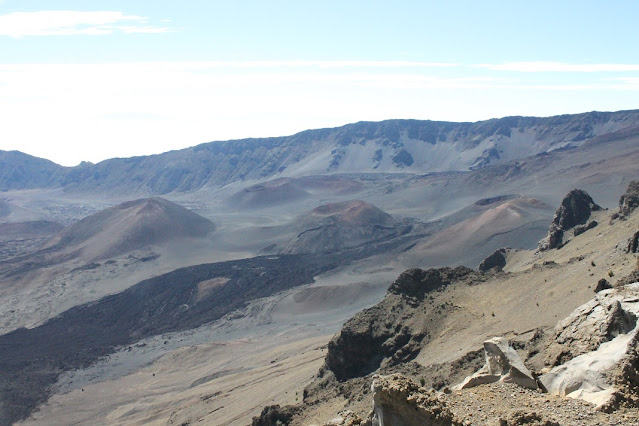
 

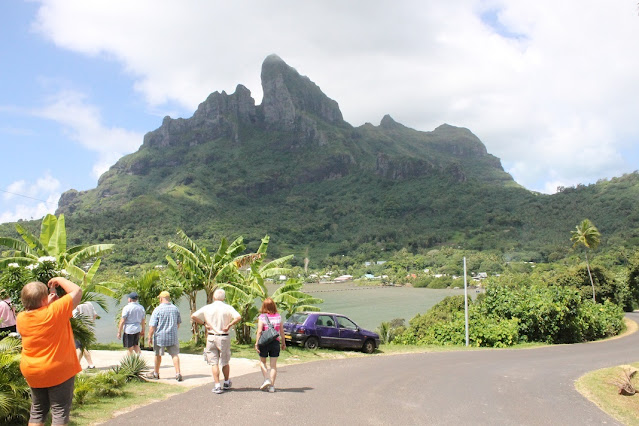
The less recently active volcanic islands (within the last 500 millennia or so) will still have jagged mountain peaks and spires thrusting up here, there, and everywhere. 


The very oldest of all will have eroded down to a flat-topped platform under the ocean with coral reefs growing all around the edges, and sandbar islands (called motus in French Polynesia) forming in a ring within the shelter of the reefs -- and thus, you have the popular image of a Polynesian island composed of nothing but sand, shells, and coconut palms, all caressed by warm, gentle tropical breezes.


Getting to Polynesia from my home in Eastern Canada is a time-consuming exercise. To give you some idea from my past travels: Toronto to Vancouver takes 5 hours, and you're still in Canada. From Vancouver, the nearest corner of Polynesia is Honolulu, 6 hours flying time away. The farthest corner is New Zealand, and Auckland is another 9 hours beyond Honolulu. Tahiti is 6 hours flying time south of Honolulu and Fiji about the same. These are not short hops! You have to cross multiple time zones, and -- in the case of a few of the more westerly Polynesian countries -- you also cross the International Date Line and arrive on a different day from the day you departed.

Oh, which part of Polynesia am I heading for? To be continued....

Note: all pictures in this blog post are taken from previous adventures in one part or another of Polynesia, in 2015 and 2017.

Saturday, February 25, 2017

The Down Under Expedition # 9: Last Thoughts on New Zealand

After my two-and-a-half weeks in New Zealand, I have now returned to the northern hemisphere.  I hope that those of you following my travels will have gotten a good idea of some places you might like to visit if and when you get to New Zealand yourself.  This final post is a combination of my own observations and reminiscences with helpful hints for those who hope to go some day.

How Long?  I can tell you quite plainly that two or three weeks is not enough.  If you really want to come to grips with this incredibly diverse country, you need more time.  The :map is rather deceptive on this score, as it is with a number of European countries.  The country looks small, but you can't travel as quickly as in North America, and roads are not as straight as many of ours.

North, South, or Both?   A tricky question.  Unquestionably, you need to see highlights of both main islands of this country.  How much time to spend with each?  That depends.  If you are interested in history, culture, museums, and the like, definitely spend more time in the North Island.  The South Island is the one to give more time to if you are more interested in the outdoors, mountain scenery, hiking ("tramping"), and other related pursuits.  But of course, there are many cultural features in the South and much spectacular wilderness in the North,

Getting Around:  New Zealand has an excellent network of frequent domestic flights, linking the numerous smaller cities and towns to one or more of the three main hub airports at Auckland, Wellington, and Christchurch.  Rail travel is confined to three main scenic train routes (one in the north island and two in the south) plus commuter trains in and around Auckland.  Bus travel has one condition unfamiliar to many Canadians: all bus seats on inter-city routes are reserved seats and must be booked and paid for before travel begins.  Bus services are fairly frequent in most populated areas.
Car travel: drive on the left!   A car is a must in more remote areas but more of a hindrance than a help in cities.  Also remember the higher cost of gas, ranging from $1.79 to $2.08 per litre.  Most New Zealand cities have fairly compact central districts and getting around them on foot is easy.

As for hikers, be aware that many of the best-known and most popular hiking trails are capacity-controlled to protect the environment and reservations must be made months or even years in advance for such routes as the Milford Track.

Between Islands:  Many air routes link the two islands.  The shortest ones hop across from Wellington on the North Island to the airports of Picton, Blenheim, and Nelson at the top end of the South Island.  Two different companies operate car ferry services several times daily between Picton and Wellington.  My rental car company would not allow you to take a rented vehicle on the ferry.  Instead, they will give you a single through rate for your city to city rental with no drop-off charge, but you will drop the first car at the ferry terminal and pick up the second car after you come off the ship at the other end.  This can also be arranged with air travel, and is cheaper than making two separate rental bookings.  I imagine most of the major companies follow this procedure.

Accommodations:  Deluxe hotels are found in all major cities.  Cheap backpackers hostels can be found in almost any community big enough to be on the map.  In between are a wide range of motels, from the very basic to the very deluxe.  In popular areas, expect to pay up to twice as much as for comparable accommodations in Canada during peak season.  I have no experience with bed and breakfast (I've never been comfortable staying in someone else's home) but expect that the same might apply for these too.  Expect to be asked to pre-authorize the cost of your stay on your credit card when you check in.

Suburbs:  The actual area of any major city is very small, since New Zealand (like Australia) makes wide use of suburban names for postal addresses and other kind of locations.  If using a taxi or shuttle service of any kind, you need to be prepared with the name of the suburb you have to reach, as well as a street name.

Food:  New Zealand has been invaded by several major North American fast food chains, and some of their products may be familiar but others are unique to this market.  Fancy a Macca's?  That's a local name for McDonald's which the corporation has actually trademarked!  Cafes are found absolutely everywhere, and always feature an espresso machine and a barista.  A favourite New Zealand treat is a "flat white" -- an espresso mixed with hot milk, with a thinner layer of foam on top than a cappuccino.  In cafes, bars, and bakeries you always order and pay at the counter, and if you are eating in you are given a number to put on your table so the server can bring your order when it is ready.  Even some restaurants do this, especially on outdoor patios!  Otherwise, restaurants offer the normal full service experience.

The diversity of menu options can be quite startling, with even small towns offering cuisine from a dozen different countries.  Prices again are high, but some locally produced items are bargains compared to the same meals in Canada:  lamb, local fish, and superb cheeses are three good examples.  New Zealand has long produced some really great wines, and craft breweries are now popping up all over the map too.  Many bars are glad to let you have a taste of this or that wine or beer before ordering a full drink.

Credit Cards:  These are readily accepted anywhere, and New Zealand adopted the chip and PIN system long before we did.  But be prepared to pay a surcharge for use of a credit card.  This hasn't been allowed in Canada -- yet.  A merchant is supposed to advise you ahead of time when a surcharge has been imposed.  I got the surcharge at one or two restaurants, but mainly with hotels -- and not even all of those made a surcharge.  Note that credit card machines do not offer a space for you to leave a tip.  You have to do that separately.

Money:  New Zealand dollar is basically at par with Canada right now, and bills look a lot like Canadian money.  Coins come in 10, 20, and 50 cents, 1 dollar and 2 dollars.  That's right, no penny and no nickel.  Prices are therefore dead simple, and not least because sales tax is always included in the price!.  Your receipt will show how much tax you have paid, but you don't have to calculate it when shopping or studying a menu.  When the price says $23.50, then $23.50 is exactly what you pay -- no more and no less.  Very sensible and refreshing after Canada's insanity of different tax rates for different kinds of purchases in different provinces, all added on at the till.  We need to get with the program!

Accent:  A couple of helpful hints go a long way in following the Kiwi accent.  The big # 1 is the simple rule, "i instead of e."  Thus, you get used to such words as Widnesday, nixt, Wist, lift, and bid instead of Wednesday, next, West, left, and bed.  This also covers the omnipresent national sound of agreement, a long-drawn and oft-repeated "Yihhh."  Since I mentioned Wist, it seems only fair to give the other three cardinal points of the compass.  These are Nohth, Aist, and Sahth.  

Maori:  The Maori are the aboriginal people of New Zealand, and are Polynesian, hence the similarities in words with such places as Fiji, Samoa, Tahiti, and Hawaii.  Much effort has been made in recent years into trying to preserve and recover the use of the Maori language and other cultural features and traditions.  Public announcements given in both Maori and English are increasingly common.

The basic rule of Maori pronunciation is to sound out all the letters -- with only a few exceptions, this works.  Your first Maori word is "Aotearoa" -- six syllables in all.  This is also a good sample of the poetic, evocative quality of the Polynesian languages.  It's the Maori name for New Zealand, and it means "the land of the long white cloud".  Since the Polynesians navigated from place to place in part by following the cloud towers that built up over the Pacific islands, it's not surprising that these much larger islands would produce a cloud that ran to length more than height.  Your second, and similar, word:  "Aoraki", the Maori name for the tallest mountain in Aotearoa, which is known in English as Mount Cook.  The name means "the cloud piercer."

Before this trip I was thinking that this would likely be my last hurrah for New Zealand.  Now, I find that I can barely wait to return once again to Aotearoa.  See you there?

Thursday, February 23, 2017

The Down Under Expedition # 8: North Island Adventures

Besides that incredible evening in Hobbiton, I managed a few other interesting experiences in the North Island of New Zealand before it was time to leave.

First of all, here are a couple of pictures of the spectacular coastal scenery at Piha, west of Auckland on the west coast.  The drive here was one of the tamer versions of the zigzag mountain roads found everywhere in this mountainous country.


In the "Just when you think you've seen it all" awards category comes this Piha road sign....


...and these two reasons why it is so very necessary.


On the way to Rotorua I passed this very unusual -- okay, weird -- landscape along a one-kilometre stretch of the road.  I'd love to know the geology behind this one.


Rotorua itself is set in a valley full of steaming vents, mud pools, hot springs, and geysers.  My hotel room directly overlooked a major section of the thermal fields, including the dramatic Te Puia Pohutu geyser.  With a view like this, who needs to pay admission?


Rotorua, like other communities in geothermal activity areas, makes good use of its resource by using heat exchangers to transmit the heat from the ground to hot-water heating tanks, swimming pools, and even home heating units for colder weather.  As well, bathing in the hot water from the springs, with its strong whiff of sulphur, is recommended for many ailments.  Most accommodations in Rotorua have their own hot springs pools for their guests, and there are also large public bathhouses for those not so fortunate.

I'm sorry I didn't get a picture because I couldn't stop due to traffic, but one day I sighted a steaming vent right under the wooden fence behind a house on the side of the main road!  That's Rotorua, in a nutshell, and it's a fascinating place -- provided the omnipresent odour of sulphur doesn't irritate you too much.  I found myself that after a day there I hardly noticed it any more.

And then there's Auckland, the "City of Sails," with its large natural harbour that makes it the country's major port of entry for cargoes of all kinds.  Auckland's airport is also the major point of entry for visitors arriving in New Zealand.  The city houses about 1.5 million people, almost 1/3 of New Zealand's entire population.

On my last night in New Zealand, I was lucky enough to stay (on my reward points) in the $400/night Hilton Hotel right on Prince's Quay in downtown Auckland.  Hilton allows you to pick the room of your choice when checking in online a day ahead, and I chose and got one that is nominally a "city view" room but still has a corner balcony where you get these views.


This hotel also has a unique outdoor heated pool with sundeck, between the hotel and its mirror-image apartment building neighbour.


Swimming in that pool was a freaky experience, to put it mildly.  Every second lap you come up against a thick plexiglass window and if you are wearing goggles you get a picture-perfect view of the waterfront four stories below -- and the inevitable passer-by staring up at you.  They stare because they get a picture-perfect view of you through the plexiglass!  Each time, I waved.  Some of them waved back.  Some of them turned away as if embarrassed to be caught staring!

By the way, if you think these buildings look a bit like cruise ships, that is not an accident.  It's a deliberate choice by the architect, carried out right to the seaward end of each building which has a point like a ship's bow.  So does the landward end of one of the apartment blocks.


Prince's Quay also doubles as a cruise ship terminal.  And that was another freaky thing that happened.  The ship docked beside the hotel was the German cruise liner, Phoenix-Reisen's Artania.  I sailed on that ship in 2000, when she was sailing for her original owner, Princess Cruises, as the first Royal Princess.  I also saw the ship again just over a year ago, when another Princess cruise that I was taking stopped for a day in the Portuguese island of Madeira, and the Artania was in port there the same day.  I think the ship is following me around!

As in many cities, one of the best ways to hit all the highlights in Auckland -- especially if you are staying downtown -- is to use the hop-on-hop-off sightseeing bus tour.  This takes you to such major attractions as Kelly Tarlton's Underwater World (which is in fact mostly underground) and the War Memorial Museum in the large public park called the Auckland Domain.


The use of the word "Domain" to describe a park is a down-underism found in most cities, towns, and even villages in Australia and New Zealand.  The incorporation of a War Memorial of some kind into the Domain is virtually a given.  But rarely do you meet one like this which serves some other purpose as well.

Another spot on the tour is Mount Eden.   Although the narrow summit road is now closed to motor vehicles, you can drop off the bus and hike the last steep 300 metres to the summit on the road.  I passed, not because I couldn't get up that hill, but because the steep grade would force me to walk very slowly on the way down (due to my bad knee) and I would probably have missed the next -- and last -- tour bus of the day.  So I settled for this partial view from the parking area.


One of the nicest things to do in Auckland is to hop on the ferry across the harbour to Devonport, a suburb on the north shore, and settle onto the patio of the dignified dowager Esplanade Hotel for lunch or dinner.


The hotel produced a marvellous meal, and the combination of sunshine and view was delightful,  And here, as I finished dinner around 6:30 pm, I saw proof of exactly why Auckland is called "The City of Sails."  It only needed enough time for the crews to get to the various marinas from their day jobs, and get their boats rigged up and ready to go -- and the harbour was transformed.


The great spectacle of the evening sailaway was the flotilla of yachts acting as escort to the Princess Cruises liner Dawn Princess as she glided majestically down the harbour towards the open sea.


And that was my final evening in New Zealand.  Five hours after these last pictures were taken I was aboard the Hawaiian Airlines' red-eye to Honolulu.  

Monday, February 20, 2017

The Down Under Expedition # 7: A Magical Evening in Middle-Earth

Tourism in New Zealand has benefited mightily from the immense world-wide popularity of Sir Peter Jackson's epic films of The Lord of the Rings and The Hobbit.  Nowhere is this more true than on a sizable cattle and sheep farm in the countryside of the North Island, where the village of Hobbiton was created for the films and remains today as a tourist attraction bringing in excess of half a million visitors a year.

This might not sound immense if the movie set were in a major metropolitan area, but it's located on the back forty of a large sheep and cattle farm in a rural region near the small town of Matamata, about half way between the small cities of Rotorua and Hamilton, and over 2 hours by road from the nearest major international airport at Auckland.

Anyone who knows my lifelong passion for the Lord of the Rings could readily guess that I would want to visit the film set.  But here's the wrinkle: when I went to the website, I found out that, among other special packages, they offer an evening excursion which includes dinner in the Green Dragon Inn, the tavern frequented by the hobbits in the film.  That totally intrigued me, and I signed up for it.

My main comment, by way of a review, was that the price looked a bit steep ahead of time but the entire event turned out to be worth every penny, and then some.  The weather was absolutely picture-perfect for the entire evening.  The tour was fantastic, informative, interesting, and a great way to get acquainted with some of the ins and outs of filming on location in such an out-of-the-way region.  The evening meal, which included the first round of free beer or cider from the bar, was a true hobbit feast -- in other words, far too much for mere humans to eat -- but we bravely did our best.  The small size of the group (less than 50 of us all told) and the large communal tables got everyone chatting and exchanging travellers' tales, just as things ought to happen in the Green Dragon Inn.  Our hosts were funny, helpful, quite happy to take pictures on our cameras, and generally everything you could want from such an event.

The dinner tour is almost always sold out -- booking well ahead of time is strongly recommended!  It lasts from 6:15 to about 10:45, give or take a few minutes.  If you decide to do this event, there are accommodations in the towns of Tirau and Matamata, each of which is about a 25-minute drive from the farm.

With that by way of intro, come and join me in reliving my trip to Middle Earth.

The first view of the Shire, as you arrive at the visitor's centre, known as the Shire's Rest.


A sign post just at the point where you enter the village.


A collage of some of the many hobbit holes we passed during our walking tour.


An area of the village known as The Dell.  Look closely and see how many hobbit holes you can spot in this one picture!


And here's Bag End, with some fellow who most certainly isn't a hobbit hanging around outside.


The Party Field, and the Party Tree, down the hill below Bag End.


The mill, at the edge of the pool.


The Green Dragon Inn, with the same non-hobbit loitering outside.


Interior views of the Green Dragon.


The dinner tables were loaded at either end with dishes of excellent food.


The real magic of the evening happened after dinner, when we were all equipped with lanterns and taken on a walk around the lower part of the village by night.  A selection of discreet lights illuminated a window here or a door there, and the Party Tree was also subtly lit up.  Here, you see some of those lights reflected in the mirror-calm surface of the pool.


We then stood in the Dell and put out the lanterns, while our guide, Bee, invited us to compose a kind of mental snapshot of the hobbit hole which had seemed most like home to us.  She then had us look upwards at the spectacle of the Milky Way sprawling across the night sky, so much brighter and clearer than you will ever see in any more developed part of the world.  It was a breathtaking image to carry away with us after having such a perfect afternoon and evening in such a remarkable place.

I like to think that J. R. R. Tolkien would have appreciated the attention to detail -- his detail -- which informed the windows, doors, turf roofs, and general rustic atmosphere in this remarkable re-creation of his beloved Hobbiton.

And one final piece of perfect timing -- less than three minutes after I pulled out of the parking lot to drive back to my hotel, the rain started hitting the windshield.