Saturday, August 22, 2015

The Great Canadian Epic, Part 3: Prairies and Mountains

Aaah, the wide open spaces of the Canadian prairies.  Everywhere you look from the train, you see the appurtenances of farming: the broad fields, the lines of trees serving as windbreaks, the steel sheds housing farm equipment, the irrigation hoses and sprinklers, the huge grain elevators.  The landscape is a patchwork of green, yellow, beige, and brown, depending on which crops are being grown (or not) in each big square field.  

There’s a popular impression among many people that the prairies are as flat as a billiard table.  As the old saying goes, if you stood on a gopher hill you could see all the way to China.  This is not true.  The area around Winnipeg and westward as far as Portage la Prairie conforms to that stereotype, but generally the land shapes itself into long rolling slopes which gradually climb up to meet the sky somewhere off in the middle distance.  The vast surface of the prairie is also carved by the valleys of rivers and streams, and speckled with salty ponds and pools known as sloughs. 


Take the region as a whole from east to west, and it actually consists of a series of three broad steps rising towards the foothills of the Rocky Mountains. 

It takes a bit of time to get used to Prairie towns and cities too.  Given the vast amount of open space available, towns were laid out on a wide scale with broad streets and with the railway station always near the centre of town.  A central feature of every old prairie town was the classic grain elevator, next to the railway tracks, and a few of the old traditional style elevators can still be seen.


 So, as we rolled west away from Winnipeg the track was dead straight and dead level and we moved right along at a good fast clip.  The line passed just north of Brandon and then the country began getting hillier, until we were actually climbing a distinct grade that slowed the train down noticeably.  The hills rose around us, looking reminiscent of Scotland with plenty of trees and grass added.  At the same time we collected a hearty little rain shower lasting perhaps 20 minutes (hence the splotches on the window). 


Across that height of land we dropped back down for a while, but then began climbing again until we were running high up on the north side of the Assiniboine River valley with its distinctively flat skyline at the top.   As soon as we levelled out at the summit we were back on more-or-less level prairie again.  And that was the first of the big steps (the second one passed during the night).

The following morning I was up very early (the time changes were getting me farther and farther ahead of normal clock time) and into the dome car where a welcome early cup of coffee woke me up enough to get some lovely photos of the prairie sunrise. 


The Skyline activity and dome cars have 24-hour coffee and tea on tap, with fruit and light snacks such as cookies.  No hurry, because the train was an hour and a half late getting into Edmonton.  These things happen, and any passenger on The Canadian needs to feel ready to roll with it.  At Edmonton, the train has to back into the station on its dead-end track.  Here, the Panorama full-length dome car has to be added.


Meanwhile, baggage has to be taken off and more baggage loaded in.  Then passengers have to be boarded or reboarded.  It’s a wonder that the crew managed all that in just under an hour (it’s scheduled to take an hour and a quarter).

Unlike, say, the Front Ranges of Colorado, the transition from prairie to mountains on this route is more subtle and takes longer.  It passes over the space of several hours while the dining car serves a leisurely brunch with open seating between 9:30 a.m. and 12:00 noon.  Hills gradually rise around the track, which is mainly through forest, and there follows a notable climb up to Obed Summit, west of the Saskatchewan River valley.  The train then drops down to cross the Athabasca River, and follows its broad mountain valley all the way to Jasper.  


As you would expect, the views are spectacular on both sides of the train, and the dome cars rapidly fill up – even on a day with clouds and rain like today.  But there were still seats in the domes for all who came.

Arrival in Jasper is in early afternoon.  People tend to think of Jasper as a resort, but its first and primary reason for existence is as a service centre for CN.  VIA Rail has a sizable presence here as well, with both the Canadian and the thrice-weekly Jasper-Prince Rupert train using the station.  It’s a beautiful old historic station building, right on the main street, and during the extended stopover here there’s time to get out and explore some of the shops and cafes which take up the street facing the station, and the street behind it.  Also Jasper is a very good place to shop for any important item you may have forgotten. 

I certainly took good advantage of the clear but cool walking weather, as the sun had begun to peep from between the clouds.  The first snow of the coming winter gleamed on the surrounding mountains, and the air certainly had an autumn-like feel to it.  But this can happen at any time of the year in a mountain resort town well over a thousand metres above sea level.  I’ll be stopping here for three days on the return trip, and will give a more detailed rundown on Jasper at that time.
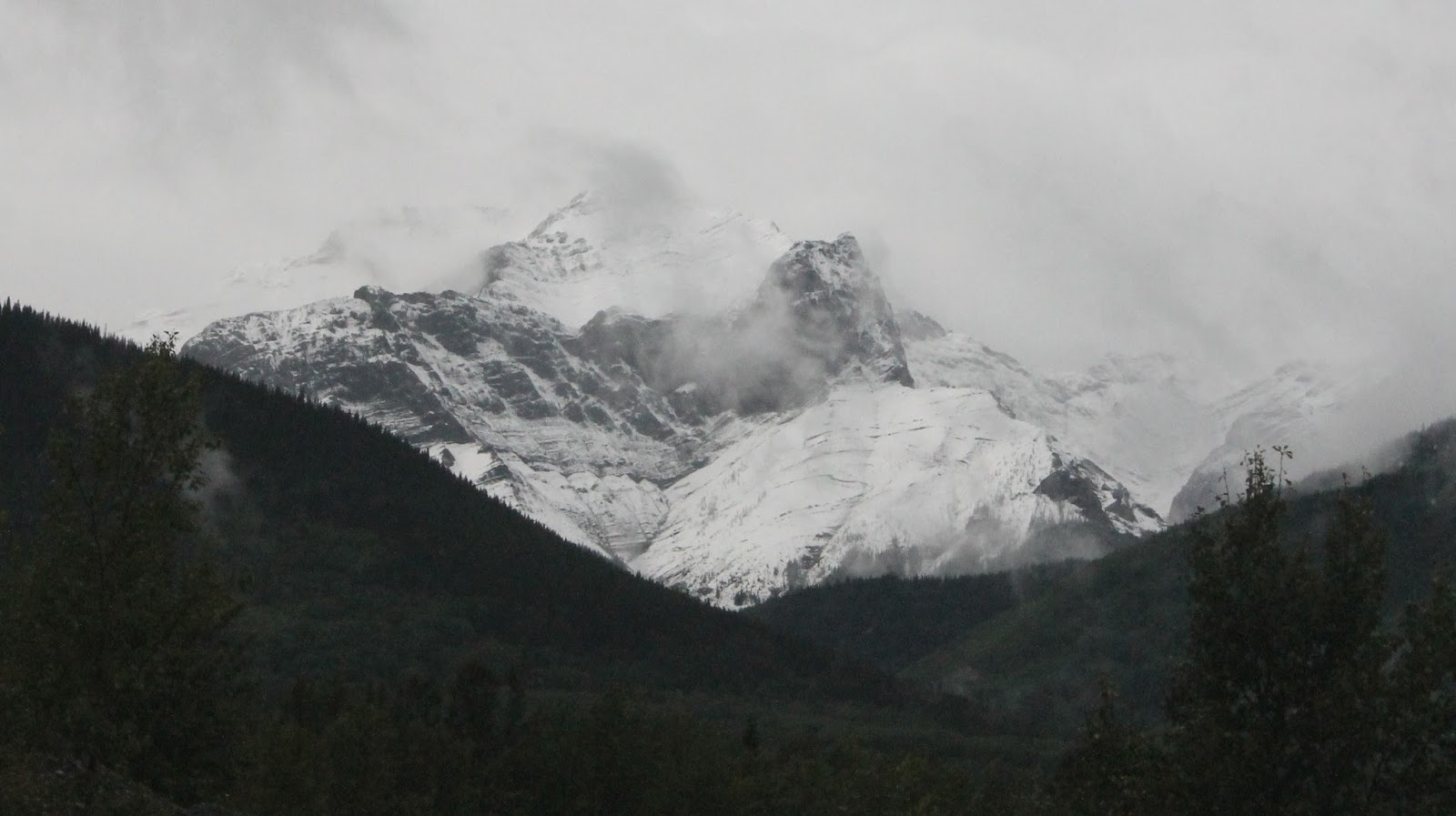

Because the Yellowhead Pass is at such a low altitude, there is almost no climbing at all out of Jasper before reaching the summit of the pass, only a short distance west.  There then follows a long descent past the expanse of Yellowhead Lake and Moose Lake.


From there the train runs down the long grade above the rapids of the newborn Fraser River, a lusty and energetic baby if ever there was one. 


Not long after that, Mount Robson, the tallest peak in the Canadian Rocky Mountains, looms into view on the right and to the rear.  Those of us seated at the back of the Skyline dome were perfectly placed for pictures, not least as we continued down the track, with the mountain sitting dead-centre behind the train.  Mount Robson's huge bulk is more than capable of generating its own weather.  I saw it full and clear in 2007 (see that picture here: Into the Mists: Canada's Pacific Northwest ) but I now think it looks even better with some weather in place.  It brings to mind that oh-so-evocative phrase from Shakespeare’s The Tempest:  “…the cloud-capped towers….”


Soon after that the train turns south into the Rocky Mountain Trench, and crosses that broad valley to climb over the Monashee Mountains and descend into the valley of the Thompson River.  This upper stretch of the Thompson valley is heavily forested.  Among the forest trees appears another scenic spectacle, Pyramid Falls (so called because of the shape of the waterfall).


This appears on the left during the evening and not long afterwards night descends.  Sadly, then, you miss the spectacular seared-desert scenery of the lower Thompson Canyon, and the steep mountain walls of the Fraser Canyon. 

Several of us lingered late in the dome, not anxious to leave.  You quickly form a special kind of partnership with your fellow passengers on a trip of this kind.  Part of this is because of the strongly international flavour of the train's population.  Within a small group of no more than 150 people (who shared my dining car and Skyline dome car), I met residents of several parts of Canada, a number of U.S. states (including New York, Maryland, Tennessee and Texas among others), Britain, Germany, Denmark, Australia, Japan, China -- and I'm sure I've forgotten a few.  As one of the group, Sarah (from Australia), observed on the last day, our varied stories were an important part of the total experience we all shared.

We dedicated dome sitters were of course a smaller, closer group.  Our little fellowship was certainly fostered by Hollie, the attendant in charge of the Skyline activity/lounge/scenic dome car during the second half of the trip.  With her flamboyant sense of humour, her great knowledge of the route, her willingness to answer and ask questions, and above all her energetic hospitality, she made the Skyline into a delightful place that rang with laughter and made people want to hang out there, and help each other get the best pictures they could. 

If you (like me) are an early riser, you make it back to the dome car by 5:45 a.m. with an early cup of coffee while the train is stopped at Hope and get some more pictures of mountain scenery and a final gorgeous sunrise before going for the last breakfast of the trip.  In fact, several of us were in the dome before 6:00 a.m. and witnessed the unforgettable sight of a sunrise over the mountains.
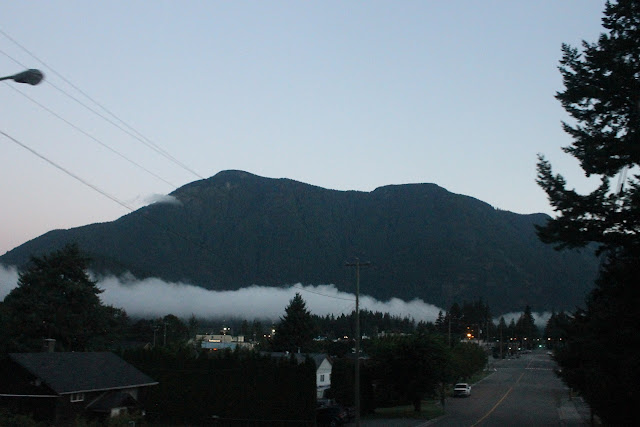


The train, ahead of time at last, rolled into Pacific Central Station at 9:00 a.m., forty minutes early. It says a lot for the special quality of the experience that people lingered, still chatting, in the station, reluctant to break the bonds we’d formed until it was time to pick up our bags and go our separate ways. 

Coming up in the next post, some scenery and other delights of Vancouver.

Thursday, August 20, 2015

The Great Canadian Epic, Part 2: Crossing the Canadian Shield

As I stated in the first post in this series, VIA Rail's deluxe trans-Canada train, The Canadian, has no onboard wifi service, and passes through sizable regions where even cellphone signals are hard to come by.

The result is that I am posting my first update on the actual trip from Winnipeg -- already halfway across the country!  Easy to do, because the train stops here for four hours for servicing and crew change.

Before departure from Toronto, all Sleeper Plus class passengers are entitled to use the Business Class lounge in Union Station, just off the west end of the Great Hall.  Free coffee, tea, juices and soft drinks are available.  Train staff come into the lounge to scan all tickets and to make dining car reservations for the first full day of the trip.  When it's time to board, you're called by PA announcement to head downstairs to the departure concourse, and then up to the train.  Staff are on hand to direct you to the proper car.  Since the train leaves at 10:00 pm, the beds are already made up for the night.

One of the oddest features of this trip from Toronto to the west coast (for my money, anyway) is that you start out by travelling almost in a circle before heading off east and northeast!  The Canadian uses the CN line up the east side of Lake Simcoe, but leaves Union Station westbound, before heading north, then east, and finally turning northeastward!  It then continues along a meandering course to the north and northeast, curving around the lake and its northward extension of Lake Couchiching to the northern tip at Washago. 

That’s the first timetabled stop, but (like most of the stops in Ontario) it’s available only by advance reservation.  No reservations, no stop.  The location is significant because Washago is the place where the train crosses the Severn River which flows from Lakes Simcoe and Couchiching into Georgian Bay.  This river’s wandering course marks the edge of the primeval brooding wilderness of the Canadian Shield.

It may come as a surprise to many, but the Shield was actually a far more formidable obstacle to the railway builders than the western mountains – partly due to the diamond-hard ancient rocks but mostly because of its sheer size.  The train entered the Shield at Washago yesterday morning at 12:40 am and didn’t leave the Shield for the western prairies until about 5:30 am this morning – a total of nearly 29 hours.  And for most of that time the train was rolling steadily forward at speeds ranging from 70 to 90 kilometres per hour.  Building a railway across this vast stony wilderness was indeed an epic feat of organization and construction.  The task required thousands and thousands of labourers, and consumed untold tons upon tons of explosives.

That wasn’t all it consumed.  Many lakes in the Shield have gradually filled up over the course of thousands of years with dead plant material.  Eventually, the piled up material rises to a point that the lake turns into a marsh and then into apparently solid ground called “muskeg”.  But don’t kid yourself.  The underneath material is still spongy and soft, and can’t support heavy weights.  Time and again, the railway builders built a mile of track over a nice flat stretch, and then woke up the next morning to find that the brand-new track had disappeared, sometimes taking an entire train with it.  They then tried dumping rock fill into the muskegs, and watched carload upon carload of big boulders vanish without a trace.  More rock.  Thousands of tree trunk pilings.  More rock.  Eventually the muskegs were tamed and the line completed, but the cost had been frightful. 

What you see from the train window today is basically an unbroken sweep of forest, dotted with lakes and interspersed with steep rocky hills.  On some lakes you can see cabins which may be year-round homes or simply seasonal hunting and fishing camps.  The track runs straight for some lengthy stretches, but often goes into an unending series of alternating left and right curves and quite a few of the curves are tight enough to make the wheels groan and squawk in protest.  The line plunges through numerous sheer-sided rock cuttings, proof positive of the amount of blasting needed to make this railway a reality. 


In the area north of Gogama the land turns much flatter, with many lakes, rivers, streams and ponds.  This is the edge of the Hudson Bay Lowlands, and even though you can’t tell by looking out the window, all the rivers in this area are flowing north to the Arctic Ocean.  The other indicator that you are closer to the true north is the forest which gradually becomes more and more dominated by conifers with fewer broad-leafed trees.  Much later on, when evening was coming on, the rocky hills began to reappear northwest of Lake Superior but by then it was too dark for any more photography.

I'll hope to get some nice pictures of the Shield country on the return journey next week!

One interesting discovery was that you can sometimes access the internet via the cellphone at certain spots, depending who your cellphone provider is.  I was able to get online briefly when we stopped at Hornepayne and again at Longlac (with Rogers).  However, a fellow passenger who was with Bell could not.  Later on we stopped at Armstrong.  This time she got the service but I didn’t!  Here's the train during our 40-minute stop at Hornepayne.


One of the great delights of the trip is mealtimes.  According to old railway tradition, a member of the dining room staff walks through the train bellowing “First sitting for dinner – premier service pour le diner” in a hearty voice.  The service director in the dining car has an uncanny knack of seating you with different people at every meal.  Everyone pitches in to keep the conversation flowing and some truly fascinating discussions ensue.

The ambiance of the dining car is like a classy restaurant of the mid-twentieth century, except that the dress code is strictly casual!  There are at least three if not four choices of main course at every meal.  The tables are all set with white linen cloths and napkins and heavy silver, with a small centrepiece.  At lunch and dinner there is a selection of wines and beers available, but contrary to the (slightly misleading) description on some of the literature these do have to be purchased.  The quality is good, and the price reasonable.

After dinner last night I wandered along to the dome car as evening fell.  It could have been a depressing day because of the unending clouds and rain, but wasn’t – due to all the fascinating conversations.  I had one more glass of wine as a nightcap and sat gazing at the unfolding panorama of forest and lake and hill as the twilight descended. 

And that’s a funny feeling I’ve gotten sometimes on train travel.  It can occasionally feel, on a smooth track, as if you are sitting still while the world rolls by outside your window.  Odd sensation.

I slept really well last night, maybe too well as I was feeling a bit groggy this morning.  This is known as taking full advantage of the one-hour-back time change.  The first thing I saw when I ran up the window shade was a spectacular prairie sunrise.


We arrived in Winnipeg at about 7:20 am, and even with a delay while the train was separated into two sections to be placed at two adjacent platforms, I was still off and walking by 7:40 on a glorious, cool, sunny morning.  The first sight was the classically-styled great hall of the station.


Across the street is the chateau-styled Fort Garry Hotel, another of the grand old hotels from the golden age of Canadian railway travel.


I took a good long walk all around the national historic park at The Forks, where the Assiniboine River flows into the Red River.


Nearby is this spectacular modern footbridge, named in honour of Louis Riel, across the Red River to the French Canadian community of St. Boniface.  (I apologize for the Blogger software which insists on turning this picture sideways, even when it has been properly set before uploading).


Close by the bridge sits this spectacular building, home of the brand-new Canadian Museum of Human Rights.  The west side is faced with local stone, giving an almost organic look, and the property by intention is landscaped with native prairie grasses.


After an hour or so of walking around, I was ready to sit, but that was easier said than done.  The area around The Forks is heavily populated with crows, and they tend to start zeroing in on anyone who stops moving for any length of time.  I wasn’t anxious to check out the (possibly) literal meaning of the correct name for a flock of these birds, “a murder of crows”, so I just kept moving back to the station.  Here, there is free wifi and a power outlet, so I can sit in a comfortable chair and work.  Later on, I’ll go out and walk around some more before it’s time to reboard for the West.

Monday, August 17, 2015

The Great Canadian Epic, Part 1: By Train Across Canada

From the days of my youth, I've been fully aware of the extraordinary tales attending the construction of Canada's major railways from Atlantic to Pacific -- the unremitting toil of the workers, the tragic confrontation of the "new" Europeanized Canada with the "old" societies of the First Nations, the struggles of the barons of finance, the gigantic political upheavals, all combine to paint an unforgettable portrait of a nation in the making by means unlike those of any other country in history.

For the railways truly were the making of Canada.  Without railways, the United States might have continued existence as primarily an east coast country, but the Canada we know today would more than likely never have come into being at all.

This great epic tale has been told in immense and fascinating depth and detail by Canadian historian Pierre Berton in his books The National Dream and The Last Spike.  It's been summarized more succinctly, but with no lessening of the epic impact, by folk singer Gordon Lightfoot in his immortal song The Canadian Railroad Trilogy which, as the title implies, is really three songs combined into one in a cyclical structure almost like a symphony.

And yet, these works of art -- powerful as they may be -- cover only one part of the whole story, although that the biggest part.  Berton, Lightfoot, and many others have immortalized the building of the Canadian Pacific Railway.  However, there's much more to be said on this theme, and many authors have done so -- although usually in professional, scholarly research works.

I've already indicated in an earlier post the broad outline of the story of the Intercolonial Railway from Quebec to Nova Scotia, which I travelled in July (read that one here: Tracking Our History ).
Now, after years of waiting, the time is at hand for me to embark on the greatest rail journey in North America and second longest in the world: VIA Rail Canada's flagship train, The Canadian, running through five days and four nights from Toronto to Vancouver.

For me, this is going to be the trip of a lifetime, and a golden opportunity to experience the vast breadth and variety of Canada's landscapes without having to concentrate on the road ahead of me.

 The Canadian at Jasper Station, 2007

One glance at this picture is enough to tell you that this train does not consist of the latest products from the high-tech world of modern railroading.  In fact, these cars are the same ones purchased by the Canadian Pacific Railway in 1954-55 to launch their new deluxe transcontinental train The Canadian.  Sixty years later, and after millions of dollars in upgrades and refurbishments, they're still on the rails, not only making the lengthy east-to-west journey but providing much of the ambience of an upscale hotel or a cruise ship along the way.  The sleeper cars, dining cars, and Park dome cars still bear the same evocative names from across the geography and history of Canada as in 1955.  And the train is still called The Canadian.

The irony is that this magnificent train no longer runs on Canadian Pacific rails.  The CPR, in fact, tried to kill off the service in the 1970s because of declining profitability, but even more because the need to operate the passenger service played havoc with freight operations on the steep grades of the Kicking Horse and Rogers Passes west of Banff.  In 1978, VIA Rail Canada was formed by the Canadian government to take over passenger rail services -- including The Canadian.  Since 1991, VIA Rail has operated the train much farther north, on the Canadian National tracks through the lower and easier Yellowhead Pass.  The train also follows the more northerly route across the Canadian Shield (between Sudbury and Winnipeg) pioneered by the National Transcontinental and Canadian Northern Railways in the early 1900s (read my comments about the history of those lines here: Into the Mists: Canada's Pacific Northwest )


And that brings up the second main reason why the train now crosses the more northerly route across Ontario.  Look on any highway map where you can see the railway lines marked in.  The CPR line runs more or less parallel to the Trans-Canada Highway from White River to Winnipeg, leaving only the Sudbury to White River stretch without alternate transport.  The CN line runs parallel to no major highways from Capreol (just north of Sudbury) all the way to Winnipeg, and almost that entire length is dotted with small settlements and wilderness outposts that have no road connection.  Again, as with several other lines in B. C. and Quebec, the Canadian government mandates the operation of this service to continue rail access to these remote points.  The parallel CP track has a daytime VIA Rail diesel car service from Sudbury as far as White River to serve the same purpose.

As originally created by the CPR, the train ran daily with a consist of up to 16 cars including 2 scenic domes, the first of their kind in Canada -- one in the mid-train and one at the end.  The much longer train today runs in the peak summer season with multiple mid-train dome cars, as well as the rounded-off end dome car.  That's possible because the service today operates only twice a week all year round, with a third weekly frequency added from May to October.

It's a four-night journey if you travel the full distance.  There are two classes of service: Economy service in spacious coaches, or Sleeper Plus service in -- where else? -- sleeper cars.  The coaches have more legroom than normal rail coaches, with a pull-out leg rest/footstool at each seat.  Snacks, meals and beverages can be purchased from the cafe and take-out counter in the adjacent Skyline dome car.

Sleeper Plus service offers a choice of accommodations, with meals in the dining car included in the fare (and beer or wine available at a reasonable charge).  There are a few of the traditional upper and lower open berths screened with curtains, bedrooms for one person (formerly called roomettes), bedrooms for two with upper and lower beds, and a limited number of bedrooms for three with one upper and two lower beds.  Each bedroom has private washroom facilities, and there is one shared shower compartment per car.  Sleeper Plus passengers have exclusive access to the Park dome car (these are named after Canada's National Parks) at the end of the train, the Skyline activity cars, and to the special Panorama car with a full-length dome top which joins the train between Edmonton and Vancouver.

So here, with a little help from the internet, is a photo gallery of pictures of the train's interiors.

[1]  The Park Car's round-ended Bullet Lounge at the rear end of the train:

VIA Rail photograph

[2]  The dining car (these are named after famous Canadian railway hotels):

VIA Rail photograph

[3]  The bedroom for two, day and night views:


VIA Rail photograph

[4]  The bedroom for one, night view:


[5]  The Skyline car's cafe and scenic dome:


VIA Rail photographs

The newest twist is a specially adapted Prestige Sleeper Class car containing extra-large bedrooms with an actual double bed and private shower in each, including a special concierge service -- and a fare two and a half times higher than the regular bedrooms!


VIA Rail photographs

The photos accurately capture the "cozy" dimensions of the bedrooms.  You definitely have to pack the minimum possible, and it has to go into a couple of really small bags in order to still leave you room to move around.  Storage space is minimal -- and that's an understatement.

In a mild fit of extravagance, I have decided to take the four-night westbound trip in a bedroom for two, which is more costly than the smaller bedroom for one -- but also more spacious.  The true extravagance of the Prestige Sleeper class is beyond me, since I have yet to win the lottery!  My return trip is on my VIA Preference points, and I didn't have enough points for the double bedroom so I have had to settle for a bedroom for one.  As all VIA tickets allow one stopover at no extra charge, I will be stopping for 3 nights in Jasper on the way back, as well as spending 3 nights in Vancouver at the western end of the journey.  So I'm going to have plenty to write about and share!

BUT -- not on the train.  The Canadian still has no wifi service aboard at all.  Wifi is available at stations in Winnipeg, Edmonton, and Jasper, as well as the two terminal points of Vancouver and Toronto and that is it.  And, as I learned on my trip down east in July, when the train gets into remote areas away from main cities and highways (as this one certainly does), cellphone service can be difficult or even impossible to pull in.  So I can write -- but posting will be sporadic.

Reality check: do you really need to spend thousands of dollars on the scenic rail trip of a lifetime just to bury your nose in your phone all the way?

Saturday, August 15, 2015

Down Memory Lane

I know this was supposed to be the summer of the railways, but bear with me on this little marine excursion -- there most definitely is a connection.

When that I was and a little tiny lad (in 1961, when I was 7 years old, if you want the facts) my parents decided to take the family on a trip to Saskatchewan.  My mother was from Regina, and many of her relatives still lived there.  At that time, the Canadian Pacific Railways' splendid deluxe streamlined train The Canadian was still only 5 years old.  Amazing to think that the same railway cars continue in service today, and still under that historic name, 55 years later!

Anyway, we travelled exclusively via the CPR -- but not entirely by rail!  At that time, the CPR still ran two passenger/cargo steamships on the Great Lakes during the summer.  Their route was from the CPR harbour at Port McNicoll (near Midland ON) to Fort William (now Thunder Bay) with two nights spent on the ship en route.  On the first morning out from Port McNicoll, the passage through the locks in Sault Ste, Marie was a highlight of the trip.  A special "boat train" connected from Union Station in Toronto to the dockside in Port McNicoll on the days one of the ships was sailing.  We went west by that route, continuing on The Canadian from Fort William to Regina, and made the entire return trip by train.


All of which is bringing me around to the fact that the very ship upon which we travelled, the S. S. Keewatin, is now once again moored dockside in Port McNicoll as a museum, and open to visitors.

The mere fact that the Keewatin is still afloat on her own keel is pretty remarkable.  This ship was built in 1907, making her 108 years old this year.  With her sister ship Assiniboia, she was designed and built at the Fairfield shipyard in Glasgow, Scotland, on the river Clyde.  The Clyde was the world's Number One shipbuilding port at that time, and the many shipyards turned out a multitude of famous ships.  Among the great Clyde-built ocean liners, the Keewatin and Assiniboia must have appeared pretty tiny and insignificant, but the design and construction followed very similar principles as you can see in these two magnificent models located aboard the ship.  The Keewatin is in front, the Belfast-built Titanic behind, and both models are built to the same scale.


But the Keewatin is still with us when such famous Clyde-built ocean greyhounds of that day as Cunard's Mauretania and Aquitania -- and even much more recent Clydesiders like the original Queen Elizabeth -- have long since gone to their fate at the scrapyards.  Indeed, the Keewatin is -- as far as is known -- the only surviving steamship in the world dating from the time before the first World War which is still afloat.  What is this miniature ocean liner's secret of longevity?

Simple.  It's called "fresh water".  The metal used in constructing the hull simply didn't corrode to anywhere close to the same extent that it would have done had she spent her entire career in the ocean.

Mind you, the Keewatin is no stranger to salt water.  She was sailed across from Glasgow to Canada on her own steam.  At Quebec she had to be cut in two and the front and back portions towed through the small locks along the St. Lawrence River and the Welland Canal.  Once into Lake Erie, the ship was reassembled at Buffalo and sailed proudly to Georgian Bay to begin her career.  This extraordinary process was built right into the ship at the design stage, by the way.

She was far from alone.  In that age before the development of highways, the marine highway of the Great Lakes was of prime importance as a transport route for both passengers and cargo.  After World War One the rival Canadian National Railway also maintained a shipping service on the Great Lakes.  So did Canada Steamship Lines, whose white-painted liners with red and black funnels were a familiar sight from Thunder Bay to Tadoussac on the lower St. Lawrence, and all ports in between.

After her final retirement in 1965, the Keewatin was taken to Douglas MI, where she was maintained lovingly as a floating museum by a local family.  More recently, a developer proposed a sizable waterfront park and real estate development on the site of the original CPR station, gardens, and dock at Port McNicoll.  The obvious centrepiece of such a development was sitting dockside in Michigan, waiting for her moment.  In 2012, the ship was towed backwards out of the mouth of the Saugatuck River -- with considerable effort and a good bit of nail biting due to the shallow sandbars blocking the channel behind her -- and then on a long voyage up Lake Michigan, through the Straits of Mackinac, across Lake Huron and down the length of Georgian Bay to her old home port.

Here's a picture of the Keewatin being triumphantly towed home into Port McNicoll three years ago:

(photo by Gail Hamelin)

A good deal of the ship's original equipment has survived all these years.  Other items have been returned or donated from many sources, or even reconstructed.  So when you visit the Keewatin, now in the process of being restored to as much of her original state as possible (with the aid of much dedicated volunteer labour), you are seeing a ship whose décor reflects the exact era that gave birth to the eternally-famous R. M. S. Titanic.  More than that, you will see a time capsule of furniture, table settings, clothes, and other artifacts reflecting the decades during which Keewatin was in service.  There's also a sizable collection of beautifully detailed marine models, donated or loaned.

I've been looking for the opportunity to visit the Keewatin ever since that grand return, and this week the chance finally came.  Walking through the Keewatin after all these years was an amazing experience -- a real feeling of time travel.  At every turn, memories were triggered by the sights and surroundings.

To start off with, here are a few black and white photos from that voyage over half a century ago.

(P. S.:  I'm the youngest one!)


The second picture plainly shows that the Keewatin was a coal burner.  Unlike many ships around the world, she was never updated to burn fuel oil.  That last picture (plainly on a windy day) was taken outside the wheelhouse.  We were actually given a personal tour of the bridge and wheelhouse.  That was thanks to my grandfather, a noted marine architect, who arranged this special visit with his personal friend, the superintendent of the CPR's Great Lakes service.

You'll also see that all the other pictures were taken on the boat deck.  That was plainly the centre of our life aboard ship, but was the one main area of the ship that was not covered on the tour -- not yet, anyway.  Maybe it will be in future.

I arrived early in the morning, and after a sizable tour group from a Great Lakes cruise was taken off to visit around the vessel, I was the only person waiting.  So I got a solo personalized tour from Ron, the former head tour guide, who is an absolute fountain of information.  All my life, I've been fascinated by any kind of transportation technology, so I was totally in my element -- quite aside from the memory aspect of the visit.

Here, then, are a selection of the photos I got today, with appropriate comments:


The ship's main staircase -- obviously Ron took this one for me.  Thank you, Ron!


The Ladies' Lounge -- where, as Ron put it, the ladies were served afternoon tea and other things that they perhaps shouldn't have been having!


The long narrow central lounge -- peering between the flower planters, you can glimpse the lower level where a grand piano was located.  I recall a singalong night in that lounge.


The skylight of the lounge contains the original panels of hand-painted glass from Italy.  The Keewatin wasn't intended for the deluxe Atlantic trade, but the CPR still decorated with a lavish hand and budget.


Original soup cups from the ship's china service on display in the dining room.  Hundreds more pieces of the original china are shown in the pantry.


Individually hand-carved wall panels in the gentlemen's lounge and bar, each one with a different face portrayed in the centre.

The basic tour of the ship costs $15.00.  For $5.00 extra you can add on a tour of the boiler room and engine room, which is absolutely fascinating.  Here's a view of the workings of the main engine, a smaller version (but still impressive) of the same type of engine used in such ships as the Titanic. 


And finally, as I left the ship on a beautiful sunny day, this end-to-end portrait of the Keewatin posing as of old alongside the dock in Port McNicoll.


Touring the S. S. Keewatin was a remarkable experience -- certainly a trip down memory lane, but also a trip back into history, to a simpler time when travel was more leisurely and more of an experience in its own right, when cars were mainly used for shorter trips and trains and ships covered longer distances while the passengers relaxed and enjoyed themselves.  Truly fascinating.