Friday, May 13, 2022

Niagara Falls Experiences That Many People Miss

The world-famous resort area of Niagara Falls has a kind of split personality. On the one hand, there's the Niagara Falls everyone knows, the one you always see in tourism ads -- this one.


In this "well known" Niagara Falls you can include such things as the Journey Behind the Falls on the Canadian side of the river, the scenic cruises up to the foot of the falls, the Cave of the Winds tour on the American side of the river, and -- almost as well known -- the Whirlpool Aero Car ride across the fearsome Niagara whirlpool.

Along with these, you can also throw in such delights as the perennial haunted-house sideshow on Clifton Hill, the enormous indoor waterpark, the giant Sky Wheel, the Skylon Tower, the Zipline across from the Falls, and more.

This blog post, though, is devoted to some of the Niagara experiences that many people miss.

To explain those, it's necessary to introduce you to the Niagara Parks Commission. This body was founded by the Ontario government in the 1880s, and given stewardship over the shorelands all along the Canadian side of the river, except for the communities of Fort Erie, Chippawa, Niagara Falls, Queenston, and Niagara-on-the-Lake. The Parks Commission was handed a very clear mandate: the Commission must be self-sustaining, and the parks must be free of entry charges. 

This was done because the river's edge had previously been dominated by avaricious private entrepreneurs who charged exorbitant fees simply to get through their premises (which ran the gamut of what the law now calls "disorderly houses") and get a look at the Falls.

Ever since the 1880s, then, the Parks Commission has existed without relying on general tax dollars, hence the sometimes hefty charges for the facilities within the parks. But the basic premise remains the same, and anyone can still enter the parks free of charge. I like to do it by just walking down the hill from my favourite hotel and then continuing along the edge of the river.
 
The backbone of the park system is the Niagara River Parkway, a two-lane road, toll-free, stretching all the way from Fort Erie to Niagara-on-the-Lake. It gives access to all the parklands and attractions in the Niagara Parks Commission's portfolio. So, all the sites I am visiting here are located along the Parkway.
 
To start with, the newest visitor attraction which just opened this year, was the first hydro-electric power station built on the Canadian side of the river. The current visitor attraction is the generator hall, which is located at the south end of the large parking lot closest to the Horseshoe Falls. 
 

The exhibits give fascinating insights into the history of electric power, the technology involved in running a hydro power plant, and the personalities of key people involved in developing this resource. The building itself has been aptly described as a "cathedral of power," and from these photos it's easy to see why.


In all, there are eleven of these huge blue generator units, installed at intervals during the plant's working life (which began in the early 1900s and continued up to the 1990s). The generators are driven by turbines installed deep below the ground, which are spun by the force of the falling water. As the water is drawn out of the river, it's fed through pipes called penstocks to drop down to the turbines. Here, a section of a penstock shows the size. Counting the part hidden under the level floor, I'm guessing the diameter of the penstocks at 10 feet or 3 metres.


One of the displays shows this historic photo of the generator hall taken in 1913 when the plant was still almost new.


When the plant was in operation, it was both very loud and very warm -- those huge generators gave off a certain amount of both noise and heat! Today, thanks to the stone walls, it's pleasantly quiet and cool inside. As for the noise, this artifact certainly illustrates how loud it could get. I didn't see a display board to explain this, but I would assume that the communication link was to the turbine hall far below.


You can tour the plant on your own, or take a guided tour. In the evenings, there's a sound-and-light show inside the plant as well.
 
Update (July 2023):  Since this post was originally published in May 2022, the power plant has expanded to include another attraction: the huge tunnel which carried the outflow from the turbines and fed it back into the river. A new observation platform has been built at the outlet of the tunnel, at the foot of the cliffs on the west side of the river, halfway between the Horseshoe Falls and the American Falls, and with a splendid view of both. This is completely separate from the well-known tunnels at the foot of the Horseshoe Falls, at Table Rock.

My next stop was about a 15-minute drive north, past the Falls and the city of Niagara Falls ON, past the Whirlpool, past the Whirlpool Golf Course and the still-new Whirlpool Adventure Course (that would be a great activity stop for younger and more flexible persons!). Here, the Parks Commission maintains a sizable Botanical Garden which is an ever-changing delight through the year. The parks throughout the system are full of flower beds and flower planters, and the displays are constantly being changed, season by season. This Garden is the headquarters of the team responsible for that massive operation.

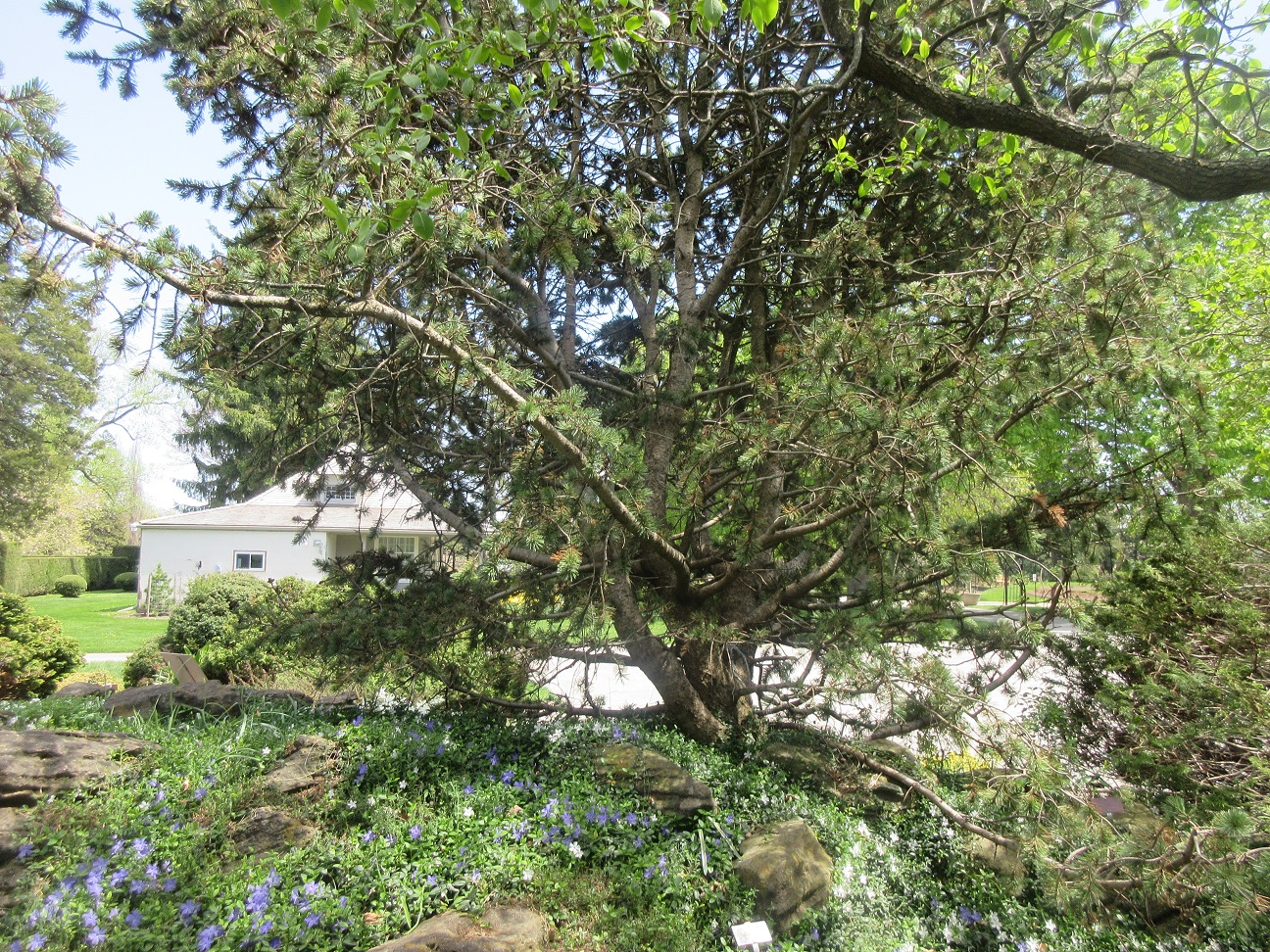
I wandered through part of the Gardens, enjoying some of the sights: a unique dwarf tree...,

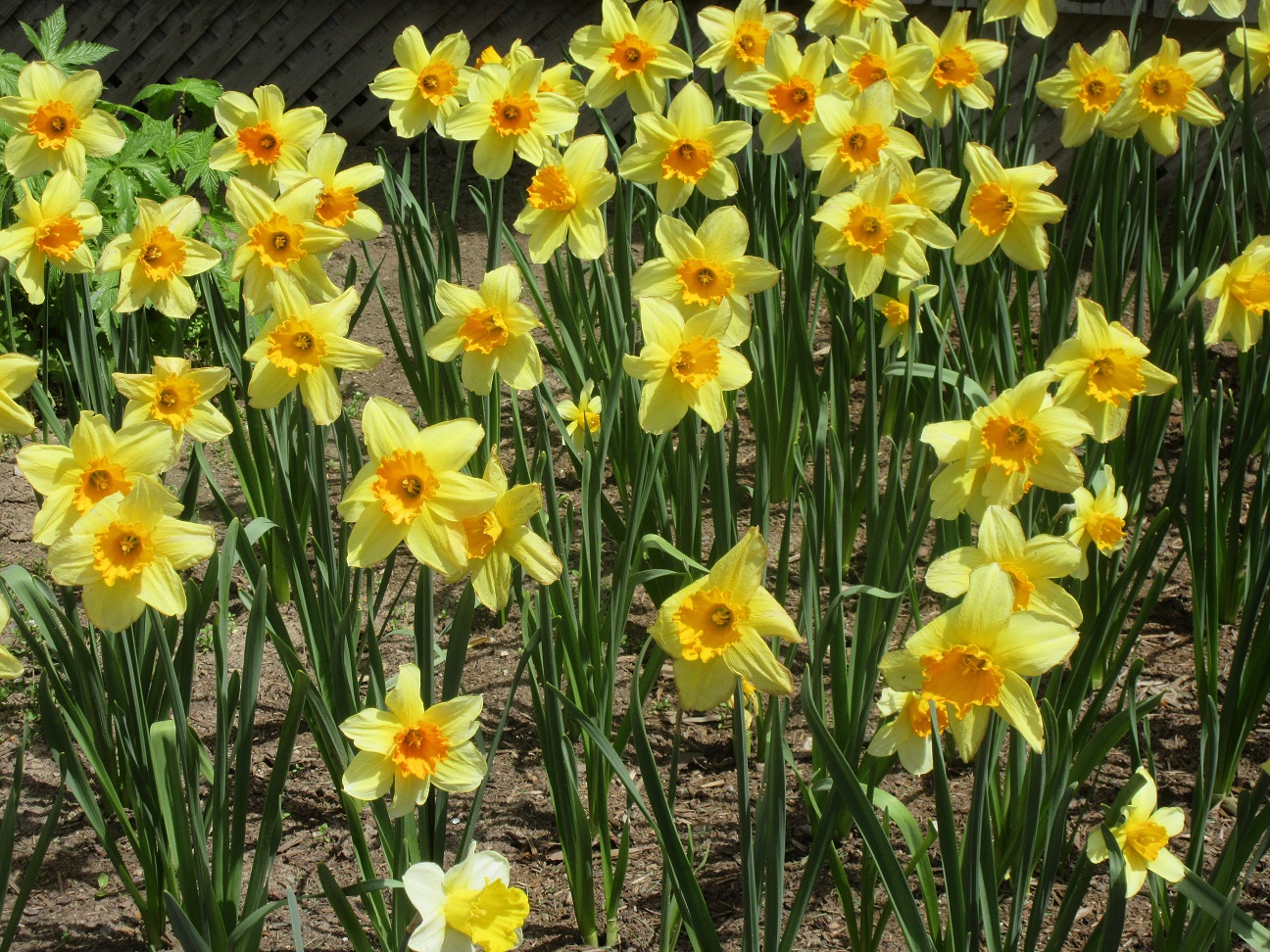
... a brilliant bed of flowers...,

...and a carefully twisted tree, which looked rather lonely, standing by itself.


It looked so lonely that I thought it needed some company.


The real delight for me was a bed in the rock garden of these attractive flowering plants.


The second picture captures more accurately the silvery-white tone of many of the leaves, no doubt the reason for the plant's distinctive name: "Snow-in-Summer."

The Botanical Garden is also the site of a really fascinating experience: the Butterfly Conservatory.   


The large glass roof houses a complete tropical jungle which is home to an ever-shifting array of multiple species of butterflies. The first stop on entering is a small theatre which shows a short but informative video about the operation of the Conservatory. From there, you enter the warm, humid tropical air of the greenhouse.

This display case holds hundreds of pupae (cocoons). The hanging trays have been loaded in from the workshop side of the building. When the pupae hatch out, this side will be opened to release the adult butterflies into the greenhouse.


There are butterflies everywhere. The trick is getting any of them to sit still long enough. And here I thought only human photo models were difficult that way! But I got a few lucky breaks.


The tricky lighting washed out the colour of the last one. It's actually a much deeper, richer, imperial blue than the photo suggests.

Barely a kilometre (if that) upstream from the Falls, a tilting section of the rock formation allowed some of the river's flow to drain over the south bank, forming a small collection of islands separated by multiple channels, all contained in a bay on the side of the river. This is the Dufferin Islands Natural Area, a park which has (in the past) been improved in accordance with then-current ideas of controlling nature, and is now being slowly restored back to a more natural condition.

Important: if you've been to Dufferin Islands before, note that the driveway around the bay is now one-way only, going counter-clockwise (it used to be clockwise some years back). All along that driveway, you can park anywhere along the outer edge -- being sure to pay one of the ticket machines, of course, or display your parking pass. Then you can walk peacefully in a quiet environment far removed from the crowds by the Falls or the relentless loudspeakers advertising haunted houses on Clifton Hill.

Sadly, human idiocy has had its way here too, and large numbers of Canada geese have made this park their permanent home. Goose poop abounds. I hope the foolish people who fed them so much have begun to realize that this was a mistake, but I doubt they would.


Backtracking from Dufferin Islands towards the falls, another often-overlooked attraction is the Floral Showhouse, located just southeast of the hydro plant.
 

There are two parking lots here, and several flowering trees were putting on a seasonal show in the east parking lot.
 
 
The outdoor part of the attraction is a cute little miniature village, laced with small gardens. 


The tall greenhouse holds the entrance, gift shop, and a small permanent display garden. Behind it is the Showhouse proper, divided into two halves. The central entrance hall welcomes you with a sculptural fountain.
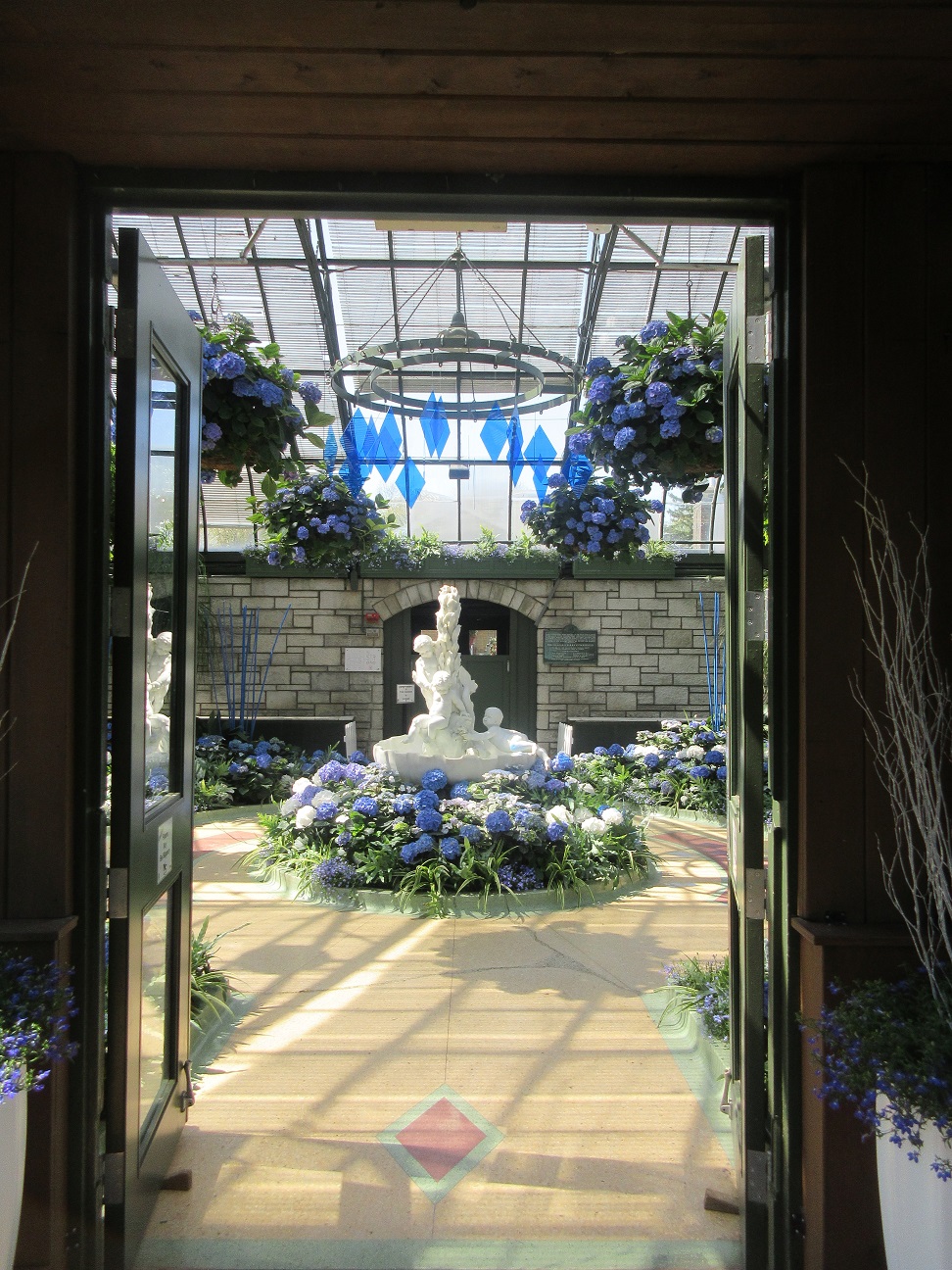
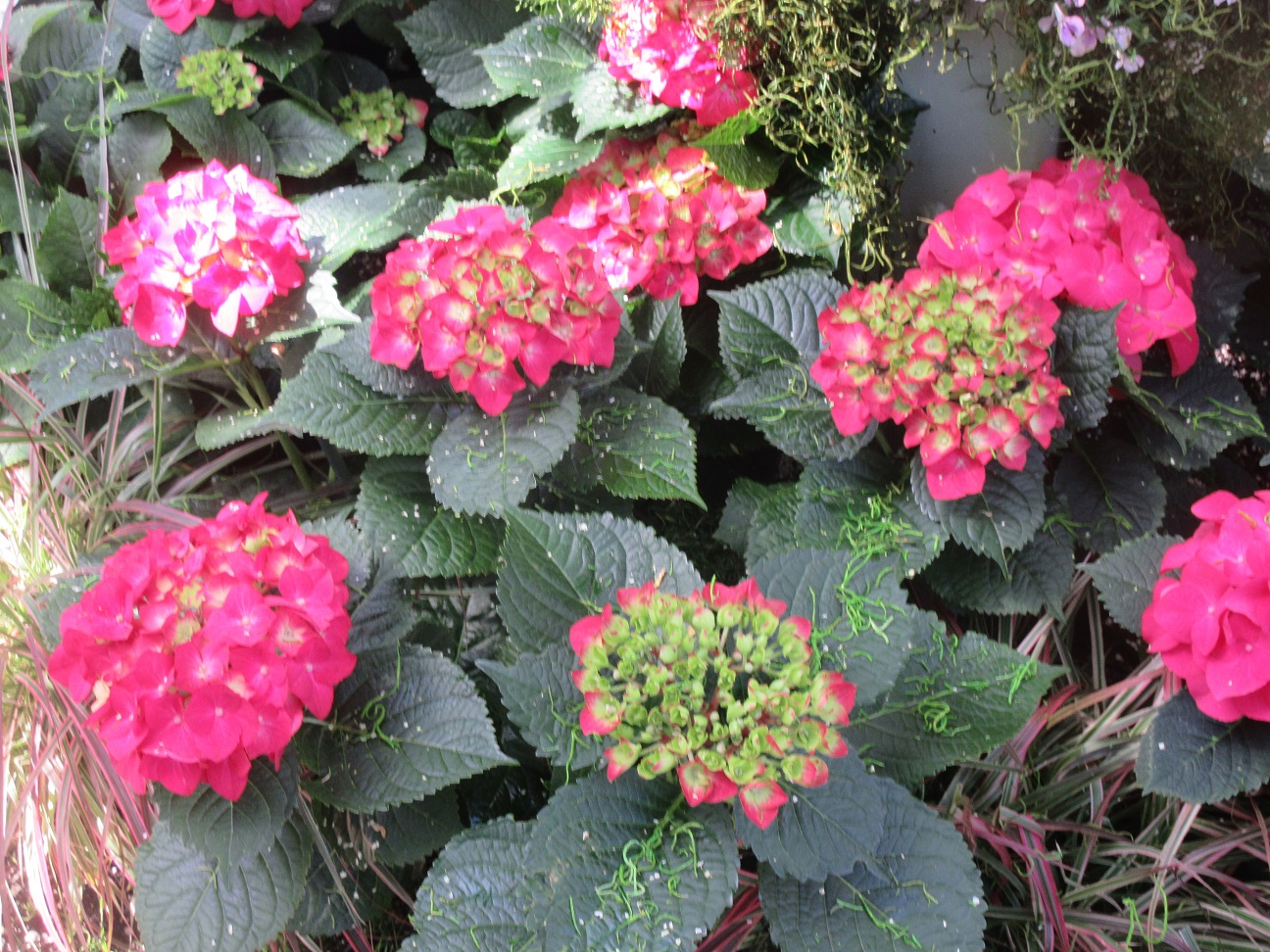
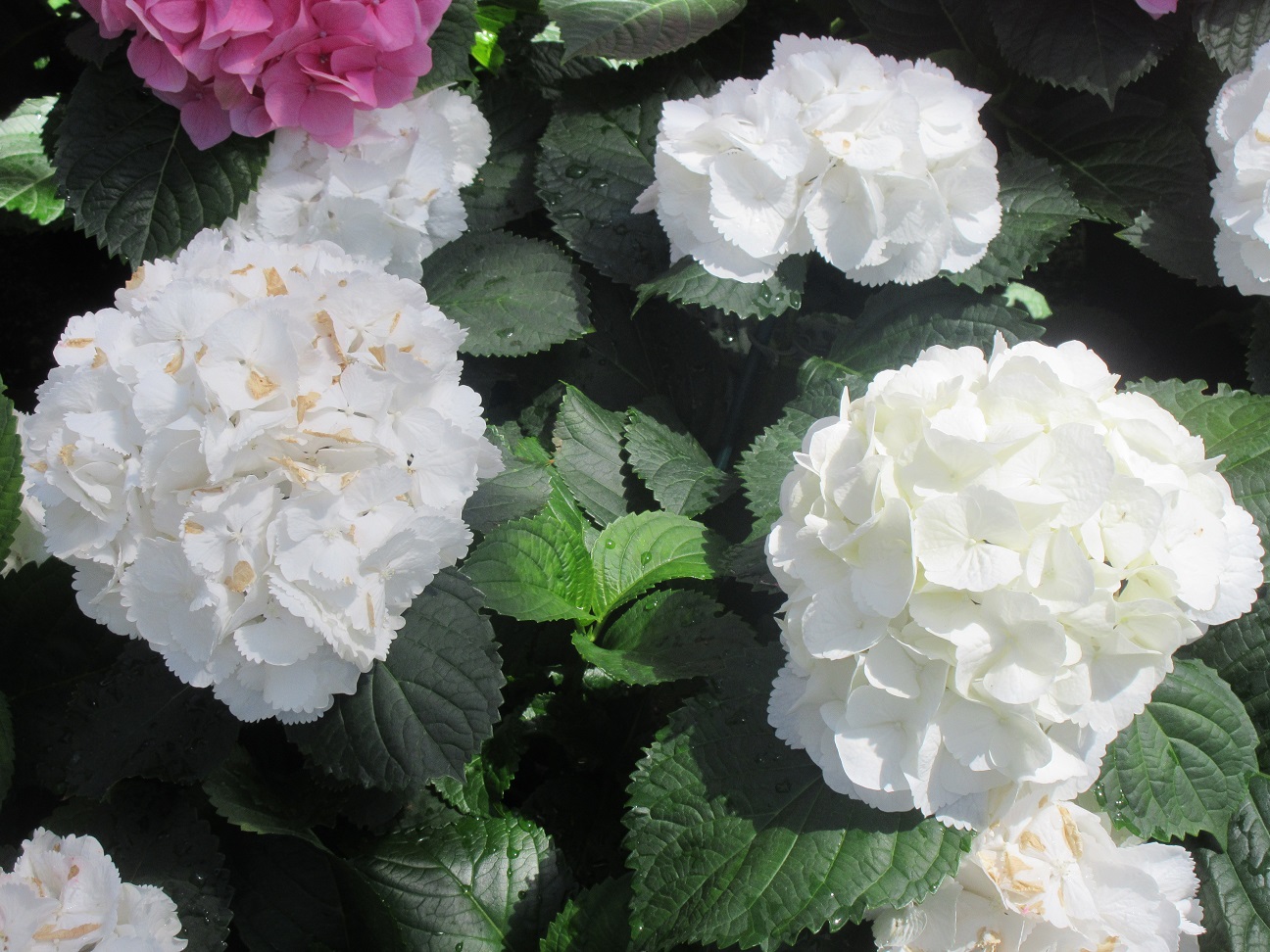
One half of the Showhouse contained a display of assorted cacti and other succulents. The other side was holding a true "Oh, wow!" show -- a seasonal display devoted to diverse varieties of hydrangeas. This show had just opened for its first day twenty minutes before I got there.


 In this picture, I've included my foot in its Size 11 shoe just to give an impression of the size of these rich blue flower clusters.


HELPFUL HINTS 

[1] Getting Around 

The first key choice is right here. Every parking lot along the Parkway charges a parking fee for the Parks Commission. The biggest lot, right by the Horseshoe Falls, is the most expensive ($30 flat rate during my visit). If you live close by (as I do -- 90 minutes away) and expect to come twice a year or more, you should order an all-year parking pass ($40) from the Niagara Parks website (the link follows at the end). Once you arrive, you should also make use of the WEGO bus system, which serves the many attractions along the Niagara Parkway from Queenston Heights to the Rapidsview parking area south of the Falls, and also runs two routes serving major tourist hotel areas up in the city.

If you're only coming in for the day, and you have the pass, you may just skip the buses (which also have a fee) and drive from point to point, as I did on this trip -- especially in the spring and fall seasons. In the summer, the much heavier traffic makes the WEGO system by far the more sensible choice.
 
During busy times, the parking lot by the Horseshoe Falls will fill completely, and the overflow parking at the Rapidsview lot, about 2 km farther south, comes into play.  When this lot is open, special free WEGO shuttles operate frequently to and from Table Rock visitor centre, which is the hub of the entire WEGO bus system.

Staying in a hotel? WEGO bus passes are often available right there, and in some of the more deluxe properties they may already be included in your compulsory amenity fee or room rate. In that case, leave the car right where it is and use the bus service (you're already paying for the hotel's parking and the bus pass, so why not?). The WEGO buses run past the big deluxe hotels in the Fallsview area and also travel west past all the budget motels along Lundy's Lane, all the way to the western outskirts of the city.

Update: July 2023:  On busy holiday weekends during the summer, the section of the Parkway from the Rainbow Bridge to the main parking lot by Table Rock is now entirely closed to vehicle traffic to make a safer experience for the throngs of pedestrians. Dates for road closures are posted in advance on the Niagara Parks Commission website (see link at the end). Visitors with cars will have to approach the Falls parking lots from the direction of Chippewa or park in one of the numerous commercial lots uphill in the Fallsview tourist district, and then use the WEGO bus system.

[2] Admission Fees 

The vast majority of attractions on the Niagara Parks Commission properties charge admission fees. To simplify matters, if you are a pre-planner, you can buy advance tickets for all of these attractions on the Parks Commission website. You will then receive, by email, a voucher with bar codes for all the tickets you have purchased. Show this on your phone or in hard copy at any Niagara Parks Welcome Centre and the agent at the desk will print out the actual tickets for you. For many attractions, you can reserve specific times for shows, tours, etc. Trust me, this one-stop advance shopping will save much time standing in lines during your visit.
 
There are several packages which group together multiple attractions for a single advantageous price. None of these packages includes absolutely everything -- and none of the three included the specific group of attractions I wished to visit. Sigh.

Note that some attractions may not open all days, or at the same times every day. All the information is on the website for you to check. The example in my case was the Floral Showhouse which opened its newest show on the last day of my visit.

[3] Off Season 

If you possibly can, you should arrange to visit in months like May or September/October. The weather will still be pleasant, most activities are still available, and the lineups will be far, far shorter. The case got summarily explained by a friend who went in the first week of July a few years back, and had to wait in line for half an hour to get a coffee and snack at Tim Hortons in the Table Rock Centre.

One thing you should certainly do, at least once, is to come in winter for the Festival of Lights. The trees and shrubs in Queen Victoria Park are decorated with thousands upon thousands of brilliantly coloured seasonal lights, from the Rainbow Bridge to the Falls and the Dufferin Islands, and other free-standing set pieces are placed throughout the parks as well. It's an eye-popping spectacle, to put it mildly.
 
[4] Table Rock Centre 
 
The central focal point, right by the brink of the Horseshoe Falls. Table Rock Centre contains the largest Welcome Centre -- ignore the signs saying that it's on the upper floor, it's on the ground level now. This is the location of the Journey Behind the Falls. Also here can be found a huge gift shop, a sit-down restaurant with a fantastic view of the Falls...,
 

..., several take-out food outlets, washrooms, the central terminal and ticket booth for the WEGO buses, and a footbridge across the Parkway to the main parking lot. At the far end of the footbridge is the Incline Railway up to the big hotels and casino in the Fallsview tourist district.

[5] Information Source 

You can find out all you need to know about the Canadian Niagara Parks Commission and all its many activities, attractions, shows, events, restaurants, golf courses, you name it, right at this link:


Saturday, April 9, 2022

Return to Aloha # 4: Helpful Hints for Hawai'i

It's been a remarkably low-key holiday, but I'm in no doubt that this is exactly what I needed. I've been off the property a couple of times, but have no more spectacular photos to share -- far too much pool and chill time this week! And the views....
 
 
What I can share is the following helpful hints, the product of five separate experiences with Hawai'i over a period of 25 years:
 
[1]  Bring lots of money (or credit limit on your cards). Hawai'i is out in the middle of the Pacific, and Honolulu is located farther away from the next nearest city of a million people than any other city of that size on the planet. This map gives you the overview.
 
 
Likely three-quarters of everything you will eat, the linens your hotel will provide, the furniture you will sit, eat, and sleep on, the gas in your car or tour bus, the vehicles themselves, all will have been shipped in from outside. It's easy to take for granted the bottle of Heinz ketchup on your table at breakfast time, but when you stop to think that the ketchup -- like you -- has travelled many thousands of kilometres from its place of origin and crossed up to six time zones to land on your table in time to go with your scrambled eggs, bacon, and potatoes... well, suffice it to say, prices in Hawai'i are high, and "expensive" is likely the most common criticism levelled against Hawai'i's restaurants, shops, and hotels.
 
[2] Be patient. Hawai'i may be an American state, and it may look American on the surface, but at heart, deep down inside, it is a tropical island culture. Take-it-easy is much more than just a cultural manifestation, it's a survival skill in the tropics, especially for those who work out of doors. The result is that much of what you will see and do in Hawai'i runs on "island time," and there's nothing to gain by expecting/demanding that service personnel keep up to your expected standards of mainland speed and punctuality. And anyway, aren't you here on holiday?
 
[3] Be realistic. You are not going to see everything Hawai'i has to offer on one trip, any more than for any other destination you might visit. My advice? Confine yourself to a maximum of two islands for your first time. Make O'ahu one of them, and pick any one of the other big three (Kaua'i, Maui, or the Big Island) to go along with it.
 
[4] Enjoy the gifts of the islands. These include the fresh fish and shellfish, the tropical fruits and vegetables, and the coffee. Oh, that Hawaiian coffee. Not many people who've never been here have any idea that Hawai'i grows some absolutely incredible coffee beans, and right here is the place to enjoy the results. I've been in heaven for over a week, brewing up a fresh cup of mouth-watering Hawaiian coffee in my room every morning, and then enjoying even more of it with my breakfast. You can imagine how I pity the people who think they're better off walking to the nearest Starbucks for their morning java. Perfume? Clothes? Liquor? Nope -- my shopping is for a stash of Hawaiian coffee to bring home with me!
 
[5] Speaking of shopping, as an American state, you can find all sorts of familiar American brand stores here, ranging from the Targets and Walmarts in the residential districts all the way up to the top-end luxury brands in the tourist areas. But why? It's actually easy to find shops and stalls selling the products of local makers and crafters, and those are the places to seek out.

[6] Lu'au. You probably want to do one, and so you should. Many hotels and resorts in the main tourist areas offer lu'aus. Many of them are good, but light years ahead of them all (for my money) is the one offered at the Polynesian Cultural Center in Laie, on O'ahu. I've been there twice and will certainly go again (just didn't make it on this trip). 
 
The ideal choice is to take one of the full-day tours which picks you up from your hotel in Waikiki, drives you to the center (about an hour away), gives you the day to visit the outdoor exhibits, shows, and demonstrations which sum up the cultures of all the main Polynesian island nations (not just Hawai'i), and then culminates with the lu'au dinner and the landmark evening show, staged in a large amphitheater with full theatrical lighting and sound effects. What makes this entire day event so special is that the participants are all residents of the various Polynesian cultures which they present to you. All have come to Hawai'i as students and faculty of Brigham Young University of the Pacific which is built entirely around the preservation and dissemination of these remarkable cultures of the islands. The PCC wrote the book on authenticity in Polynesian culture, arts, and food. If you can only do one thing on O'ahu, let this be it.

[7] Speaking of tours, Pearl Harbor is one place where a tour is advisable. The number of visitors to the USS Arizona memorial has to be limited each day, and by turning up on your own you might find you need to wait for a long time. On a busy day, especially on the weekend, you might not get in at all if you don't arrive early enough. Tours, of course, have space pre-booked and get in with no waiting. It matters because the memorial is reached by boat from the landside parking, museum, and exhibition.

[8] On being early. Hawai'i consists of tropical islands, and the temperatures ensure that clouds build up over the islands as the day goes on. Every day. Depending on location, if you are a chronic late riser, you might not see much sun at all. Trust me on this. In the tropics, you are far better off to cut your big nights short and get up each morning in a timely way. Case in point: the pool area was filled with gorgeous sunshine this morning; by 3:00 pm the sky was clouding over. Also, there's the rain. Little sprinkly showers can happen almost any time of any day, but are certainly more common, and sometimes more forceful, in the afternoon. Just as a by-the-way, I read years ago that islanders refer to these frequent little showers as "liquid sunshine."
 
[9] Rental cars, like everything else, are pricey. On O'ahu in particular, I recommend doing without your own wheels.  The traffic in and around Honolulu is heavy-duty, not surprising in a city with nearly a million people in the metropolitan area. Now, really, did you have to travel all this way just to sit in traffic jams? Especially this is so when the range of coach tours on offer is so enormous, and when the island's own transit bus service (laconically called "The Bus") runs on an unbelievably cheap fare of just $1.00 per ride.

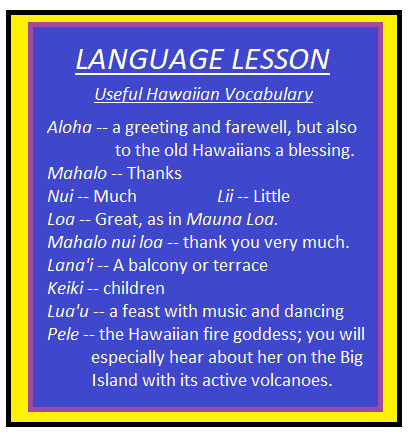
If you ever decide to go to Hawai'i, I hope these hints will help you. I can guarantee you that Hawai'i is not just "another resort" like Cancun or the Dominican Republic. To close this off, I'm going to wrap up with a collection of useful Hawaiian words that you should certainly know if you are going to come here. Some of them have already cropped up in earlier posts.
 
Well, that's a wrap. Hope I will see you in Hawai'i the next time I choose to go!

Saturday, April 2, 2022

Return to Aloha # 3: A Hike Around the Hawaiian Village

In my last post, I mentioned that some guests can probably spend a week at the Hilton Hawaiian Village and never go off the property (except, perhaps, onto the beach, which is of course a public beach and not private to the hotel). Some readers may think, "Isn't that kind of boring?" Well, it is and it isn't, and in this post I want to introduce you properly to this resort which is definitely like no other I've ever visited. For certain, I've never seen another resort hotel looking like this one!


To start yourself off right, you need a map. These maps appear on signboards in various places around the property, and always include a recommendation that you photograph it yourself to keep a copy. It's very good advice. (this map is a slightly outdated version, but close enough)
 

By the way, if you click on any photo in this blog, it will enlarge.

Calling this walking tour a "hike" is a slight exaggeration, but the distances involved are such that you can get in quite a bit of exercise just going from place to place on this property. As an example, just yesterday I went for a walk after breakfast from Tropics Restaurant at the base of the Ali'i Tower, along the beachfront, all around the Duke Kahanamoku Lagoon, back out to the beach and around to the side of the Rainbow Tower facing the Super Pool to go up to my room. Fifteen minutes.

Let's begin with that walk, which shows two of the three main private swimming venues in this resort village. The first is the Lagoon, which can be used for all kinds of watersports opportunities -- SUP boards, giant waterbikes, kayaks, and just plain swimming. This was an early morning walk; the lagoon will get much, much busier as the day goes on. Notice, too, that you are looking at one of the very few private beaches in Hawai'i. Because the lagoon and its beach are artificial, they don't fall under the state's jurisdiction.


Now, I ask you: is that a poetic view of the extinct volcano Diamond Head or what? And could there be a more lovely, evocative place to do morning yoga on a paddleboard?

On this walk, you also pass by the Paradise Pool which is fitted very creatively into the limited space between the Lagoon Tower and the edge of the property. It's actually a series of several pools of varying sizes, all edged with natural-looking volcanic rock formations, and with the upper and lower levels connected by a kid-sized waterslide. There are also two bigger waterslides which empty into the upper main pool, and are open at specified hours each day. The entire Paradise Pool is really a kid's paradise, and a must-visit for families with children.


Completing that walk around the lagoon, you come back to the beach front and pass by the Rainbow Tower to the Super Pool -- the heartpiece of the resort. It's actually two pools -- a huge main pool, and a smaller but still healthy-sized shallower pool for "keiki" -- children. This means, of course, that all of the kids are normally in the main pool. This is the pool that features in the view from my "lana'i" (balcony or terrace -- note that this is again a three-syllable word!).


It just looks like there are a lot of vacant lounge chairs. Vacant chairs are dark chocolate brown. The grey chairs have grey pool towels draped on them. Just like a cruise ship, the Hilton Hawaiian Village has an ongoing problem with greedy, selfish people who hog lounge chairs for hours on end without actually using them. The real problem, though, is that there just aren't anywhere near enough lounge chairs for the sheer size of the place.
 
Going around the far side of the Super Pool, you come to Tropics Restaurant, my personal favourite among the resort's food outlets. It has outdoor and indoor portions, both huge, and a regular army of servers who work very hard at seeing that their guests are happy at all mealtimes. The outdoor portion is draped with mesh nets to deter the many and aggressive pigeons and gulls which haunt the resort at all hours. Smaller birds have figured out how to get inside the nets and hop around after crumbs, but they do not harass diners as the pigeons and gulls would do if given half a chance.
 
The real delight of Tropics is that it has a number of tables-for-two arranged along the outer edge, with the best views of the beach, the beachfront walkway, and the endless array of people going by. 


 Turning inland at this point, you walk past the Ali'i Tower, the resort's most deluxe section. "Ali'i" is a word designating the traditional and hereditary nobility of the peoples of Hawai'i. The Ali'i Tower has its own concierge service, a private bar and food outlet, and a private pool.
 
You then walk into the Ali'i Plaza, between the Ali'i Tower and the Diamond Head Tower. This is the first of several collections of shops you'll encounter as you walk through the resort, although there are in fact shops in every tower of the complex. 
 

 The shops range from high-end clothing, perfume, and jewellery purveyors to ABC convenience stores, and all points in between. Passing through the Ali'i Plaza, bear to the left and you will come to the Village Green and the Akalā Chapel (formerly called the Ocean Crystal Chapel).


It's not hard to guess that this beautiful place is meant to host weddings. But, you may wonder, what about beach weddings? Remember, though, that here in Hawai'i every beach is public property. You can try to have a beach wedding, and the resort will help you to arrange it if you wish -- but there is no legal way to prevent the immediate world from dropping in and watching.
 
From the chapel, you pass by the Tapa Tower (tallest in the resort), cross the driveway, and enter the Rainbow Bazaar. You'll find a great deal crammed into a small space here, from architecture inspired by the traditions of Japan, China, and colonial America to shops and restaurants of all kinds. At one time, the Hawaiian Village was proposing to tear down the Bazaar and replace it with yet another high-rise tower. I hope they've abandoned that plan permanently, as the Rainbow Bazaar is truly one of the most unique features of the property.


Here in the Bazaar is where you will find many of the independent food outlets, including a pizza place, a deli, a seafood restaurant, an Italian restaurant, and more. When you've walked through the entire Bazaar, you come out onto the driveway and find yourself again facing the long, low building which houses the front desk, concierge, tour desk, and other such services. It's really a building in name only, for the most part, as so much of it is a roof covering an open-air space.

Turn right, away from the front desk building, pass the Rainbow Tower, and you come to the Great Lawn. In the past, this has been used for receptions and events of one sort or another. Now, it is the venue for the resort's "lu'au" -- a Hawaiian feast with singing and dancing, which is one of the better-known cultural features of Hawai'i. The name specifically refers to the hole in the ground, lined with lava rocks, which is first preheated with fire, then filled with food to be baked, and then covered over with palm leaves, rocks, and sand to trap all the heat and steam/smoke the food. 
 
In the Hawaiian Village's version, there is no lu'au oven -- but there is an excellent mixture of traditional and modern dishes, an ample supply of mai tais, wine, and other refreshments, and a spectacular post-dinner show. I did my best to get some pictures, but without a flash it was tough -- even though I paid a premium price to be seated in the front section.


The second picture shows the dancers wearing a traditional skirt made out of ti leaves. I particularly like the last picture because it captures something of the grace and beauty of the classic Hawaiian dance, the sacred hula -- a poem in music, movement, and gesture.