Wednesday, February 28, 2018

California Dreamin' # 2: Where in the World is Ken in San Diego?

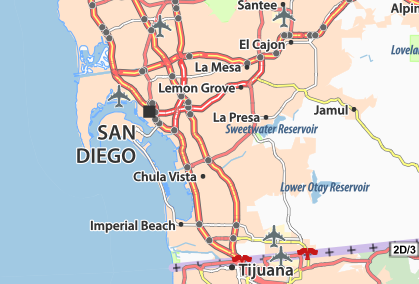
California's third major metropolitan area after Greater Los Angeles and the San Francisco Bay area, San Diego is located around a uniquely-shaped harbour on the Pacific coastline, and its southern suburbs push right smack-dab up against the Mexican border city of Tijuana.

It's the huge natural harbour that was the making of San Diego, providing a sheltered anchorage for the earliest European ships to sail this coast (Spanish) and later for a major naval base and naval air station.  This map illustrates the peculiar, almost paperclip shape of San Diego Bay, and shows the locations of a number of smaller airports around the metropolitan area.  The main San Diego International Airport is the one closest to downtown, just a couple of miles northwest of the city centre.  When I was flying in late at night last week, the office towers of downtown were brilliantly lit up, apparently just beyond our port wingtip, and their top floors were farther above the ground than our plane was.  Now, that's close!

Coronado Island, in the bay, is linked to the city by a high bridge and physically connected to the mainland by the long coastal sandbar stretching all the way south to Imperial Beach.  Half of Coronado Island is occupied by the Naval Air Station.  The other half is home to a residential area and the famed Hotel del Coronado, an iconic old wooden resort hotel which has featured in many TV shows and movies.  I didn't actually get to Coronado on this trip, but here's a picture of the hotel I took back in 2005.


If you're thinking you'd like to stay here, I can't blame you -- but like most iconic and world-famous old resort hotels, it costs a sizable fortune each night.  Better win the lottery first.

The big # 1 tourist attraction of San Diego is the Sea World theme park, just north of the airport.  I went there once, back in the 1980s, and have not been back since.  Theme parks just aren't my thing any more -- not that they ever really were.  So where did I go during my visit to this fascinating city?

I'm always attracted to places that are pleasant to walk in, so my first stop was up in Balboa Park, on a rise of land just north of downtown.  A broad boulevard in the centre of the Park, El Prado, and its surrounding showplace buildings, were constructed in two phases: in 1915 for the Panama-California Exposition, and in 1935 for the California Pacific International Exposition.  They've been listed on the National Register of Historic Places since 1977.

Actually, not much remains of the originals.  They were constructed out of temporary materials, never meant for long-term use.  By now, some of the old buildings have been replaced with more modern structures, while others have been re-built as permanent duplicates on the same site.

Most of the El Prado promenade is now pedestrian-only, and the buildings house many of San Diego's leading museums.  Here are a few samples:


These structures, with their fantasy-wedding-cake--Spanish decoration, set a style trend for public architecture whose influence can easily be seen in other fair and exposition grounds, such as Exhibition Place in Toronto.

Adjacent to the Prado is the Japanese Friendship Garden, a multi-year project which has now spread to a sizable garden on the plateau, and an even larger and more extensive garden in one of the valleys which carve through the Park.  Even in winter, with not many plants bedded out, it's a serene and lovely place to walk.


Balboa Park is also home to the San Diego Zoo, and the whole park is a popular place with San Diegans and tourists alike.  Even on a weekday, the parking lots are pretty much filled up before noon, so this is one place where it pays to be early!

By the way, the Park is just north of the inbound flight path to the airport.  Try not to be disturbed by the airliners looking like they are going to practise their roof landings.


La Jolla is another place for morning visiting.  This coastal town, carved out of a steep hillside above the water, is another popular walking/shopping destination in San Diego, and another place where the early bird gets the good parking spots.

La Jolla (pronounced "La Hoya", for those not up in their Spanish) is famous for its rugged cliffs, caves, and tide pools.  This makes for an unusually scenic waterfront promenade.


If you're wondering why there's so much litter on such a sheltered beach, look a little closer.


La Jolla has a sizable permanent population of seals and sea lions.  The ones on the beach are mostly resting quietly.  This lot, frolicking in the water and on the rocks, were much more active -- and a whole lot more vocal.


With its beautiful waterfront park and such spectacular views, you'd expect La Jolla to have a good collection of waterfront restaurants.  But no.  Just homes and condos.  You have to start up the hill towards the main shopping street before you find any eateries.  This was the view from outside the first café up that hill.


The third key place I went was the Cabrillo National Monument, at the southern tip of Point Loma.  This park is actually located inside the Point Loma Naval Base, so you have to pass through or by the military presence and the Fort Rosecrans military cemetery as you visit.  But it's worth it.  The Monument is named after the first European navigator to land on the Pacific Coast in 1542.  Here's the actual memorial to Cabrillo, with a live tourist and his silly grin taking up part of the foreground.


From the hilltop memorial, on a clear day, you can easily see southeastwards towards Tijuana and the mountains beyond -- Mexico.


A zoom lens brings the Hotel del Coronado and the city beyond it much closer.


The opposite Pacific Ocean shore of Point Loma has some spectacular rock formations and tidepools.


Not surprising for a military base, the Pelican Air Force can frequently be seen practising their formation flying.


Of course, there's far more to San Diego than just these highlights.  Two major attractions which I missed on this trip are places which I have previously visited and enjoyed.  First is the Old Town historic preservation district, just north of the current downtown area and airport.  Here are some pictures of Old Town (the original centre of San Diego) from my trip in 2009.


Another major attraction is the Maritime Museum on the downtown waterfront, with its extraordinary collection of historic civilian and war ships.  Here are a few samples from my 2005 visit.


As you can see, there's plenty to do in this city, with something for every interest from history to nature to simply lazing on the beach.

Saturday, February 24, 2018

California Dreamin' # 1: Laid Back in Carlsbad

If there's one thing my current trip proves, it's the importance of keeping an eye on air fares, especially on air fares to, from, and within the USA.  I'd been thinking for some time of a holiday in California, and had been scoping out air fares just to get a feel for the range of costs.  The return fares from Toronto to San Diego were ranging from $700 to $1000 or more depending on dates of travel.

Then, just a couple of weeks ago, I ran a search on Air Canada's website and spotted a flight down on Feb. 21 and back on Feb. 27 for $360, including all taxes and fees.  Okay, I'm booking that one fast before it changes its mind!  Air fares have a way of bouncing up and down like a yo-yo where travel in the USA is concerned.  

The cheap flight meant I had to connect through San Francisco both ways, but the connecting times were good -- well over an hour each way.  Good thing too, because the flight down from Toronto was delayed leaving while bags for a couple of no-show passengers were found and off-loaded.

And here I am -- relaxing in sunny, but cool, Carlsbad, California.


Carlsbad is a quiet, laid-back city of about 100,000 people, sitting on the Pacific coast about 50 minutes drive north of San Diego.  It's main claim to fame is the presence of the Legoland USA theme park.  The last time I came here, you could fly into Carlsbad-Palomar airport on a small commuter aircraft, but that's no longer possible as the major airlines have been ditching those little prop-job routes at top speed.  Pity.  So now you fly into San Diego and rent a car.

I like Carlsbad because it is much more relaxing than the major cities of the state.  The centre of town is actually called the "Carlsbad Village."  Here you find an assortment of older buildings, and a fantastic collection of diverse restaurants that would do credit to many much larger cities I know.


The main intersection of the Village is flanked by a couple of historic hotels, and is busy enough to have a four-way crosswalk setting on the traffic signal. One of the old hotels now houses a restaurant, a café, and a couple of shops.


The back of this historic building is attached to the modern Village Faire shopping centre.


Best of all, the Village district has a half dozen free parking lots of various sizes.  All you have to do is get there early enough in the day, say, by 11:00am on weekends, and then you can park for as long as you want.  It's great because, like many smaller cities, Carlsbad is very pedestrian-friendly.

I like this singular mosaic pattern in the corner sidewalk at the main intersection.


From that main corner, walk downhill one block to the ocean.  Carlsbad has a lengthy ocean-front promenade along the top of the bluffs overlooking the beach, and another promenade at the foot of the bluffs.  The view is spectacular from the upper walkway in clear weather.


This is also a great place to watch the pelican air force on manoeuvres.


When Saturday morning rolled around, traditional weekend activities were underway on and off the beach, despite the cool temperatures and stiff breezes which deterred most sunbathers.


There are a number of hotels in and around Carlsbad.  Beachfront resorts near downtown are among the most expensive.  A few budget hotels stand alongside Interstate 5, a dozen blocks from the ocean.  The mid-range chain hotels are grouped out along the airport road, and farther south along the Interstate.

The best thing about Carlsbad?  It's a holiday destination where you don't have to do incessantly, you just have to be.  That works for me.

And if you need things to do, the manifold attractions of San Diego are less than an hour away.  I'll be looking at a few of those in the next post.

Tuesday, January 16, 2018

The Sunny South # 9: Winter in Gulf Coast Florida, Helpful Hints

I've been to the western or Gulf Coast of Florida enough times in the winter to be able to offer some advice and hints if you are thinking of heading that way.  Here are my thoughts, in no particular order except for the Big Number One.

[1]  Weather.  It's rarely hot.  Pleasantly warm is about as high as the temperatures in Florida go during December-February.  Think of a late spring day in Ontario, with temperatures in the high teens to low twenties Celsius, and you'll be about right.  Sometimes (as this month) it can get downright chilly.  In fact, most of my winter trips to Florida have included a day or two where the temperatures went near freezing overnight and barely rose to 10C in the daytime.  Rainy days are also not uncommon.  Bring layers and be prepared to roll with it.  If you require "hot," then you'll have to get much farther south, down into the Caribbean islands.  (I don't do "hot" very well, so Florida suits me right down to the ground.)

[2]  Sun or Clouds.  Bad news for sleep-in specialists.  In common with tropical areas the world over, Florida almost always gets at least a bit cloudy as the day goes on -- sometimes more than a bit.  It's the combination of daytime heating with moisture from the oceans.  The clouds are very likely to appear right above -- you guessed it -- the beaches.  In my experience, there's usually good sunshine until about 2:00pm.  After that, some days are luckier than others.

[3]  South is warmer.  You can usually find temperatures several degrees warmer by heading right down to Fort Myers/Naples on the west coast or Miami/Fort Lauderdale on the east coast.  I still haven't been all the way down to the Florida Keys -- that's for another trip.

[4]  "Beach front" versus everything else.  The prime hotels, motels, condos, etc., are almost always the ones which stand right on the edge of the beaches.  These are "Beach Front" locations.  All the others, though, are very good at marketing themselves to make it sound like they are on the beach front.  Sure, they're "On the beach" (the whole island is called "What's-its-name Beach"), and enticing words like "Sands", "Ocean", "Beach", "Sea", etc., recur in property names with great frequency.  "Steps to the beach" is another good marketing dodge.  Do your homework and verify the location online or with GPS if you absolutely need a room or apartment facing the beach.

[5]  Wheels.  You must bring a car, or get a car in Florida.  Urban and suburban sprawl is the name of the game here.  That nice little map on the website of that great restaurant makes it look like the place is right over there, and then it turns out to be a 30-minute drive or more.  Beach parking in many areas is very limited; you must arrive early in the day to get a space, especially on weekends.  Also note that gas is usually cheaper off the beach islands, and in any case there are only a tiny handful of gas stations on the beach islands.

[6]  Shopping.  It's not true that everything is cheaper in Florida.  If you want to shop for bargains, you need to do price homework ahead of time and learn to calculate the exchange rates quickly in your head!  And no matter what some people think, the word "Outlet" does not magically guarantee the lowest prices.  There are many small shopping plazas and individual stores scattered up and down the beach islands, but the major shopping malls and outlet malls are all inland, sometimes a very long way inland.  Plan plenty of driving time if you are on the beach but heading for the malls.  The good news?  There's always a chain drugstore nearby (Walgreen's or CVS).  They're much like a Shoppers Drug Mart in offering a little of just about everything, including some grocery items.

[7]  Happy Hour.  It's not always loudly advertised, but many restaurants offer Happy Hour drink specials.  There may be Happy Hour food specials too -- a limited number of menu items, at lower prices, available before 5:00pm or 5:30pm or 6:00 pm.  Be sure to ask.  Several places I know offer well drinks, house wines, and basic draft beers at 2-4-1 on their already low prices from opening at 11:00am until 7:00pm, and one of them has a similar Happy Hour promotion going on at all times they are open!  Over on the east coast, some places offer half-price on all their bottles of wine on the slack days like Monday and Tuesday.

[8]  Chain Restaurants.  These are nearly non-existent on beach islands.  There are all kinds of terrific restaurants, at all price points, all up and down the beach islands but rarely a Mickey Dee's or KFC.  If you absolutely must eat chain "food," I feel sorry for you -- in more ways than one -- but you usually have to find it by driving off the islands and heading inland.

[9]  Chain Hotels.  Mostly located around the same areas as the chain restaurants.  There are only a few chain hotels on the Gulf Coast beach islands.  You notice them right away because they are such rare birds (except at Clearwater Beach, where there are a half dozen or more of them).  

[10]  Beaches.  There are lots of beaches, but the Gulf of Mexico is really too cold for swimming in winter unless you have a wetsuit.  I haven't seen anyone get right into the water without one.  The water is a bit warmer on the Atlantic side, thanks to the warm current of the Gulf Stream.  All beaches and beach parking lots get a lot more crowded on weekends -- Floridians love their beaches, too.  Pick your beach with care.  They're all different.  Here's my take on some of the west coast ones which I haven't already written about this year:

     [a]  Clearwater Beach.  Heavily marketed, Clearwater is the beach for those who want to escape from high-rises, crowds, and heavy traffic by coming to more high-rises, crowds, and heavy traffic.  The traffic has gotten notably worse the last few years with a new crop of giant high-rise hotels and condo towers crowding the south end of the beach front.  Giant and expensive. 

     [b]  Sand Key, Longboat Key.  These two, one south of Clearwater, the other west of Sarasota, are the beach resorts with cachet, suitable for CEOs and lottery winners.  Properties here, especially on Longboat Key, have the rarest of all Florida beach luxuries -- space and privacy.  If you have to ask the prices, you can't afford Sand Key or Longboat.  Nuff said.

     [c]  Fort Myers Beach.  Popular and crowded.  Lots of island character and plenty of traffic congestion, mostly around the terribly-planned intersection just at the entrance to the island from Fort Myers.  

     [d]  Fort de Soto county park.  South of the city of St. Petersburg, a beautiful undeveloped beach with acres and acres of sand, and plenty of parking.

     [e]  Pass a Grille beach.  The far south end of St. Pete Beach.  A fine beach, backed by a village which preserves a bit of quaint old Florida character.  Great spot for walking around, and plenty of top-notch eateries and drinkeries as well.

     [f]  Bradenton Beach.  Unusual, a sizable beach park lined with trees instead of condos.  Nice rural feeling, gets crowded on weekends.  Actually, all the beaches do.

     [g]  Sanibel Island.  Beaches everywhere are littered with shell fragments.  Sanibel's beaches are shells and shell fragments.  Sanibel was famous among shell collectors long before the high-rise world discovered Florida.  It's the easiest place in the world to get bitten by the shell-collecting bug!

Monday, January 15, 2018

The Sunny South # 8: Life's a Boat in Fort Lauderdale

Fort Lauderdale is an urban resort.  That means that any stay here comes with all the conveniences and inconveniences of modern urban life -- and "traffic" ranks pretty high on the latter list.  Not least of the reasons for the traffic problem is all the water around here.

But thanks to an enterprising business, the water has been put to good use.  One of the best tourist services in Fort Lauderdale is the Water Taxi -- which is a bit of a misnomer.  It's really a water-borne version of the "Hop-on-hop-off" tour buses found in so many cities today.  Like those buses, it operates over a designated route with designated stops, through a particular time period (10:00am to 10:00pm daily, approximately every half hour).  Also like the bus tours, this one offers a running commentary on the major homes and other sights being passed.

It works because Fort Lauderdale's nickname, "The Venice of America," isn't just a name.  Like its Italian precursor, this is a city built on land reclaimed from the water.  And like the original Venice, Fort Lauderdale is seamed with miles of canals.  In this town, life isn't complete if your waterfront home hasn't got a giant yacht moored outside, and there are dozens of marinas like this one for those who don't live right on the water.


The map shows the approximate routes used by the Water Taxi tour service, with the leg on the west side going up the New River into the heart of downtown, and the orange line to the south representing a separate shuttle boat that runs down to Hollywood Beach.


Since my ideal of "relaxation" rarely involves sitting still for long, and since yesterday was chilly and windy by beach or pool standards, a day of bopping around from place to place on the Water Taxi was a natural thing for me to do.

More than any other American city I have seen, Fort Lauderdale is a monument to glitzy, garish consumerism.  The houses generally combine the worst aspects of unlimited wealth allied to non-existent good taste.  The gigantic private yachts only make it seem worse.  The commentary on the Water Taxi boats points out certain homes for their astronomical price tags or their unique features, and also singles out one particular yacht.  Here we go.


The commentator jokingly described this house under construction as "the new Terminal 5 at Fort Lauderdale International Airport."


The main channels and canals are lined with hundreds of similar monster homes.

The owner of this massive mega-yacht, the biggest one in town, is apparently dissatisfied with it because a friend has a bigger one, and he wants to get a bigger yacht still, to keep ahead. 


A baby like this goes for something in the range of $250-275 million dollars new, and you can expect to pay 10% of that amount every year for maintenance, upkeep, insurance, crewing, and docking costs -- even before you sail the damn thing one foot away from its dock.  We passed hundreds of similar vessels, just none quite as big as this.  Oh, yes -- the owner?  Steven Spielberg.

No surprise, then, that "detailing" here doesn't mean your car -- it's for your boat.


Once you sail west on the New River into downtown, the picture changes dramatically.  Instead of the waterfront being used to parade plutocratic wealth, it becomes a people place to be shared by everyone -- the Fort Lauderdale Riverwalk.  The main Water Taxi route ends at the beginning of the Riverwalk.  The bright-yellow boat in the first picture is one of the Water Taxi fleet.


Even the lift bridges across the river are artistically decorated, rather than just being painted in the sort of utilitarian shades usually seen on bridges.


These bridges are constantly opening and closing for the taller boats, and the traffic disruption on the downtown streets would be horrible if it weren't for U.S. Highway 1, which passes under the river in a short tunnel.

After a good walk, I stopped for lunch at Briny's on the Riverfront, a classic old indoor-outdoor Florida restaurant.  It's billed as an Irish pub, but the zany assemblage of overhead "décor" is pure Florida.  The fish sandwich here was both delicious and huge.


Walking farther west from Briny's, I crossed the railway tracks and found myself in Old Fort Lauderdale village, a small assemblage of historic houses and buildings grouped around the New River Inn, right at the spot where the town first grew up -- where the railway crossed the river.


Along this portion of the Riverwalk there's more room for trees, shrubs, and grassy patches -- and that means room for urban wildlife, from a cute little 3-cm lizard posing on the corner of a concrete sidewalk slab...


...to two male Colombian iguanas, having a loud and ferocious shoving battle -- no doubt, over territorial rights.  It doesn't look like any biting took place, but their deep-throated growls sounded like they emanated from much larger beasts.


Heading back, I rode part of the way on the Water Taxi's Riverfront shuttle which works back and forth just through the downtown area.  I then walked some more, up onto Las Olas Boulevard which is an upscale -- and very popular -- shopping and restaurant street.  A few years back, I had one of the most awesome pizzas of my entire life at Gran Forno Pronto on Las Olas.


On the return boat ride back to the beach area, the boat stops under the 17th Street bridge, and you get a grandstand view of the cruise ships just beyond the bridge in Port Everglades.  There were seven cruise ships docked yesterday; six of them appear in this picture.


Close by is the 15th Street Fisheries in the Lauderdale Marina.  This popular fish market and restaurant is another stop for the Water Taxi.


The upstairs restaurant is upscale fine dining, with a splendid view of all the boats coming and going out on the Intracoastal Waterway.  The downstairs is an indoor-outdoor casual café/bar environment, with live music Friday through Sunday, and fish swimming around right under your feet -- as you can see through the plexiglass windows in the floor.  They also provide fish food, so kids can amuse themselves by feeding the fish off the dock. 

I came back on the boat for dinner, ate upstairs, and had a spectacular meal of conch chowder (spicy), sea bass with a miso glaze served with mango fried rice and Thai stir-fried vegetables, and capped off with a heavily-loaded Irish coffee!  Either upstairs or downstairs, it's an awesome restaurant and my one true must-do every time I come to  Fort Lauderdale.  Just be sure to bring a jacket or hoodie -- the ride back in the Water Taxi gets a lot chillier after sundown at this time of year.