The main destinations on this cruise are two of the six Dutch Caribbean islands. Perhaps the most famous single sight in all of these islands is the Queen Emma pontoon bridge crossing over to the colourful row of Dutch-inspired buildings along the Handelskade in Willemstad, the capital of Curaçao.

Aruba and Curaçao each rank as Constituent Countries in the Kingdom of the Netherlands, alongside Sint Maarten and the Netherlands itself. The three less populous islands, Bonaire, Sint Eustatius, and Saba, have the status of Special Municipalities.
On a more casual level, the six islands have often and traditionally been referred to as the "ABC Islands" and the "SSS Islands." This map shows clearly why. The ABC Islands lie well to the south, just off the coast of Venezuela in South America in fact. The SSS Islands are much farther northeast, in a very crowded neighbourhood which includes islands formerly (or still) ruled by Britain, France, Denmark, and the United States as well as the Netherlands. Indeed, Sint Maarten is famous for amicably sharing its island home with the French overseas collectivity of St. Martin. The map doesn't show the two smallest islands, Sint Eustatius and Saba, but they lie more or less south of Sint Maarten, and west-northwest of the French island of Guadeloupe.

Base Map Attribution: https://freevectormaps.com/world-maps/caribbean/WRLD-CI-02-0001?ref=atr
To reach Curaçao and Aruba, our ship had to follow a slightly snaky course. It was inevitable that the large islands of Cuba and Hispaniola (Haiti/Dominican Republic) would get in the way.

Base Map Attribution: https://freevectormaps.com/world-maps/caribbean/WRLD-CI-02-0001?ref=atr
We've come directly down to Curaçao from Fort Lauderdale, a stretch which takes two full days at sea. Those multiple sea days are the special attraction of this cruise for many of those on board. As well, there is the two-day stop in Curaçao. This is a feature that is becoming more common on cruises in recent years, at locations where there are many attractions ashore which people might wish to explore. We are docked there from Monday at noon to Tuesday at 11:00 PM. We then spend a day in Aruba, before beginning the return voyage, with two days to the stop at Half Moon Cay, and one last overnight back to Florida.
Curaçao has one of the most diverse populations you will find anywhere on the planet, outside of the major international trading cities. There are over 100 nations represented in the population here, and over seventy separate and distinct religions. In such a society, it's scarcely surprising that the common local language is a polyglot mixture of indigenous Caribbean speech, several African languages, and Portuguese, all stirred together into a glorious melting pot of intersecting meanings called "Papiamentu."
As our guide explained to us, the school system teaches in addition two languages which every student can speak fluently at graduation: English and Dutch. Many also speak Spanish and/or French.
Curaçao and Aruba are both dry, semi-arid islands. Tropical in latitude, they feature the common two seasons of tropical climates all over the world: Wet and Dry. Even in the wet season, though, rain seldom happens except at night. In looking at this decidedly dry environment, bear in mind that my visit took place during the Wet season. The yellowish tone of many of these pictures comes from being taken through the window of a moving tour coach.

Curaçao's capital of Willemstad is distinctly a two-part city, as the photo at the head of the post shows. It is split down the middle by the narrow channel of Sint Annabaai, a natural waterway connecting the open ocean to the inner harbour, the Schottegat. This picture shows a small oil tanker entering Sint Annabaai, enroute to the oil refinery on the far shore of the Schottegat. Needless to say, since the ship was moving steadily into the channel, Queen Emma had already moved out of the way.

She's attached to the shore at one end, and pivots around that end like a hinge of a door. The photo at the heading of the post shows Queen Emma moments after she had closed again following the tanker's passage -- which explains the huge, dense mobs of pedestrians crossing the bridge in both directions. There are passenger ferries to maintain crossings of Sint Annabaai when the bridge is open, but I suspect most people find it easier to just stand and wait. Queen Emma's propensity for opening and shutting has led to her other, and much less official, name: "The Swinging Old Lady." In this shot, you see a nearby pub named after the bridge.

The bridge was originally installed in 1888 and rebuilt in 1939. It was named after the Queen Consort of the Netherlands in 1888, Queen Emma. It's now used solely by pedestrians. Here are some views of the two shores, taken from the middle of the bridge. On the east side are the colourful buildings of the Handelskade (Workers' Quay).

On the west side, you get the more open space of the Brionsplein (Brion Square).

In between them, crossing the inner end of Sint Annabaai, is the much newer Queen Juliana bridge, opened in 1974, which completed a four-lane road link around the Schottegat and permanently solved the traffic problems created by the Swinging Old Lady.

And here, on the Handelskade side, is the clever solution to the perennial problem of romantic people wanting to fasten lovelocks onto bridges. It's supposed to be a touching symbol of True Love Forever, but I have always looked on these things with an ironic eye after learning that people sometimes end up with three or four (or more) locks on the same bridge.

The Handelskade is the tourist highlight of the east side of town, the Punda ("the Point"). The other side is laconically called Otrabanda ("the Other Side," in case you hadn't guessed already). The cruise terminal is located in Otrabanda.
Here are a couple of pictures taken from, the high level road crossing, the Queen Juliana Bridge. The first shows the view of the oil refinery and the Schottegat.

The other direction shows the two-part layout of old Willemstad, the venerable Queen Emma bridge, and the cruise ship port with our ship.

Here's a map of the city to give you an impression of the whole layout.

Source map: Open Map Project
On the short walk from the cruise terminal to the centre of town, you pass a restaurant called 5 O'Clock Somewhere Curaçao, and this is a recurring theme in gift shops with tee shirts, postcards, wall signs, shot glasses, you name it. You also pass in front of the Renaissance Resort. What you don't see from the walkway, behind the building across the road, is the resort's enormous outdoor pool with artificial beach, sandy bottom, and infinity wall -- all located inside the wall of the Old Rif Fort (and seen here from the top deck of the ship).

The resort incorporates the Old Fort on the tip of the land beside the entrance to Sint Annabaai. It's not just the pool. The main courtyard of the fort has been converted into a shopping mall with multiple restaurants, plainly aimed at the tourist and cruise trade, and the walkway from the cruise terminal to the centre of town passes right through the fort. The corresponding fort in the Punda, across the channel, has also been incorporated into a hotel.

Our morning coach tour took us around some of the districts in the city before heading out to the countryside. As soon as you look at this waterway in the Punda, the Dutch influence is obvious.

The brilliant colours of the buildings are said to be the result of a decree by a long-ago Dutch governor that white and whitewashed buildings were forbidden, since the brilliant whites exacerbated his migraines. Years later, after he had passed away, it was found that he had been the owner of the biggest firm of paint merchants on the island. Whether that's all true or not, the colours are certainly lively, and the owners take good care of the brilliantly-painted limestone from which so many of the buildings are constructed.


Even these small cottages originally built for labourers share the colourful look.

Some are covered with attractive murals instead of plain vivid colours.

Once you leave the central area, the outlying districts around Willemstad incorporate much more modern and architecturally less interesting buildings. It's here that you find yourself in the commercial district, surrounded by groceries, hardware stores, and light industries, and full of chain restaurants such as McDonald's, KFC, Burger King, and Pizza Hut. I'm glad the tour bus didn't bother stopping!
Our tour had three main stops. The first was at the Landhuis Chobolobo, which now houses a distillery producing the "the original Curaçao liqueur."

Here, as the guide explained to us, the bottles which hold the world-famous spirit are dictated by law. They must be orange-shaped, as shown here, and the glass must be textured like the peel of an orange.

The liqueur has just four main basic ingredients: cardamom, cane sugar, dried peel from Valencia oranges, and cloves. In the photo above, the row of five bottles all hold variants of the standard and traditional orange flavour. The second row of four supplement the orange with other flavours including chocolate and tamarind. We were offered tastes of three: the chocolate, the tamarind, and the orange triple sec. It's funny how many of these cruise tours seem to involve day drinking, especially as in this case when it was still only 9:15 in the morning.
Sure enough, there's another sign to reinforce that recurring theme.

Our next stop was farther out in the rural countryside at a plantation growing aloe vera. I've never heard anyone say it like this before, but here in Curaçao it's pronounced "a-lo-ee vera." We were given a fascinating illustrated talk about the growing habits of the plants.
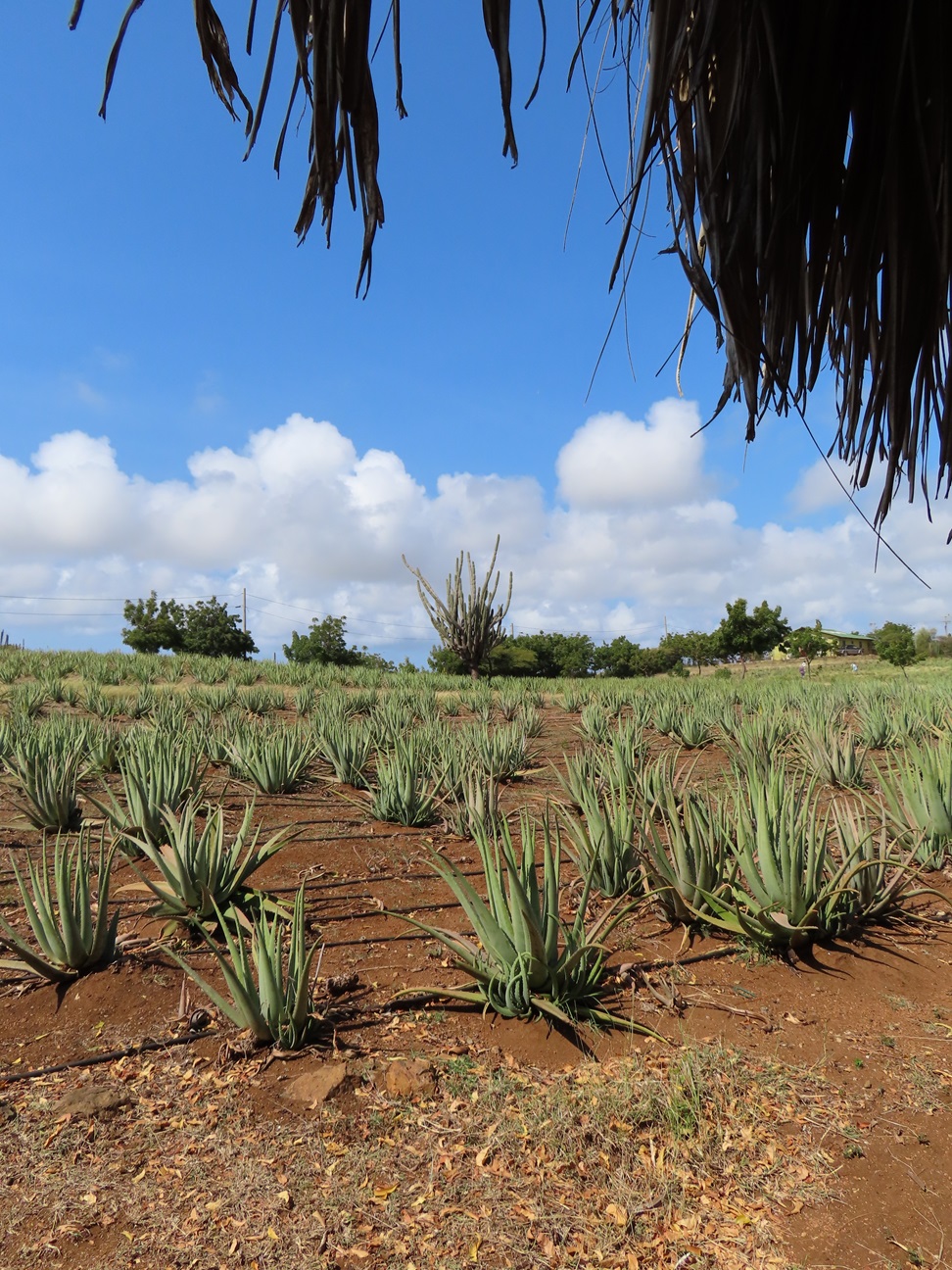

The talk also covered the goats grazing among the rows of aloe vera, shown here in a photo from the coach window as we arrived. Apparently their natural fertilizer is very agreeable to the aloe vera plants.

Our final stop was at Serena's Art Factory, a workshop for making traditional Chichi sculptures. We learned that "Chichi" was a title given to the oldest daughter in the family, and that younger siblings would not call their oldest sister by name but address her as "Chichi." A similar title of respect for the oldest son was "Bubu."
The sculptures are formed in a mold, and then brilliantly coloured with many patterns and designs, traditional or otherwise, according to the ideas of the various artists who paint them by hand. The facility also offers painting workshops to visitors. The small artist-painted pieces in the shop are sold under the trademarked name "The Real Chichi" as a guarantee of local and hand-made authenticity. The large-sized pieces on display in the gardens are nothing if not eye-catching.


Easy to overlook amid all these bright colours was this more subtly toned turtle, enjoying a mid-morning snack.

For a whole range of reasons, I could certainly consider returning to Curaçao as a vacation destination in its own right -- and I know there are many more aspects of the island which I haven't yet seen. But now: on to Aruba!